

The Pulse of Global Business: Year-End 2025 Review
As we close out December 2025, the global business landscape is defined by a paradox: remarkable technological acceleration set against a backdrop of fragile economic stability. While the “AI hype” of the previous years has matured into real-world operational impact, businesses are simultaneously navigating a world of trade barriers and shifting geopolitical alliances.
- The Economy: Resilience Amidst Headwinds
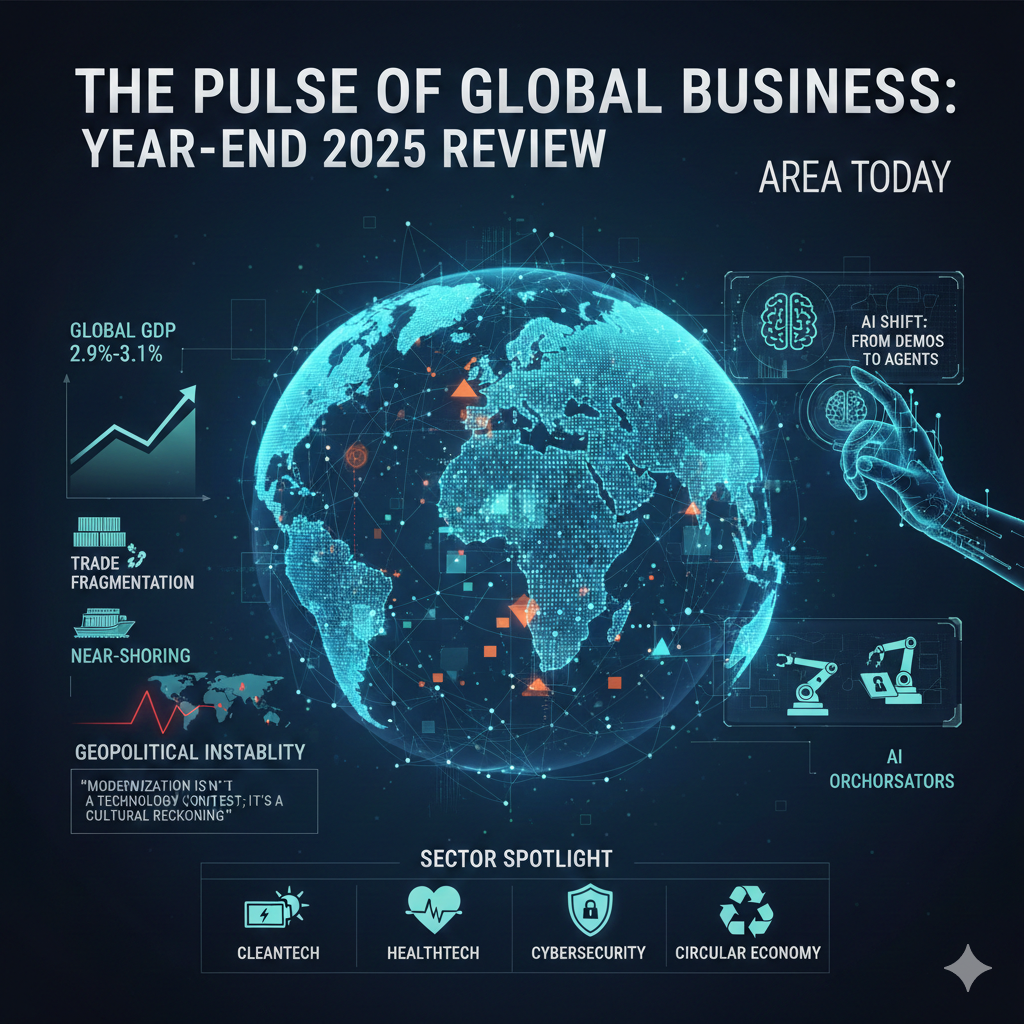
The global economy has proven surprisingly resilient this year, though growth remains modest. Forecasts for 2026 suggest a slight cooling, with global GDP expected to moderate to around 2.9% to 3.1%.
- Inflation & Interest Rates: Central banks have successfully lowered interest rates from their post-pandemic peaks, but the era of “near-zero” borrowing costs is officially over.
- Trade Fragmentation: Trade tensions, particularly between the US and China, have reshaped supply chains. “Friend-shoring” and “near-shoring” are no longer just buzzwords; they are the standard operating procedure for most Fortune 500 companies.
- The US Lead: The United States continues to lead the G7 in growth, driven largely by its early and aggressive adoption of automation technologies.
- The AI Shift: From “Demos” to “Agents”
2025 was the year the “show” ended and the work began. Businesses have moved past simple generative AI chatbots and into the era of Agentic AI—systems capable of independently completing complex workflows.
- Productivity Gains: A staggering 92% of businesses now report measurable results from AI integration, particularly in finance and logistics.
- The Labor Market Paradox: While AI has begun displacing entry-level roles (some firms have cut graduate hiring by up to 30%), it has simultaneously created a massive demand for “AI Orchestrators” and “Strategy Partners.”
- Strategic Partners: In the finance sector, 80% of CFOs now expect digital tools to dominate operations, allowing human staff to focus on high-level scenario planning rather than manual reporting.
- Sector Spotlight: Where the Growth Is
As we look toward 2026, several “Area Today” sectors are emerging as the new engines of wealth and innovation:
Sector Key Trend Why it Matters
CleanTech Energy Storage & Grid Software Governments are providing record subsidies for carbon-footprint consultancy and solar infrastructure.
HealthTech Preventive Digital Health Wearables and AI wellness assistants are moving healthcare from “reactive” to “proactive.”
Cybersecurity AI-Driven Defense As AI-powered phishing attacks rise, the global security market is projected to exceed $300B.
Circular Economy Product Life Cycle Management Consumers are increasingly choosing sustainability, forcing companies to rethink waste and recycling. The “Area Today” Challenge: Geopolitics
Perhaps the greatest threat to business today isn’t technology, but geopolitical instability. Over two-thirds of executives cite regional conflicts and social instability as the leading threats to their 2026 strategy. “Modernization isn’t a technology contest; it’s a cultural reckoning. Success today is measured by how quickly a company can pivot when global conditions change overnight.” — Summary of 2025 Industry SentimentSummary for Leaders
To thrive in 2026, businesses must balance their digital transformation with human-centric resilience. This means investing in upskilling workers to manage AI agents, securing supply chains against geopolitical shocks, and prioritizing transparent sustainability practices to meet rising consumer expectations.
Would you like me to focus on a specific region or provide a more detailed breakdown of one of the high-growth sectors mentioned?
