

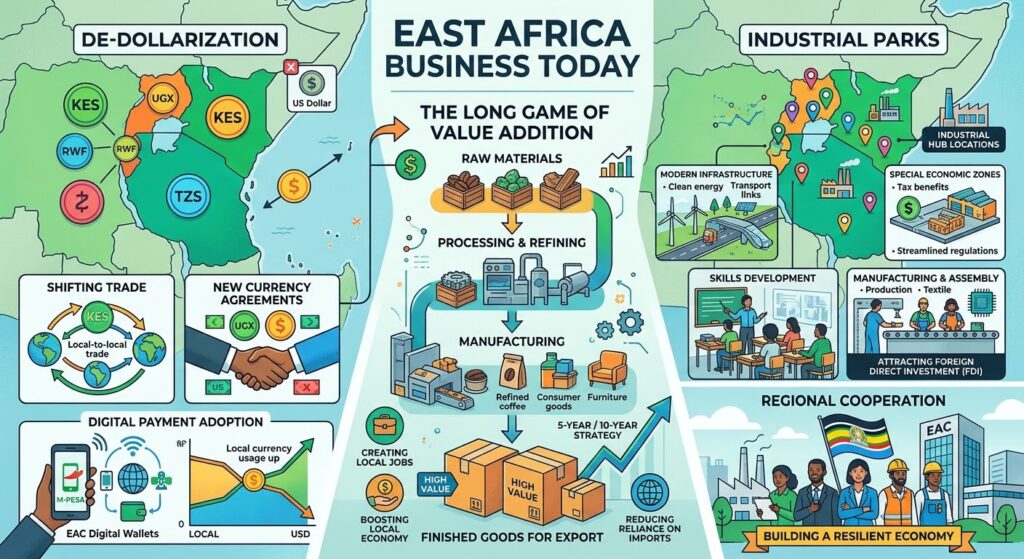
NAIROBI/KAMPALA — East Africa’s business agenda in early November 2026 is being shaped less by headline-grabbing announcements than by a series of quiet, structural decisions that will determine whether the region’s growth translates into durable prosperity. The East African Community is moving to reduce its reliance on the US dollar for cross-border trade. Kenya has signed a Sh90 billion deal to power its flagship industrial zone at Dongo Kundu. Tanzania has secured $60 million to expand agricultural lending and launched a five-year industrial partnership with UNIDO. And Uganda’s president has spent the week courting Italian investors with a simple message: stop buying our raw materials and start processing them here. Each initiative addresses a different bottleneck. Together, they represent a coherent, if incremental, bet that East Africa can move up the value chain and keep more of the wealth it generates.
The Slow Push Against the Dollar
The most consequential long-term reform is the EAC’s effort to dismantle the dollar’s grip on intra-regional trade. On November 3, Uganda’s First Deputy Prime Minister and Minister for EAC Affairs, Rebecca Kadaga, told Parliament that the bloc is developing an integrated payment and settlement system designed to allow individuals and businesses to transfer funds “securely, instantly and affordably” between member states using bank accounts, mobile money wallets, and other digital channels .
The existing East African Payment System already connects the real-time gross settlement systems of Uganda, Kenya, Tanzania, and Rwanda, enabling commercial banks to settle transactions in regional currencies. But Burundi, South Sudan, the Democratic Republic of Congo, and Somalia are not yet fully integrated, limiting the system’s coverage. The EAC’s Cross-Border Payment System Masterplan, adopted in 2025, provides for expanding the platform, harmonizing licensing and regulation of payment service providers, and increasing the use of partner states’ currencies in regional transactions .
The practical problem is liquidity, and it is one that traders feel every day. Uganda’s Shadow Minister for EAC Affairs, Hakim Kizza, welcomed the initiative but pointed out a stubborn reality: “Despite the rhetoric of local currency settlement, traders are still forced to convert to the US dollar for cross-border transactions due to liquidity shortages in regional currencies at commercial bank levels.” A Ugandan trader buying goods from Kenya must convert shillings to dollars, then dollars to Kenyan shillings—a double conversion that banks profit from and that raises the cost of doing business. Kizza called for a central bank-backed liquidity facility to ensure commercial banks have sufficient supplies of regional currencies . Whether the masterplan can overcome the liquidity constraints that have defeated previous attempts at de-dollarization is the test ahead.
Dongo Kundu: Powering the Industrial Bet
Kenya’s flagship industrial project took a significant step forward on November 6, when ARISE Integrated Industrial Platforms Kenya and AMACO Energy signed a memorandum of understanding to establish a Sh90 billion integrated power, cooling, and digital infrastructure project at the Dongo Kundu Special Economic Zone in Mombasa .
The HERCULES project is designed to provide reliable 24-hour power supply to heavy industries, port operations, and data centres without placing additional strain on the national electricity grid. It will initially have a net electricity generation capacity of 250 megawatts, with the potential to scale up to 1 gigawatt as industrial and digital demand grows. The system integrates liquefied natural gas-based power generation with cooling systems and specialised infrastructure to support AI and data centre operations .
The strategic logic is straightforward. Mombasa hosts seven submarine fibre-optic cables, and combining that connectivity with reliable power infrastructure is expected to strengthen Kenya’s ambition of becoming East Africa’s leading AI and data centre destination. The project is also expected to generate more than 1,500 construction jobs and create between 550 and 650 permanent direct and indirect employment opportunities .
ARISE IIP is developing the 500-acre Coast Integrated Industrial Park at Dongo Kundu, a priority project under the government of Kenya-Afreximbank Country Programme. Afreximbank is financing the development of the Dongo Kundu and Naivasha special economic zones through an investment of approximately Sh128.5 billion . The power deal is the kind of enabling infrastructure that determines whether an industrial park becomes a functioning manufacturing hub or a collection of empty warehouses. Whether the businesses arrive to fill it is the next question.
Tanzania: Agricultural Finance and Industrial Policy
Tanzania secured two complementary wins this week. The African Development Bank approved a $60 million loan to strengthen the capital base of the Tanzania Agricultural Development Bank, part of a $120 million initiative with a matching contribution from the Tanzanian government . Agriculture employs about 65 percent of Tanzania’s active population and generates nearly a quarter of its economic output, yet it receives only about 12 percent of private sector credit. The annual financing gap is estimated at $1.5 billion, with women and young people particularly affected .
The new capital will allow TADB to lend at larger scales and longer tenors, both directly and through wholesale lending and co-financing with partner financial institutions. At least 30 percent of supported jobs are expected to benefit women and another 30 percent young people. By 2030, TADB aims to raise financing for women-owned businesses to 30 percent of its portfolio and youth-led businesses to 20 percent .
Separately, Tanzania and UNIDO launched the Programme for Country Partnership 2026–2031, an indicative investment framework of almost $67 million covering policy and governance, sustainable value chains, skills development, investment and export promotion, cleaner production, and energy access. The programme supports Tanzania’s ambition of a $1 trillion economy by 2050 . Deputy Minister for Industry and Trade Dennis Londo framed the programme as part of a broader effort to “accelerate industrial development, create employment opportunities and strengthen the country’s productive capacities” .
Museveni’s Pitch: Process Here, Not There
Uganda’s President Yoweri Museveni spent November 7 meeting a delegation of more than 80 Italian government officials, investors, and business representatives at State House, Entebbe, with a message that has become his signature economic argument: Africa loses by exporting raw materials, and Uganda is open for processing .
Using coffee as his example, Museveni said Uganda earns slightly more than $2 per kilogramme from exported coffee, while processed coffee products can fetch considerably higher prices in European markets. “This kilo in Europe is like $40 or more,” he said. “I am sure if we add value here, we will get more from a kilo than $2, and that will give us more money and jobs” .
He invited Italian companies to establish coffee processing factories in Uganda, and called for partnerships in mineral processing and lithium battery manufacturing for electric vehicles. “I am making my electric vehicles now, but I want a partnership in making batteries. We have lithium here, but I want a partnership,” he said . Italy’s development cooperation office has reopened in Uganda, serving also Rwanda and Burundi, and a development cooperation agreement was signed at the meeting. Prime Minister Robinah Nabbanja revealed that Italy had mobilised €120 million for Uganda’s coffee sector, with €60 million expected as the first instalment, alongside a separate €44 million pledge from the European Union .
The China Market: A Growing but Uneven Opportunity
The ninth China International Import Expo in Shanghai, running November 5–10, has become a focal point for East African exporters seeking to capitalize on China’s zero-tariff policy for African countries, which took effect in May 2026. Kenyan officials reported that total exports to China have increased by 73 percent since the policy’s implementation, with coffee exports up 241 percent and avocado exports up 86 percent . Eric Rutto, president of the Kenya National Chamber of Commerce and Industry, said the removal of a 4 percent tariff on Kenyan flowers had improved margins and made Kenyan exporters more competitive against Asian suppliers .
Rwanda’s M&M Sozo, a honey producer, is participating in the expo for the third time. Founder Grace Mbabazi said the expo’s free booths and the zero-tariff policy have reduced the cost of market entry, allowing her to reinvest in product development and packaging. The company produces seven tons of honey monthly and works with 36 permanent beekeepers, with plans to expand from 5,000 to 25,000 hives by 2028 .
The opportunity is real, but so is the risk of overreliance on a single market. Kenya’s exports to China remain concentrated in a narrow range of agricultural commodities, and the 73 percent growth figure, while striking, starts from a low base. Diversification—both in products and in destinations—remains the more durable strategy.
The Common Thread
Each of these developments addresses a different piece of the same puzzle. The payment system tackles the cost of moving money across borders. Dongo Kundu tackles the infrastructure that manufacturing requires. TADB tackles the finance that farmers need to produce at scale. Museveni’s pitch tackles the value that Uganda captures from what it grows and mines. The China expo tackles the market access that makes production worthwhile.
None of these initiatives will transform East Africa’s economy overnight. The liquidity constraints that force traders to convert through dollars will not disappear because a masterplan has been adopted. An industrial park in Mombasa will not fill itself with factories because the power supply is reliable. A coffee farmer in Uganda will not earn more because a processing plant has been promised. But the direction of travel is clear, and it is toward a region that produces more, processes more, and keeps more of what it earns. For the traders, farmers, and manufacturers waiting for that future to arrive, the question is whether the pace of institutional reform can match the urgency of their needs.