

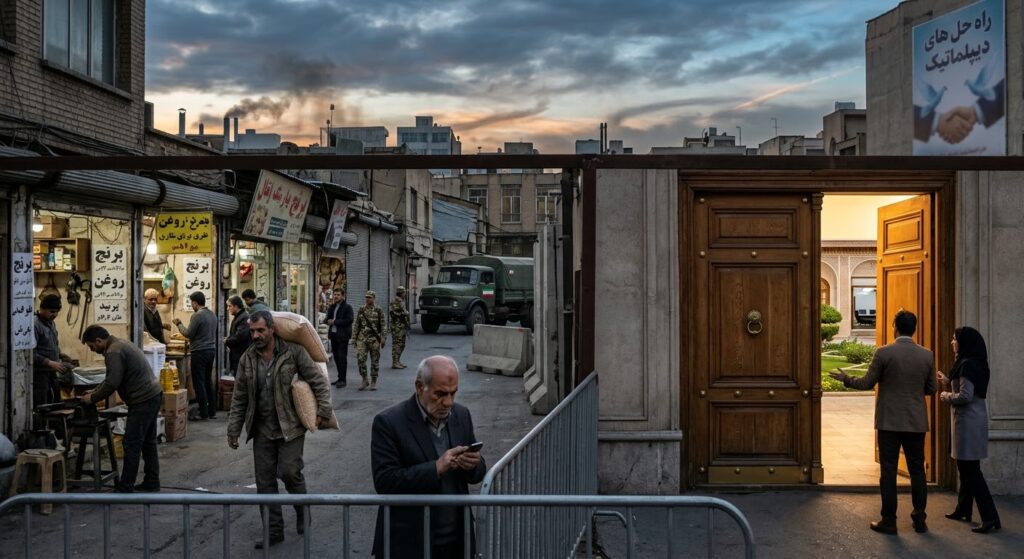
TEHRAN — Iran in early November 2026 presents a regime simultaneously besieged and calculating. Its oil exports have been driven to near zero by an American naval blockade, strangling the lifeblood of its economy . Its streets are quieter than they were in January, but only because the state has executed dozens of protesters and jailed thousands more, a crackdown that a UN expert says the war has only intensified . And yet, in the past week, a diplomatic channel has flickered to life: Iran has sent a nuclear proposal to Washington via Qatar, and Supreme Leader Mojtaba Khamenei has granted the government “powers” to negotiate . Whether this is a genuine opening or a tactical pause before the next round of strikes is the question that hangs over Tehran.
The Economic Siege
The numbers are stark. FGE NexantECA, the energy consultancy, estimates that Iran’s oil exports have fallen to almost nothing since the US imposed its naval blockade. Only 200,000 to 300,000 barrels per day are still reaching international markets, routed through Iraq. Before the war, China was the primary buyer of sanctioned Iranian crude, with discounted cargoes popular among independent teapot refineries. Bloomberg tanker tracking indicates Iran loaded no crude onto tankers in September or October .
Fereidun Fesharaki, FGE’s honorary chairman, told Bloomberg TV that Tehran will face an acute cash crisis by the end of November. “They will be in deep trouble because no money will be coming in,” he said . The blockade has cut off a critical source of revenue after more than eight months of war, yet economic pressure has not yet forced Iran to make major concessions in peace talks. Instead, Fesharaki argued, Tehran believes President Trump has been politically weakened by the Republican Party’s crushing defeat in the midterm elections, and is now making demands the White House cannot accept. The risk of renewed military strikes remains high, he said, because both Trump and Israeli Prime Minister Benjamin Netanyahu have limited time to act .
The Nuclear Proposal: A Door, Not an Opening
On November 5, a senior Iranian official told Reuters that Tehran had submitted a nuclear proposal to the United States through Qatar. The proposal is being reviewed in Washington, but Iranian officials say substantive discussions will not begin until the US meets seven conditions: lifting sanctions, unfreezing Iranian assets, and paying war reparations. Iran has also refused to reopen the Strait of Hormuz or resume negotiations before those demands are met .
The sequencing is the sticking point. Washington wants the nuclear issue addressed at the outset of any talks. Tehran insists that the full list of conditions—from ending the war to lifting sanctions—must be satisfied before nuclear discussions can begin. “Both sides have made the other’s substantive concession their precondition,” a CCTV analysis noted. “Neither currently shows the willingness or space to soften its position” .
On the nuclear substance itself, the gap remains wide. Iran has rejected transferring its highly enriched uranium abroad, accepting only dilution inside the country. Its proposal likely includes the dilution methods it can accept, the resulting concentration levels, and storage plans for low-enriched uranium. It will almost certainly reaffirm Iran’s right to retain nuclear capabilities and civilian nuclear power, committing only to suspending high-enriched uranium production. The US, by contrast, insists on zero nuclear capability: no bomb, no highly enriched uranium, no enrichment activity at all, and full verifiability .
A Qatari-mediated proposal under discussion would reportedly focus first on Iran reopening the Strait of Hormuz in exchange for the US easing sanctions, with broader nuclear talks to follow. But Ali Bagheri, a senior Iranian security official, said on November 6 that Iran is not satisfied with commitments on paper and needs to see practical steps from Washington before launching any new diplomatic effort .
The Supreme Leader’s Calculated Concession
The most significant domestic political development is the Supreme Leader’s decision to grant the government authority to negotiate. President Masoud Pezeshkian said on November 2 that Khamenei had “conferred certain powers on the government” in its talks with the United States, and that Iran is “striving to resolve the issue through dialogue” . The language is carefully calibrated. It signals flexibility without committing the Supreme Leader to specific concessions. It allows the government to explore a deal while preserving the option to blame Washington if talks collapse.
Pezeshkian also struck a defiant note, saying the enemy “cannot make Iran surrender through war” and that the government must work to strengthen the people’s resilience . The dual message reflects the regime’s dilemma: it needs relief from the economic siege, but it cannot appear to capitulate to the same adversary that has bombed its cities and killed its citizens.
The Security Hardliners
Not everyone in Tehran is speaking the language of diplomacy. On November 1, IRGC spokesman Brigadier General Hossein Mohebi declared that “no geographical limits” exist in the new war, and that identifying new targets and planning operations in new areas are on the agenda. He claimed the US had failed to keep the Strait of Hormuz open, that American military bases had become “sources of insecurity for their host countries,” and that an F-35 fighter jet had been brought down during the war .
Mohsen Rezaei, secretary of the Supreme National Security Council, said on October 31 that the war must end in a way that leaves no country daring to attack Iran again. “If Trump is not punished, any country could potentially attack Iran,” he said, adding that the United States must accept and recognize the rights of the Iranian nation before entering discussions on the nuclear issue . Ali Akbar Velayati, an adviser to the Supreme Leader, wrote that “either collective security is achieved, or everyone will experience collective insecurity,” and that “any energy or transit corridor designed to bypass Iran will either come at a high cost or prove unstable” .
These statements serve multiple purposes: reassuring domestic hardliners that the regime is not surrendering, signaling to Washington that military pressure has costs, and laying down markers for any future settlement. But they also constrain the government’s room to maneuver. Every concession Pezeshkian offers must be defended against critics who believe the war must end with a decisive victory, not a negotiated compromise.
The Human Cost at Home
The war has provided cover for a domestic crackdown that predates it. A UN report covering February to August 2026 found that military strikes “compounded domestic repression,” with protesters recast as agents of attacking states and peaceful expression prosecuted as a national security threat. At least 34 people have been executed in connection with the December-January protests. Hearings lasted minutes, forced confessions were broadcast within days of arrest, and dozens of defendants were tried together in capital cases .
The executions have continued. On November 3, authorities hanged Amirhossein Maleki and Amirhossein Ebrahimi in connection with the Alikhani Square protest case in Isfahan. They were among 12 defendants sentenced to death in the case, seven of whom had already been executed since July 19 . On November 8, three more men—Hassan Dioband, Hamid Kazemi, and Reza Zanganeh—were executed after the Supreme Court upheld their death sentences for alleged participation in the January protests on behalf of Israel, the US, and hostile organizations .
The US State Department condemned the executions, highlighting the case of Alireza Raeisi, 21, whose father was taken blindfolded to his son’s secret funeral without being shown where the body was buried, and Alireza Sepahi, 24, a university student who married his fiancée in prison before his execution. His wife remains behind bars serving a five-year sentence . Mai Sato, the UN Special Rapporteur on Iran, said the war “has delivered nothing to the people of Iran” and called for a moratorium on executions .
A Regime Betting on Time
Iran’s strategy today appears to rest on a simple calculation: the United States and Israel have limited political and military bandwidth, while Iran has endured sanctions and isolation for decades. If Tehran can survive the economic siege long enough, the argument goes, Washington’s attention will shift, the coalition against it will fracture, and Iran’s leverage will grow.
The nuclear proposal and the Supreme Leader’s grant of negotiating authority suggest that Tehran is testing whether a deal can be had on terms it considers acceptable. The hardliners’ rhetoric suggests that the regime is preparing for the possibility that no such deal materializes. And the executions suggest that the regime intends to ensure that domestic dissent does not become a third front in the war.
For ordinary Iranians, the calculation is grimmer. Their oil is not being sold, their currency is not being earned, their protests are being punished, and their country is being bombed. Whether the diplomatic door that opened this week leads anywhere depends on whether Washington and Tehran can bridge a gap that neither side has been willing to close. For now, the door is ajar. The war economy is tightening. And the executions continue.