

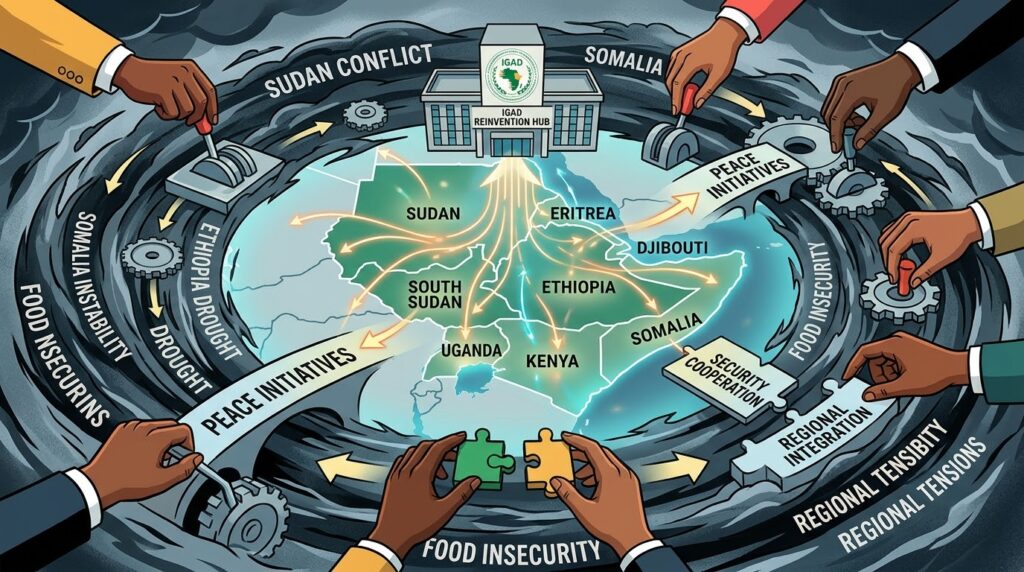
DJIBOUTI/NAIROBI — The Intergovernmental Authority on Development enters the final quarter of 2026 as an organization in the midst of a deliberate institutional reinvention, even as the crises it was created to manage multiply across its eight member states. In the past six weeks alone, IGAD has launched a regional media network on food systems, convened a high-level seminar on maritime chokepoints with an Italian foundation, advanced technical cooperation on digital agro-climate advisory services, and seen its 2023 Treaty cross the ratification threshold needed to enter into force. Yet the same period has witnessed renewed war in Ethiopia, a political crisis in Somalia that has turned violent, a humanitarian emergency on the Kenya-Ethiopia border, and a Sudanese conflict that shows no sign of resolution. IGAD’s challenge today is not relevance—no other body convenes the Horn of Africa’s states—but whether its institutional deepening can translate into tangible impact on the ground.
The Treaty Enters Into Force
The most consequential institutional development of 2026 came at the 74th Extraordinary Session of the IGAD Council of Ministers in Djibouti on September 15. The Council welcomed the attainment of the two-thirds ratification threshold for the 2023 IGAD Treaty, marking what it called “an important milestone in strengthening IGAD’s institutional and legal framework” . The Council endorsed the Treaty’s formal entry into force and directed the Secretariat to advance the necessary institutional, legal, and administrative measures for its operationalization, including alignment with the African Peace and Security Architecture and the African Governance Architecture .
The Treaty’s entry into force is significant beyond its procedural weight. IGAD was founded in 1986 as a drought-focused body and only reoriented toward conflict prevention and security in 1996. The 2023 Treaty represents a more ambitious legal foundation for an organization that has often struggled with mandate ambiguity and resource constraints. The Council also discussed the organization’s financial and institutional condition, emphasizing the need to strengthen institutional capacity, financial sustainability, and operational effectiveness .
Peace and Security: Sudan and Somalia
On Sudan, the Council reiterated its call for an “immediate and unconditional cessation of hostilities,” demanded the protection of civilians and unimpeded humanitarian access, and underscored that “fragmented mediation cannot substitute for a coherent peace process” . IGAD has convened three Forums of Special Envoys on Sudan, bringing together the Quintet—IGAD, the African Union, the European Union, the League of Arab States, and the United Nations—alongside Track II mediation institutions including CMI, Promediation, and the Centre for Humanitarian Dialogue . The July forum in Nairobi focused on moving “beyond routine coordination towards greater strategic coherence,” protecting emerging convergence among Sudanese civilian actors, and preventing military escalation and competing political initiatives from undermining progress . Whether this coordination architecture can produce a ceasefire remains deeply uncertain, but the institutional machinery is more developed than at any prior point in the conflict.
On Somalia, the Council renewed its solidarity with the Federal Government in the fight against terrorism, commended the African Union Support and Stabilisation Mission in Somalia (AUSSOM) and troop-contributing countries, and called on the UN Security Council to ensure “adequate, predictable and sustainable financing” for the Mission . It also upheld Somalia’s sovereignty and territorial integrity and commended efforts toward democratization. Those words carry added weight given the political crisis that has seen armed clashes in Mogadishu and Baidoa and a dispute over electoral timelines.
Food Systems: From Policy to Communication
IGAD’s food systems work has moved into a new phase focused on communication and public engagement. From October 26 to 28, IGAD concluded a three-day regional Media and Influencer Training in Nairobi, bringing together journalists, digital content creators, and focal persons from foreign ministries to strengthen public awareness of the Digital Agro-Climate Advisory Services (DACAS) and the IGAD Fertilizer and Soil Health Hub. The training concluded with the launch of the FSRP Media and Influencers Network .
The initiative reflects a recognition that the CAADP Kampala Declaration’s targets—a 45 percent increase in agrifood output, tripling intra-African agricultural trade, and mobilizing $100 billion in investment—depend on how well they are “understood, communicated and owned by the communities they are meant to serve” . Austine Opata, head of IGAD’s Communication Unit, told participants that through their reporting and creativity, they “influence which issues receive attention, whose perspectives are heard and how complex developments are understood” .
This builds on technical work concluded in Arba Minch, Ethiopia, from October 21 to 24, where experts from seven member states validated regional syntheses of national gender profiles in food systems and recommended establishing national coordination arrangements and regional minimum standards for data quality and interoperability . The Arba Minch session also advanced the DACAS Knowledge Network as a regional platform for knowledge generation and sharing .
Maritime Security and Strategic Connectivity
On October 27-28, IGAD’s Red Sea Maritime Affairs Office and the Med-Or Italian Foundation convened a high-level seminar in Nairobi titled “Corridors & Chokepoints – From Hormuz to Bab el-Mandeb: How Maritime Disruption Will Reshape Strategic Infrastructure and Connectivity across the Horn and East Africa” . The seminar brought together government officials, diplomats from the IGAD region and Europe, private-sector executives, and regional experts under the Chatham House Rule. It was distinctive in bringing public officials and diplomats together with private-sector leaders in a single forum, examining shipping, ports, freedom of navigation, energy infrastructure, and digital and AI connectivity .
The seminar reflected a growing recognition within IGAD that the Red Sea crisis—Houthi attacks on shipping, the disruption of the Bab el-Mandeb corridor, and the resulting spike in insurance and freight costs—is not a distant geopolitical drama but a direct threat to the region’s economic prospects. It marked the first joint initiative under a Memorandum of Understanding signed by IGAD and Med-Or in June 2026 .
The Gap Between Institution and Impact
IGAD today is demonstrably more active, more legally robust, and more externally engaged than it was a year ago. Its Treaty is entering into force. Its mediation architecture on Sudan is more coordinated. Its food systems work has moved from technical validation to public communication. Its maritime agenda has attracted European partners.
But the crises it confronts are outpacing these institutional gains. The war in Ethiopia has resumed, with federal forces advancing on Adwa and Eritrean troops reportedly inside Tigray. Somalia’s political dispute has turned violent. Fifty thousand people have fled across the Kenya-Ethiopia border. And in Sudan, the Council’s call for an unconditional ceasefire has been met with the same silence that has greeted every previous appeal.
IGAD’s value lies in its convening power and its capacity to build the frameworks—on food systems, maritime security, digital integration, and mediation—that will shape how the region responds to the next crisis. Whether that value translates into protection for the people of Moyale, Mogadishu, and El Fasher depends on whether member states are willing to invest IGAD with the political authority and resources its new Treaty envisions. The institution is ready. The question is whether its owners are.