

ADDIS ABABA — The headline circulating in some corners of the internet—”Ethiopian Airlines SU35″—conflates two entirely separate entities. Ethiopian Airlines, Africa’s largest carrier, operates a fleet of Boeing 787s, Airbus A350s, and other commercial jets. It does not fly fighter aircraft. The Su-35 is a Russian air superiority fighter, and the entity that received them is the Ethiopian Air Force, not the national airline. The distinction matters because the delivery of twelve Su-35s to Ethiopia in late October 2026 represents one of the most significant military developments in the Horn of Africa in years—and it has nothing to do with commercial aviation.
The Delivery: Twelve Fighters, One Year Early
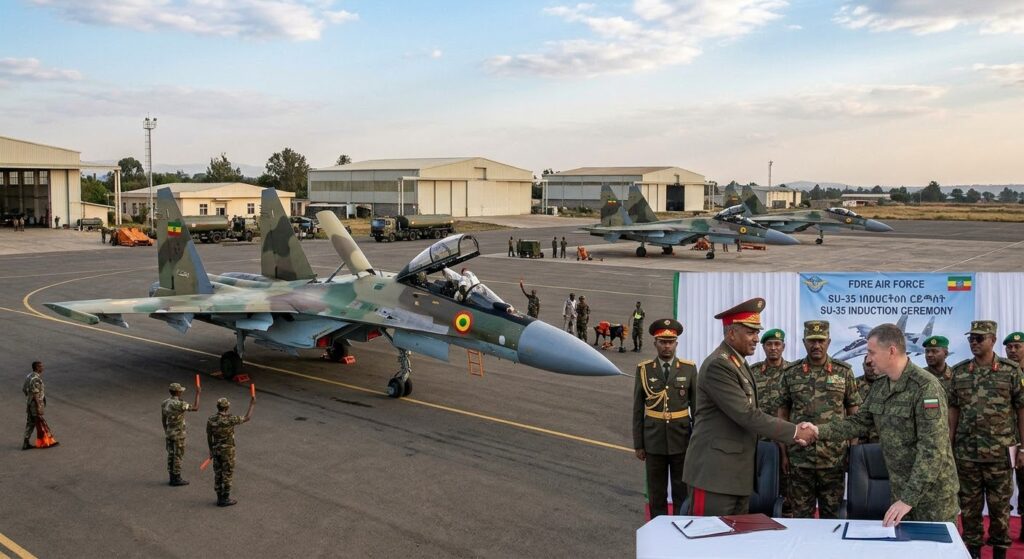
On October 28, 2026, Ethiopian Prime Minister Abiy Ahmed announced on X that Ethiopia had taken delivery of its first twelve Su-35 “4++ generation” fighter jets from Russia, a full year ahead of the agreed schedule . The handover ceremony took place at Zhukovsky International Airport near Moscow, coinciding with the Russia-Africa Summit . Photographs released by the Prime Minister’s office showed at least two aircraft bearing Ethiopian Air Force markings and tail numbers 2551 and 2552 .
Abiy credited Russian President Vladimir Putin personally for accelerating the delivery, describing the acquisition as a “historic achievement” that strengthens Ethiopia’s sovereignty and provides a “massive capability boost” . He also confirmed that Ethiopia has ordered four batteries of Russia’s S-400 long-range air defense system, though those have not yet been delivered .
There is a discrepancy in the reporting that should be noted. While Abiy stated that twelve aircraft were received, Reuters cited Russia’s state arms exporter Rosoboronexport as saying that the first batch delivered on that day consisted of two aircraft . Aviation Week similarly reported the transfer of two of the twelve ordered, and the photographs released showed only two . It is possible that the remaining aircraft will follow in subsequent deliveries, or that Abiy’s announcement referred to the full order rather than the aircraft physically present at the ceremony. What is undisputed is that Ethiopia has acquired the Su-35, and that it is the first sub-Saharan African nation to operate the type .
Why the Su-35 Matters
The Su-35 is a heavily modernized derivative of the Su-27 Flanker, which Ethiopia has operated since the mid-1990s . That common lineage is operationally significant: Ethiopian pilots and maintenance crews are already familiar with the Flanker family, making the transition to the Su-35 far more straightforward than acquiring an entirely new platform . Ethiopia also took delivery of a small number of Su-30K fighters in 2024, which are expected to serve as trainers for the Su-35 fleet .
The Su-35 brings capabilities that the Ethiopian Air Force has never possessed. Its Irbis-E radar, according to Vietnamese defense reporting, can detect aerial targets at ranges up to 400 kilometers under favorable conditions, track thirty targets simultaneously, and engage eight . It carries thrust-vectoring engines that enable extreme maneuverability, and its weapons suite includes long-range air-to-air missiles and precision air-to-ground munitions . Abiy stated that the aircraft can detect and neutralize cruise missiles approaching from up to 200 kilometers away .
The addition of four S-400 batteries would create a layered air defense network that no other sub-Saharan African state can match. The S-400 is designed to engage aircraft, cruise missiles, and certain ballistic threats at long range. However, Russia has struggled to produce enough S-400 systems for its own use in Ukraine, and the delivery timeline for Ethiopia remains unclear .
The Strategic Context: War at Home, Tension Abroad
The timing of the delivery is inseparable from Ethiopia’s security crisis. The announcement came as federal forces were fighting a renewed war against the Tigray People’s Liberation Front (TPLF) and its allies in the north, a conflict that erupted on September 23 and shattered the 2022 Pretoria peace agreement . The war has also triggered a diplomatic rupture with Eritrea, which Ethiopia accuses of supporting the TPLF—allegations Asmara denies .
Kaleab Segatu, a military intelligence analyst cited by the BBC, described the Su-35 acquisition as “an important signal that Ethiopia is preparing not only for internal conflict but also for the possibility of war with other countries” . The reference to “other countries” is difficult to read as anything other than Eritrea. Ethiopia and Eritrea fought a brutal border war from 1998 to 2000, during which Ethiopian Su-27s reportedly downed Eritrean MiG-29s in all four known engagements . The Su-35, as a direct descendant of the Su-27, represents a continuation of that lineage—and a qualitative leap beyond anything Eritrea operates.
The delivery also underscores Russia’s continued willingness to supply advanced weapons to African states despite the demands of its war in Ukraine and Western sanctions. Rosoboronexport has stated that African countries account for more than 30 percent of its order portfolio and that it is preparing more than 20 joint projects across the continent . For Moscow, Ethiopia is both a lucrative customer and a strategic partner in a region where Russian influence has been expanding.
What This Is Not
It is worth stating plainly what this development does not involve. Ethiopian Airlines, the commercial carrier, has no role in the Su-35 acquisition. Its fleet modernization in 2026 has focused on Boeing 787-9 Dreamliners and Airbus A350-1000s, aircraft designed to carry passengers, not to fight wars . The airline’s most notable operational news in October was the resumption of flights to Mekelle after federal forces retook the city—a decision driven by the security situation on the ground, not by any connection to the fighter delivery .
The conflation likely stems from the shared national name and the coincidence of timing. But for anyone seeking to understand Ethiopia’s military trajectory, the distinction is essential. The Su-35s belong to the Air Force. They are a signal of intent, a statement of capability, and a marker of deepening ties with Moscow. They are not a commercial aviation story, and they will not be appearing at Bole International Airport’s passenger terminals.
A New Balance of Power
Ethiopia’s acquisition of the Su-35 changes the military calculus in the Horn of Africa. It gives Addis Ababa an air superiority capability that no neighboring state can currently counter, and it signals that Ethiopia is willing to invest heavily in hard power even as its economy strains under war, inflation, and the lingering effects of the Middle East fuel shock. Whether the aircraft will be used to deter Eritrea, to prosecute the war in Tigray, or simply to signal strength to a region watching closely, the Su-35s have arrived. The question now is what Ethiopia intends to do with them.