

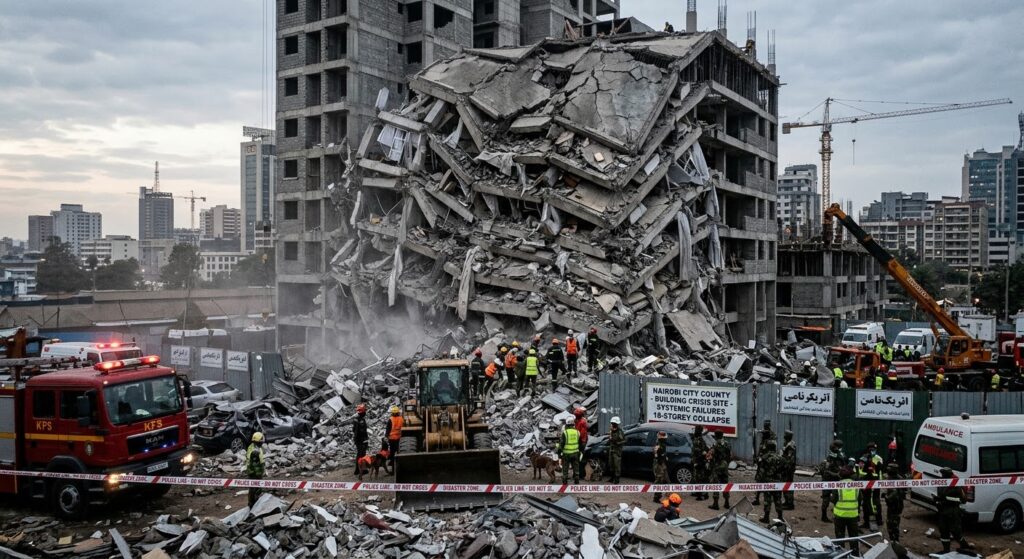
NAIROBI — The images are seared into the national consciousness: an 18-storey building in Eastleigh crumpling into a cloud of dust in seconds, its concrete floors stacked like pancakes, trapping an unknown number of people beneath the rubble. The collapse on Friday, October 23, 2026, killed and injured an untold number, left seven missing, and triggered a manhunt for the owner and contractor . But for anyone who has watched Kenya’s construction sector over the past year, the disaster was not a surprise. It was an inevitability.
Less than ten months into 2026, Nairobi has already witnessed collapses in South C, Karen, Westlands, and the central business district . The Eastleigh tragedy is merely the latest—and most visible—symptom of a governance failure that stretches from the county planning offices to the National Construction Authority, from the developers who cut corners to the professionals who look away.
A Building That Should Never Have Stood
The Eastleigh building was under construction when it came down at around lunchtime on Friday. According to Interior Cabinet Secretary Kipchumba Murkomen, 67 construction workers were on site; 66 escaped unharmed, one was injured. The missing were believed to be in the 11 shops that had already opened on the ground floor and basement—businesses operating in a structure that had no occupancy certificate .
Nairobi Governor Johnson Sakaja was blunt. Records showed that an application for a 15-storey building with a basement had been submitted but never approved. “The application was never granted, meaning there is no approval for this construction,” he said. The Urban Planning Committee had raised concerns about the basement and ground-floor shops as early as November 2024. An enforcement order was issued earlier this year. Construction continued anyway .
The pattern is familiar. In South C, a building approved for 12 storeys reached 16 before it collapsed in January 2026, killing at least two people. The developer had pressed on despite stop orders from both the NCA and the county government . In Eastleigh, the same script played out on a larger scale.
The 87 Percent Problem
Perhaps the most damning statistic in Kenya’s construction crisis comes from the National Building Inspectorate. A report found that 87 percent of buildings audited nationwide last year failed to meet standards or lacked the required approvals . That is not a marginal failure rate. It is a systemic collapse of regulatory oversight.
The causes are not mysterious. Bibiye Mahmoud, president of the Institution of Engineering Technology of Kenya, told AFP at the Eastleigh site: “The contractors and the engineers are supposed to ensure that the works are followed by professionals. But most are not. This is why we are seeing these catastrophes… There is no accountability” .
John Ogallo, vice president of the Institution of Engineers of Kenya, noted that warning signs had been visible. “People here are saying distresses were observed, like cracks,” he said. “If you build with the wrong materials, it becomes a time bomb” .
A Regulatory System That Cannot Enforce
Kenya does not lack laws. The Building Code, the Physical Planning Act, and the National Construction Authority Act provide a framework for safe construction . The NCA is mandated to register projects, issue compliance certificates, and halt construction where necessary . The Office of the Director of Public Prosecutions has partnered with the NCA to prosecute construction offences . The Ethics and Anti-Corruption Commission has committed to addressing governance gaps, including “the proliferation of unqualified practitioners and gaps in development control processes at the county level” .
Yet the enforcement machinery is failing at the point where it matters most. Governor Sakaja revealed that more than 200 construction-related files are stuck at the DPP’s office, awaiting prosecution. “Without prosecution, people continue to construct,” he said. He argued for prosecutorial powers to be returned to the county, asserting that the current process impedes timely action .
The fragmentation of responsibility is another obstacle. County governments issue approvals; the NCA registers projects and conducts inspections; the DPP prosecutes; professional bodies regulate architects and engineers. Each link in the chain has its own priorities, its own capacity constraints, and its own vulnerabilities to political interference. The Architectural Association of Kenya has repeatedly recommended a “One Stop Shop” for approvals, unifying planning, environmental, and construction compliance into a single coordinated system . That recommendation has yet to be implemented.
A Boom Without a Conscience
Nairobi is in the midst of a construction boom. The number of buildings completed annually rose from 20,025 in 2022 to 25,090 last year, according to the statistics bureau, as East Africa’s leading business hub draws people from across the region . Eastleigh, a densely populated commercial and residential district, has been at the center of this surge, with high-rises springing up between busy market stalls and crowded residential blocks.
But the boom has outpaced the capacity—and the will—to regulate it. Between 2009 and 2019, Nairobi recorded 86 building collapses, killing an estimated 200 people, according to the Kenya Institute for Public Policy Research and Analysis . The pace has not slowed. In 2026 alone, collapses have occurred in South C, Karen, Westlands, the CBD, and now Eastleigh .
Corruption has allowed contractors to cut corners or bypass regulations entirely. The Commission on Administrative Justice has recommended prosecution of five senior Nairobi City County officials for allegedly issuing irregular approvals and failing to enforce stop orders in a separate case . The developers who profit from non-compliance face penalties that Sakaja himself described as a “slap on the wrist”—insufficient to deter repeat offences .
The Human Cost
Behind every statistic is a person. Joseph Kaula, a plasterer working on the fifth floor of the Eastleigh building, heard the screams and ran. “I was the last person to walk out before it collapsed and the whole area was filled with dust,” he said. He suspects some of his colleagues were trapped in the basement .
One woman was rescued from the rubble and hospitalized. Another voice, crying for help, went silent . On Saturday, two more survivors were pulled alive, but five remained missing . Families gathered at a tent set up to report the missing, their loved ones’ phones now unreachable.
The rescue itself was hampered by the conditions regulators had allowed to develop: the building was wedged between other high-rises, limiting access for heavy equipment. Rescuers initially used poles stripped from trees to poke at the rubble. Concerns about air supply to those trapped forced them to stop using excavators .
What Comes Next
A manhunt is underway for the building’s owner and contractor . The NCA has identified the company behind the development, as well as the architect and structural engineer. The Directorate of Criminal Investigations has been asked to act. Governor Sakaja has promised a city-wide crackdown on illegal construction, vowing to “stop all of those developments and even bring down those that need to come down” .
But Kenya has heard these promises before. After the South C collapse in January, the government announced a policy framework to address construction beyond approved designs and a nationwide review of buildings . Ten months later, an 18-storey building with no approval was allowed to rise in one of Nairobi’s most crowded neighborhoods, its ground-floor shops open for business, its upper floors still under construction, until the moment it fell.
The question is not whether Kenya has the laws to prevent the next collapse. It does. The question is whether anyone will enforce them before another building—and another set of lives—is lost. For the families of the seven missing in Eastleigh, that question has already been answered in the most devastating way possible.