

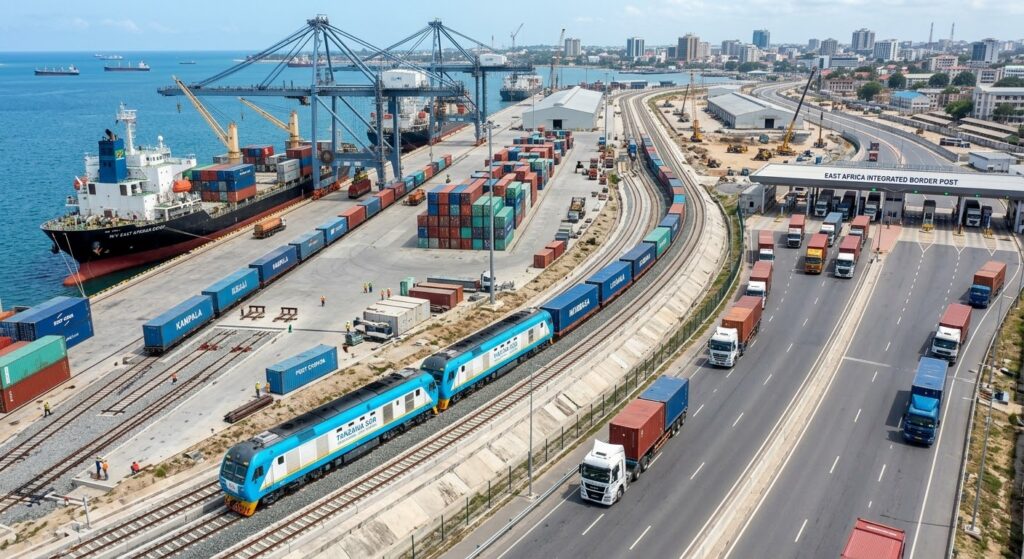
MOMBASA/KAMPALA/DAR ES SALAAM — East Africa is in the midst of its most ambitious transport transformation in decades. From the expansion of Mombasa’s port to accommodate record cargo volumes, to the extension of standard gauge railway lines toward the Ugandan and Tanzanian borders, to digital systems that allow a single customs bond to cover goods across multiple countries, the region is betting that connectivity will cement its position as Africa’s fastest-growing economic bloc. Yet the gaps remain stubborn: railways in Kenya and Uganda will use different signaling systems, border inefficiencies still cost traders time and money, and the financing needed to complete the network far exceeds what has been secured.
Mombasa Port: Record Volumes Drive Expansion
The Port of Mombasa, East and Central Africa’s premier maritime gateway, handled a record 45.45 million metric tonnes of cargo in 2025—a 10.9 percent increase over 2024—with container traffic reaching 2.11 million TEUs . Transit cargo destined for Uganda, Rwanda, Burundi, South Sudan, and the DRC rose 19.5 percent to 15.88 million tonnes .
To absorb the growth, the Kenya Ports Authority is constructing Berth 19B at a cost of Sh19 billion. The 240-metre berth, with a 15-metre draft, will accommodate vessels up to 45,000 deadweight tonnes and add approximately 300,000 TEUs of annual capacity. KPA CEO Capt. William Ruto said the project is around 56 percent complete and on course, with some sections expected to be released before the December cargo peak .
Digital transformation is proceeding in parallel. In July, KPA unveiled a Sh1 billion Vessel Traffic Management and Information System at Mombasa, integrating real-time vessel tracking, radar surveillance, and oil-spill detection across three interconnected sites . A smart gate at Gate 24 has been completed to reduce manual interfaces and ease congestion. At the Dongo Kundu Special Economic Zone, the Sh41.1 billion port component—including seven berths across 1,300 acres—is underway, with the first 300-metre multipurpose berth at roughly 23 percent completion and scheduled for December 2028 .
KPA is also positioning Lamu Port as a complementary gateway. The planned East African Oil Refinery, a Sh2.2 trillion project developed with Aliko Dangote, is expected to drive vessel traffic and demand for maritime services. In late September, the MV Da Yang Bai He docked at Lamu carrying about 2,930 tonnes of construction equipment for the refinery .
Rail: Kenya Pushes West and South, Uganda Secures Financing
Kenya’s Standard Gauge Railway extension from Naivasha to Kisumu and Malaba is advancing. Construction on the Narok-Kisumu section commenced in October, with Kenya Railways Managing Director Philip Mainga expressing confidence that the contractor could complete the work within two years. Kisumu is slated to host one of the largest stations on the SGR network as part of a railway city spanning more than 100 acres .
Most of the extension toward Kisumu and Malaba is expected to be completed by June 2027, bringing the railway to the Ugandan border . On the Ugandan side, Cabinet approved a proposal to issue €405 million (Sh1.84 trillion) in sovereign financing for the Malaba-Kampala SGR section, alongside €142.69 million (Sh650 billion) to upgrade two roads serving the Bwindi tourism area .
Yet the technical hurdles of connecting the two networks are significant. Uganda’s planned SGR will use the European Rail Traffic Management System and European Train Control System Level 2, while discussions with Kenya cover signaling, power supply, communications, rolling stock, and operating rules. Having the same track gauge does not guarantee seamless cross-border operations; differences in equipment may require technical adjustments and additional border procedures .
Kenya is also pursuing a southern rail link. The government has allocated approximately Sh5 billion to extend the SGR from Voi to Taveta on the Tanzanian border, a 130-kilometre line that would connect Mombasa to Moshi and Arusha . In parallel, rehabilitation of the legacy metre-gauge Voi-Taveta line has reached 40 percent, with a Sh5.5 billion initiative that includes a dry port at Voi and renovations to stations at Mwatate, Bura, Maktau, and Taveta .
Tanzania, for its part, has signed a memorandum of understanding with Arab Contractors for the development of the Mtwara-Liganga SGR project, linking the Indian Ocean port of Mtwara with Mbamba Bay on Lake Nyasa, with branches serving mineral-rich areas .
Urban Mobility: Nairobi’s Congestion Crisis
Nairobi’s traffic congestion costs the economy approximately Sh120 billion ($825 million) annually in lost productivity, according to Kenya’s Ministry of Transport and the Nairobi Metropolitan Area Transport Authority . Kenya Railways has launched the search for consultants to modernize and electrify the capital’s commuter rail network under the $447 million Kenya Urban Mobility Improvement Project, backed by the World Bank. The plan will upgrade the 57-kilometer Nairobi-Thika corridor, modernize stations and signaling, and introduce new trains. Consulting assignments are expected to begin in December 2026 .
The railway effort is complemented by a bus rapid transit network. Construction of BRT Line 5, a 10.5-kilometer corridor with 13 stations, is underway with $59 million in financing from the Export-Import Bank of Korea .
Trade Facilitation: Digital Bonds and Border Reforms
The East African Community’s trade facilitation agenda has produced measurable results. The EACBond system, a regional customs bond that allows a single guarantee to cover goods moving across multiple member states, received a $29 million guarantee from Afreximbank in September. The system entered a pilot phase in Uganda in August 2025, with Rwanda and Burundi joining in January 2026 before its official launch at the EAC Heads of State Summit in March 2026 .
The timing is opportune. Intra-EAC exports rose 33.2 percent year-on-year to $3.2 billion in the second quarter of 2026, while total regional trade reached $52.3 billion, up 37 percent . The Commonwealth Association of Tax Administrators commended the EAC in October for its digital revenue administration achievements, citing the Single Customs Territory, EACBond, and the Electronic Cargo Tracking System as initiatives that have simplified procedures and strengthened cargo monitoring .
Yet bilateral frictions persist. Uganda and Kenya agreed in mid-October to remove remaining trade barriers affecting agricultural goods, including vegetables, following concerns raised by Kampala over restrictions on its exports. Kenya’s Principal Secretary for Trade, Regina Ombam, confirmed commitment to operationalizing One-Stop Border Posts and removing discriminatory taxes and levies, though some barriers require legislative amendments . At the Lungalunga border with Tanzania, Kenya’s EAC Affairs Principal Secretary Caroline Karugu acknowledged declining competitiveness compared to neighboring countries, citing high costs of doing business, border taxation, and logistical inefficiencies .
The Financing Gap and the Road Ahead
The ambitions are substantial, but so are the constraints. Uganda’s SGR financing alone requires €405 million in sovereign borrowing, and the Bwindi road upgrades add another €142.69 million . Kenya’s port expansion, rail extensions, and urban mobility projects collectively run into hundreds of billions of shillings. The African Development Bank has estimated the region’s annual development financing gap at $119 billion.
The private sector’s role is growing. KPA has engaged trade delegations from Britain, the Netherlands, Belgium, Argentina, and Japan on infrastructure development, private investment, and operational efficiency, with discussions covering the Dongo Kundu SEZ and Lamu Port as strategic investment opportunities . Kenya’s partnership with Rwanda on petroleum imports through Mombasa—marked by the arrival of the MT Sea Wolf carrying 40,000 metric tonnes of petroleum products in late September—signals a shift in regional logistics patterns, with Rwanda diversifying away from the Central Corridor through Dar es Salaam .
For the traders, truckers, and travelers who depend on these corridors, the transformation is tangible but uneven. A new berth at Mombasa, a railway line reaching Kisumu, a digital bond that replaces stacks of paperwork at border posts—each represents a step toward a more integrated East Africa. But the gaps between Kenya’s and Uganda’s signaling systems, the legislative amendments needed to remove non-tariff barriers, and the sheer scale of financing required suggest that the region’s transport revolution is still closer to its beginning than its end.