

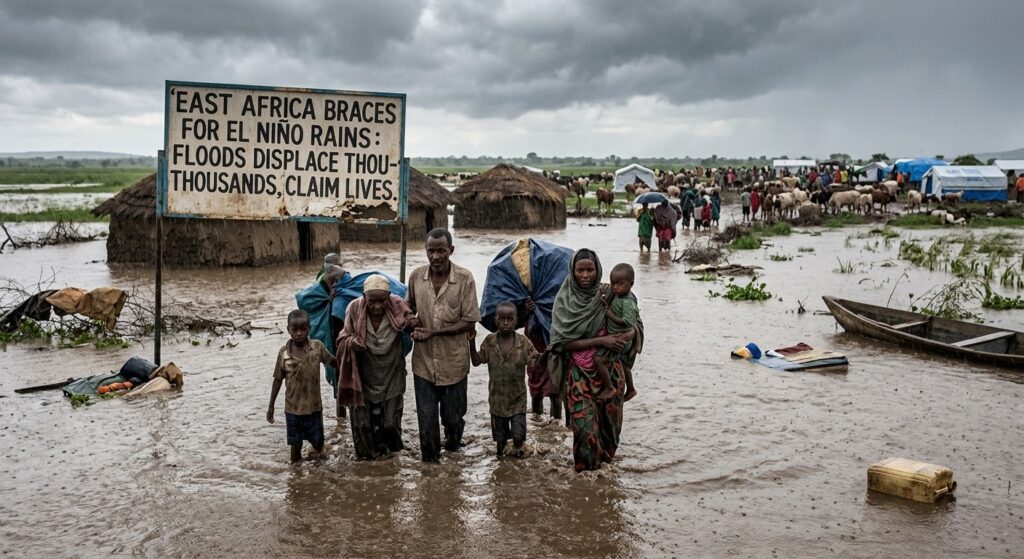
NAIROBI/KAMPALA — East Africa is on high alert as a powerful El Niño event begins to unleash above-average rainfall across the region, with catastrophic flooding already claiming lives in Uganda, displacing communities in Somalia, and prompting governments from Nairobi to Dar es Salaam to mobilize emergency resources on an unprecedented scale. Forecasters warn that this could be the strongest El Niño since 1997, with up to three million people potentially displaced by year’s end in the worst-case scenario .
A Region on Edge
The IGAD Climate Prediction and Applications Centre (ICPAC) has forecast that most of the Greater Horn of Africa will receive above-normal rainfall during the October-December season, with a 99 per cent chance of El Niño and a 96 per cent chance of a “very strong” event . Nicholas Savage, a weather scientist involved in the regional outlook, said models suggest conditions could persist into 2027.
The consequences are already being felt. In Kampala, Uganda, two people died on October 11 following heavy rains that pounded the metropolitan area. In Bulabira Zone, police recovered the body of an unidentified man aged between 22 and 28 from a drainage trench; he is suspected to have been swept there by floodwater. In Ttuba Zone, Kyanja Parish, 25-year-old Jalia Nameere died after a perimeter wall collapsed onto her rented room during the overnight downpour . Floodwater also destroyed a perimeter wall in Mbalwa and damaged a vehicle, while a motorcycle was recovered from floodwater in Kireka .
“Police recorded two deaths and damage to property following heavy rains in parts of the Kampala Metropolitan Area,” Police spokesperson Kituuma Rusoke said, urging the public to avoid flooded roads, drainage channels, and trenches, and not to walk or drive through fast-flowing water .
Somalia: The Sharp End of the Crisis
Somalia is expected to bear the brunt of the displacement crisis. Danish Refugee Council modeling projects that in the worst-case scenario, Somalia would account for 60 per cent of the up to three million people displaced across the region, with Kenya accounting for 33 per cent . The scenarios range from 750,000 displaced in a less severe outcome to three million in the most severe.
“In Beledweyne, I met families still rebuilding after the devastating 2023 El Niño floods,” said James Curtis, DRC Executive Director for East Africa and Great Lakes. “Now they are watching the river rise again, wondering whether they will be forced to flee for a second time. This is the human cost of repeated climate shocks: people are not simply losing homes and livelihoods; they are being forced to rebuild their lives again and again” .
ICPAC’s weekly forecast for October 6-13 warned of “more than usual rainfall” over northern parts of Somalia and south-eastern Ethiopia, with rainfall exceeding the 95th percentile expected in those areas and flooding incidences anticipated .
Kenya: Preparing for the Worst
Kenya is mobilizing at both national and county levels. The Kenya Meteorological Service has forecast above-average rainfall across more than 80 per cent of the country for the October-December short rains season, driven by intensifying El Niño conditions . The National Disaster Operations Centre has identified Nairobi, Mombasa, and Kisumu as high-risk urban hotspots, with the El Niño set to peak in December .
In Nairobi, Governor Johnson Sakaja announced that the county has identified 227 flood-prone hotspots, with approximately 100,000 residents potentially facing displacement in a worst-case scenario. Twenty-six of 61 critical drainage sites have been cleared across the county’s 17 subcounties, with drainage clearance works continuing even on Sundays at a cost of Sh5.17 billion .
“We have a plan for that together with the Kenya Red Cross and the national government. Shelter kits will be positioned in those areas. We do not want to create IDP camps,” Sakaja said, explaining that designated rescue centres would mainly be schools and social halls. “In Nairobi, if you give people some resources, cash transfers, they will find their way” .
Sakaja dismissed doubts about whether the El Niño rains would materialize, citing a 96 to 98 per cent probability of onset in the third week of October. “I have heard people doubting whether there’s El Niño. We must respect science,” he said, adding that forecasts indicated all counties except Turkana and Marsabit were likely to experience heavy rains .
In Mombasa, Governor Abdulswamad Nassir has directed the department of environment, water, and solid waste management to ensure drainage systems in all six subcounties are thoroughly cleared. The county has verified flood hotspots across all 30 administrative wards and cleared drainage channels using heavy-duty equipment including hydro-jetters. Three hundred officers from the county government and national agencies have participated in rescue, marine safety, casualty management, and emergency-response exercises .
“We want clean drainage systems in the subcounties to avoid flooding,” Nassir said. “This will be no ordinary rainy season, and our response cannot be ordinary. Mombasa is preparing early, mobilizing every available resource and working across agencies to protect lives, livelihoods and property” .
The memory of the 2023 El Niño floods, when nearly 3,900 households were affected in Mombasa, looms large. Residents are taking individual precautions. Joseph Odhiambo, a resident of the Kongowea area, said he had already made plans to move his family and property to higher land. “El Niño is not a new phenomenon in Kenya or in Mombasa. It is up to us to look out for ourselves and expect as little help from the government as possible,” he said .
Tanzania: A $275 Million Mobilization
Tanzania has set aside $275 million for emergency measures ahead of the heavy El Niño rains, supporting risk mapping, drainage works, resource mobilization, disease prevention, and other measures . The Tanzania Meteorological Authority has warned of above-normal rainfall in the Lake Victoria Basin and coastal areas, including Dar es Salaam, where residents are still recovering from the 2024 El Niño floods that killed at least 155 people.
The government has directed road agencies to identify areas vulnerable to flooding, improve drainage, and monitor high-risk roads. In Dar es Salaam, Minister of State Hamad Yussuf Masauni urged residents living in high-risk areas along the Msimbazi River to relocate to safer places, warning that “their lives are truly at risk” .
Transport infrastructure including roads, railways, and airports has been earmarked for possible disruption. TMA Director General Ladislaus Chang’a warned that road embankments could collapse, bridges and railway infrastructure could be damaged, and cargo operations at ports could be delayed, particularly for goods requiring protection from moisture .
South Sudan: A Permanent Hydrological Crisis
In South Sudan’s Unity State, the climate crisis has become a permanent feature of life. Persistent flooding has submerged around 70 per cent of the land in Bentiu, and the upcoming El Niño rains threaten to overwhelm the earthen dykes that protect 300,000 civilians sheltering behind them .
“The residents of Bentiu face a multipronged threat,” warns Sam Korutaro Muhumure, Head of the UN Mission in South Sudan’s Field Office in Bentiu. “While the weather pattern has changed, heavy rains are set to coincide with the El Niño phenomenon from October to February. If the water level rises above what we saw at the beginning of this year, then the earthen dykes will not be able to hold back the water” .
The dykes are maintained around the clock by UNMISS and the International Organization for Migration. “If they cannot get funding to continue their work, then the lives of the people in this region are at stake,” Muhumure says. “If a breach in the dykes was not repaired within ten hours, we estimate that 50,000 people will be submerged” .
The FAO-WFP Early Action Analysis warns that river flows are expected to increase, elevating flood risk in South Sudan during the latter part of the year. Counties at risk of famine—Luakpiny/Nasir, Ulang, Nyirol, and Akobo—sit where conflict, flood exposure, and drought converge, and conflict has interrupted dyke and drainage maintenance .
Ethiopia: Contrasting Extremes
Ethiopia faces a starkly divided climate threat. Western and eastern parts of the country are currently experiencing below-average rainfall, while eastern and southern regions face heightened flood risks from expected above-average rainfall between October and December . The Food Security and Nutrition Working Group warns that the rapid build-up of El Niño through July 2026 mirrors the devastating 1997-1998 event, with NOAA forecasting a 95 per cent chance of a “strong” or “very strong” episode .
The report warns that above-average rainfall in Ethiopia’s southern highlands can trigger downstream flooding in Somalia, and that water- and vector-borne diseases affecting people and livestock could increase nutrition risks among vulnerable groups, particularly young children . Global Weather Hazards data shows a high risk of flooding in southern Ethiopia and parts of Somalia during the next week .
Rwanda and Burundi: Preparedness Under Pressure
Rwanda has strengthened preparedness through improved weather forecasting and early warning systems, community mobilization, and enhanced coordination among relevant institutions. Anthony Twahirwa of the Rwanda Meteorology Agency said the developing strong El Niño, coupled with a positive Indian Ocean Dipole, is expected to contribute to above-normal rainfall, raising the risk of flooding, landslides, soil erosion, and infrastructure damage .
Measures include clearing drainage channels, reinforcing vulnerable infrastructure, promoting relocation from high-risk areas, and strengthening the capacity of district disaster management officers. “Strengthening impact-based forecasting, early warning dissemination, inter-agency coordination and anticipatory action will therefore be essential to minimize potential losses,” Twahirwa said .
In Burundi, El Niño is expected to bring above-average rainfall potentially reaching up to 90 per cent above normal levels, increasing the risk of flooding and landslides . Disaster risk expert Dr. Athanase Nkunzimana warned that while initiatives are underway, “we cannot guarantee that Burundi is well prepared at the moment.” He called for anticipatory action across all sectors—from agriculture and infrastructure to health and education. “The identification of risk zones is essential, and most of these zones are well known. What is needed is for anticipation measures to be in place” .
A Choice Between Action and Reaction
The DRC is calling on donors, governments, and partners to integrate refugees, IDPs, and host communities into national disaster plans and early-warning systems before crisis strikes, and to allocate financing for anticipatory action that can be released when danger is certain and imminent. The organization is seeking €4.3 million globally to protect 240,000 people ahead of peak El Niño impacts, alongside €8.6 million to enable rapid emergency response .
“We know the risk is coming,” Curtis said. “The choice is whether we act before the river breaks its banks, or respond only after people have lost everything once more” .
For the millions of East Africans living in flood-prone areas—from the crowded informal settlements of Nairobi and Kampala to the riverbanks of Beledweyne and the dyke-protected camps of Bentiu—the coming weeks will determine whether this El Niño season brings a manageable challenge or a repeat of the devastation that has become all too familiar. The forecasts are clear. The preparations are underway. What remains uncertain is whether the resources and political will exist to prevent the worst.