

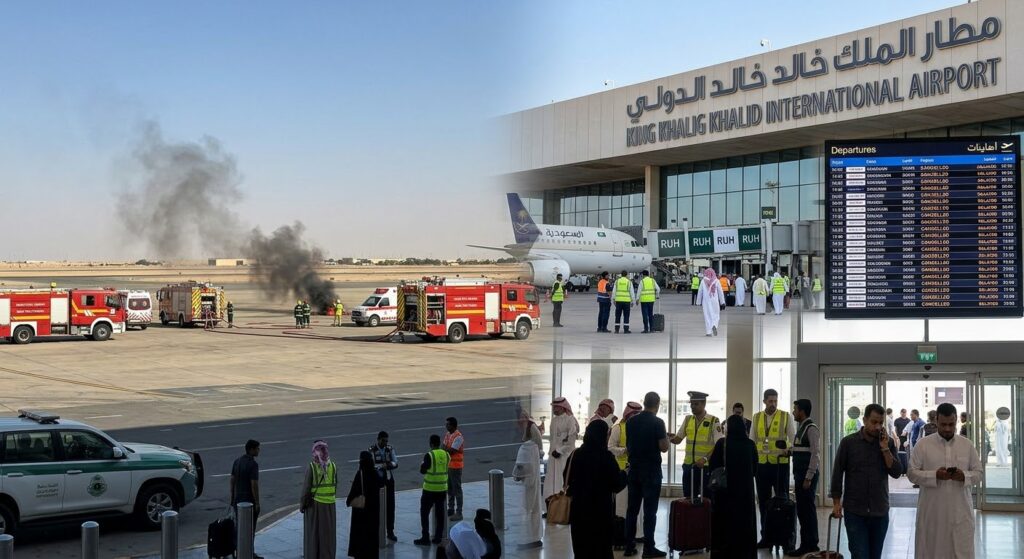
RIYADH/SANAA — Saudi Arabia’s King Khalid International Airport remained closed on Monday as authorities extended the suspension of all operations following a devastating wave of Houthi missile and drone attacks that killed at least 13 people and injured more than 320 others at the Riyadh hub. The attacks represent the most severe cross-border escalation in the Yemen conflict in years and have sent shockwaves through global aviation networks.
A Second Deadly Strike
The latest attack occurred on Sunday evening, when a Houthi ballistic missile struck King Khalid International Airport, killing a Pakistani national and injuring 11 others . The strike came just one day after a devastating Saturday attack on a passenger terminal at the same airport that left 12 people dead and 309 wounded .
Saudi Arabia’s General Authority of Civil Aviation (GACA) announced Monday that it was extending the closure of the airport “to complete the necessary procedures to verify the safety and operational readiness of the airport’s facilities” . No timeline was given for reopening.
In a separate attack on Sunday evening, King Fahd International Airport near Dammam in the Eastern Province was also targeted, with damage assessments and safety inspections underway .
Houthi Claims Four Operations in 24 Hours
Houthi military spokesman Yahya Saree, in a televised statement broadcast on the group’s al-Masirah TV, claimed responsibility for four missile and drone operations over the previous 24 hours . The targets included:
- King Khalid International Airport in Riyadh — struck in three waves beginning Saturday evening, which the Houthis claimed disrupted air traffic and forced the airport’s closure
- Aramco’s Shedgum gas facility in the Eastern Province — claimed “direct hit” causing a large fire
- Aramco’s Tanajib facility in the Eastern Province — also claimed to have been hit
- King Fahd International Airport near Dammam — claimed to have disrupted aviation operations
Saree said the operations were in response to intensified Saudi airstrikes across Yemen, claiming Saudi warplanes had carried out 124 strikes in the previous 24 hours targeting Sanaa and the provinces of Taiz, Marib, Al-Jawf, Hajjah, Hodeidah, and Saada .
The Saudi-led coalition confirmed it intercepted and destroyed a ballistic missile launched toward Riyadh, with coalition spokesman Turki Al-Malki stating that air defenses also intercepted two ballistic missiles targeting Khamis Mushait .
A Warning to Global Aviation
The Houthis issued a stark warning to international airlines, urging them to suspend flights to Saudi airports, stating that all Saudi airports and airspace—except those in the holy cities of Mecca and Medina—constitute “an area of operations” for the group’s forces .
“We warn all airlines, experts, employees, workers, and travelers not to take flights to airports inside Saudi Arabia,” Saree said, describing these airports as “unsafe” .
Global Aviation Disruption
The impact on international air travel has been immediate and severe. More than 275 flights to and from King Khalid International Airport were cancelled on the day of the first major strike, representing 40 percent of arrivals and 30 percent of departures . International carriers have responded swiftly:
- Lufthansa suspended flights to Riyadh until at least October 16
- Air India halted operations to Riyadh through October 10
- Qatar Airways announced on Monday the temporary suspension of flights to and from Riyadh and Dammam
Multiple governments have issued travel warnings. The United States, Britain, Spain, and Canada have all issued travel advisories or aviation safety warnings. The U.S. Embassy in Riyadh now requires government employees to obtain special permission before using airports in Saudi Arabia, while the Federal Aviation Administration has urged American carriers to exercise caution when flying to or through Saudi airspace .
Riyadh’s Daily Life Disrupted
The attacks have profoundly affected daily life in the Saudi capital. All schools in Riyadh have transitioned to online learning, and some businesses have begun arranging remote work for employees. Roads leading to the airport’s terminals and parking areas are guarded by police, with emergency repairs underway inside the facility .
Residents described hearing multiple explosions across the city. One Riyadh resident told AFP: “After the explosions, birds became agitated, and the entire house was shaking” .
International Condemnation and Diplomatic Efforts
Saudi Arabia, Egypt, Pakistan, and Turkey issued a joint statement on Sunday strongly condemning the Houthi attacks, demanding the group “immediately and unconditionally cease such attacks” . The statement said the attacks violate Saudi sovereignty and territorial integrity and threaten regional and international peace and security.
The United Arab Emirates’ presidential adviser Anwar Gargash urged the revival of joint Gulf action, stating: “We are all targeted, and our security is indivisible” .
Iran, meanwhile, has signalled willingness to mediate. Iranian Foreign Minister Abbas Araghchi held a phone call with Saudi Foreign Minister Prince Faisal bin Farhan, expressing concern about the escalation and emphasizing that “insisting on a military approach and ignoring a political solution would complicate the current situation.” Araghchi said Iran was ready to provide assistance to help start dialogue between Saudi Arabia and the Houthis .
A Dangerous New Phase
The attacks mark a significant escalation in the long-running Yemen conflict. The Houthis have demonstrated an enhanced capability to strike deep into Saudi territory, targeting the kingdom’s most critical civilian infrastructure with precision. The targeting of civilian airports represents a crossing of red lines that Saudi Arabia cannot ignore.
For global aviation, the closure of Riyadh’s main international airport—a key hub connecting East and West—poses logistical challenges that ripple far beyond the Middle East. For the people of Riyadh, the attacks have brought the war’s violence to their doorstep in ways not seen since the conflict’s earliest days. And for the broader region, the strikes raise the specter of a wider conflagration involving Iran, the Gulf states, and potentially the United States, which President Trump has said is considering direct military involvement against the Houthis .