

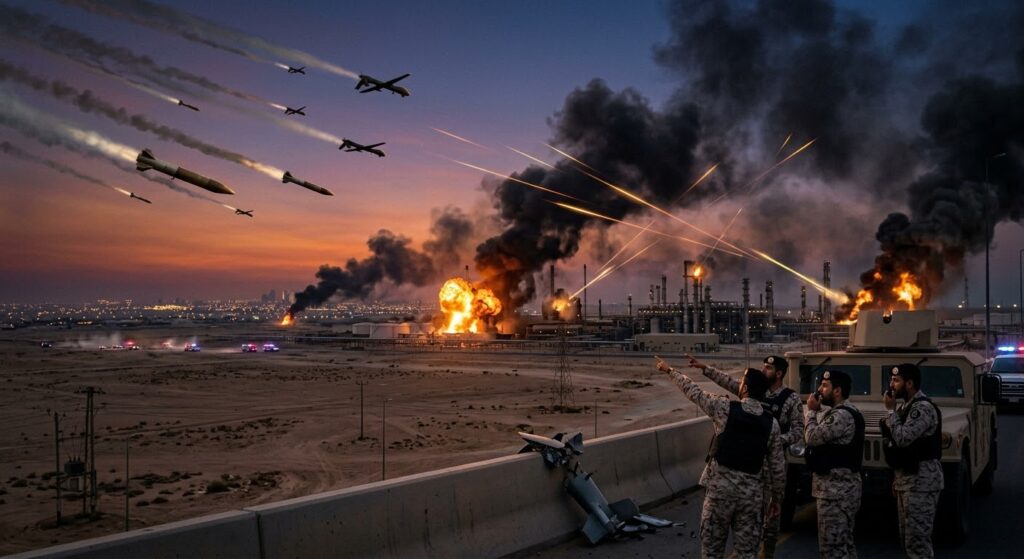
RIYADH/SANAA — Saudi Arabia is confronting its most severe cross-border security crisis in years as Houthi forces in Yemen have launched a sustained wave of ballistic missile, cruise missile, and drone attacks targeting the kingdom’s airports, energy infrastructure, and capital city. The escalation, which intensified dramatically in early October 2026, has killed at least three Saudi citizens, injured dozens more, disrupted civilian aviation across the country, and prompted the United Nations to warn of a return to “full-scale war” in Yemen.
A Relentless Barrage on Saudi Cities
The latest Houthi offensive has struck at the heart of Saudi Arabia’s civilian and economic infrastructure. On October 8, Saudi air defenses intercepted three ballistic missiles launched toward Riyadh and the southwestern city of Khamis Mushait. Despite successful interceptions, falling debris caused material damage to a kindergarten and a medical clinic complex in the capital, according to the Saudi Civil Defense Directorate .
The attacks followed a devastating strike on October 7 targeting King Khalid International Airport in Riyadh and Abha International Airport, which killed three people and injured 36 others. Saudi aviation authorities confirmed that all three fatalities were Saudi citizens, including a pilot, and that at least one aircraft was damaged . The Houthis claimed responsibility, stating they had targeted King Khalid Airport with two cruise missiles and Najran Airport and Khamis Mushait Air Base with ballistic missiles .
Flight tracking data revealed the scale of the disruption: at least 275 flights to and from King Khalid International Airport were cancelled on October 7 alone, representing 40 percent of arrivals and 30 percent of departures. International carriers including Lufthansa and Air India suspended operations to Riyadh, with Lufthansa halting flights until at least October 16 .
Targeting Energy Infrastructure and Holy Sites
The Houthi campaign has extended beyond airports to target Saudi Arabia’s critical energy infrastructure. On October 4, the group announced it had launched ballistic missiles and drones at two Saudi Aramco facilities, including the Khurais oil complex southeast of Riyadh. Houthi military spokesman Yahya Sarea claimed the attacks “hit their targets with precision” and sparked large fires . The group also claimed to have struck an Aramco refinery in Rabigh on the Red Sea coast .
In a particularly alarming escalation, Houthi forces have threatened Saudi oil facilities directly, warning all engineers, workers, and employees at Saudi oil installations to evacuate areas that constitute “targets” for their forces . The group has also renewed warnings to international airlines operating in Saudi airspace and at Saudi airports, urging them to suspend flights for their safety .
The attacks have even reached near Islam’s holiest sites. In September, Saudi air defenses intercepted a Houthi drone south of Mecca before it could enter the city’s restricted airspace. The Houthis have also been accused of targeting a power distribution station in Medina that serves the Prophet’s Mosque, causing a transformer to go out of service . The Houthis denied responsibility for the Medina attack, calling the allegations “lies” .
The Saudi-Led Coalition’s Massive Response
Saudi Arabia and its allies have responded with overwhelming force. On October 10, the Saudi-led coalition announced it had destroyed 136 military targets belonging to the Houthis in areas under their control, as part of a large-scale operation targeting the group’s personnel and capabilities. Coalition spokesman Maj. Gen. Turki Al-Malki stated that the coalition is working to “dismantle and destroy the Houthi ballistic missile network,” releasing video footage showing the destruction of ballistic missile storage facilities inside mountain tunnels in Sanaa .
The coalition is providing around-the-clock air support to Yemeni government forces on the ground. Houthi military spokesman Yahya Sarea claimed that Saudi warplanes conducted approximately 77 airstrikes on Houthi targets in Sanaa and other provinces on October 9 alone, bringing the total number of Saudi air and missile strikes since the current escalation began to over 1,500 .
The intensified coalition campaign coincides with a new ground offensive by Yemeni government forces. On October 5, Yemen’s Presidential Leadership Council announced the launch of “Operation Yemen Dawn,” a military campaign aimed at restoring state institutions, liberating Sanaa, and ending the Houthi rebellion. The coalition reported that 100 fighter jets participated in the operation’s initial phase, destroying 324 high-value Houthi targets .
A War Returning to Full Scale
The UN Special Envoy for Yemen has warned that the country has returned to “full-scale war,” with hostilities spreading across multiple front lines. Fighting has intensified particularly around the strategic Bab al-Mandab Strait, where the Houthis consolidated control over the western coast earlier this year, and in the southwestern province of Taiz .
The International Organization for Migration has documented massive displacement, with over 152,000 people displaced by the end of September as fighting intensified. The escalation has also triggered fears of a broader regional conflagration, as the Yemen conflict increasingly intersects with the ongoing war in Sudan, Houthi attacks on Red Sea shipping, and the broader Iran-Israel confrontation.
International Condemnation and Calls for Restraint
The attacks on Saudi civilian infrastructure have drawn widespread condemnation. The Independent Permanent Human Rights Commission of the Organisation of Islamic Cooperation condemned the Houthi attacks “in the strongest terms,” stating that the deliberate targeting of civilians, civilian airports, commercial aircraft, and other civilian objects constitutes “a flagrant violation of international human rights law and international humanitarian law.” The Commission called on the international community and the United Nations to “unequivocally condemn these attacks and act urgently to prevent their recurrence” .
UN Secretary-General’s spokesman Stéphane Dujarric reiterated that “attacks targeting civilians and civilian infrastructure are prohibited under international humanitarian law,” calling on all parties to “fully comply with their commitments and obligations under international humanitarian law, refrain from directing attacks against civilians and civilian infrastructure, and always take necessary measures to protect civilians and essential infrastructure” .
Qatar, Al-Azhar, Sudan, and Turkey have also issued statements condemning the attacks on facilities near holy sites and expressing solidarity with Saudi Arabia .
A Region on the Brink
The current escalation represents one of the sharpest spikes in hostilities since the Yemen conflict began in late 2014, when the Houthis seized Sanaa and much of northern Yemen, prompting a Saudi-led coalition to intervene in March 2015 in support of the internationally recognized government.
The Houthis’ demonstrated capability to strike deep into Saudi territory—targeting the capital, major airports, and critical energy infrastructure—presents a fundamental challenge to Saudi Arabia’s security architecture. The kingdom’s air defenses, while effective at intercepting many incoming threats, cannot prevent all debris from causing damage in populated areas, as the Riyadh kindergarten and clinic incident demonstrated.
With the Saudi-led coalition vowing to dismantle the Houthi missile network and the Houthis threatening further attacks on oil facilities and airports, the trajectory points toward further escalation rather than de-escalation. For the people of both Yemen and Saudi Arabia, the coming weeks may bring more death, more displacement, and more destruction—unless diplomatic efforts can somehow catch up with the pace of the missiles.