

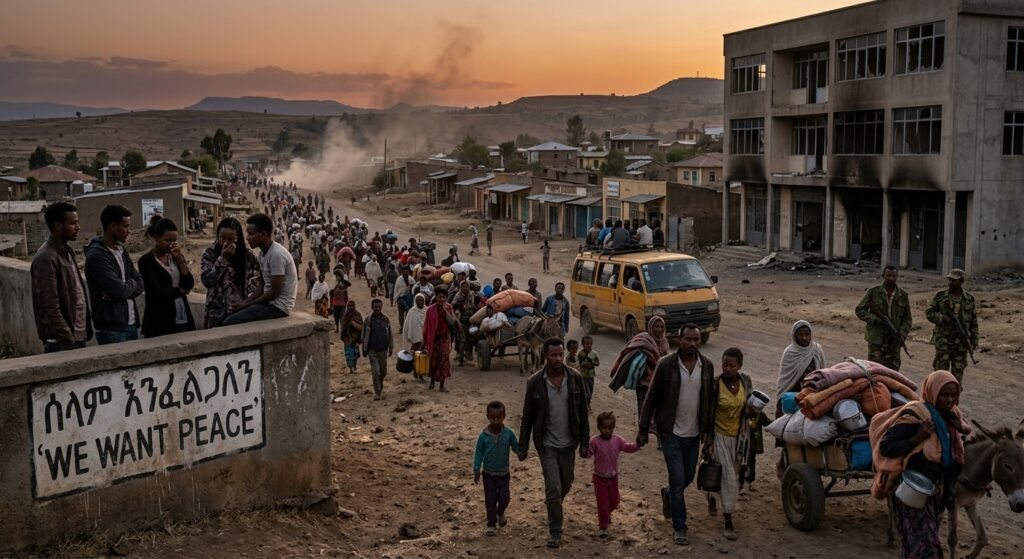
ADDIS ABABA/MEKELLE — Ethiopia stands at its most dangerous moment in four years. On September 21, 2026, large-scale fighting erupted between the Ethiopian National Defense Force (ENDF) and the Tigray People’s Liberation Front (TPLF), effectively shattering the Pretoria peace agreement that had ended the devastating 2020-2022 civil war. Within days, the conflict spread from Tigray into neighboring Afar and Amhara regions. By early October, federal forces had retaken the regional capital Mekelle after the TPLF withdrew. But the human cost—and the risk of regional conflagration—continues to mount.
The Collapse of Pretoria
The renewed hostilities mark the most serious challenge to Ethiopia’s stability since the November 2022 Cessation of Hostilities Agreement. On October 1, the UN Secretary-General’s spokesman warned that the fighting has made the Pretoria framework “effectively collapsed”. UN Secretary-General António Guterres issued an urgent call for all parties to “cease hostilities immediately” and return to dialogue.
The military dynamics have been fluid and violent. The TPLF initially seized the Mekelle airport and regional capital, but by October 4, government-allied Tigray Peace Force fighters entered Mekelle, and the TPLF announced its withdrawal—apparently to spare the city from destruction, mirroring its 2021 retreat. Federal police fanned out across the city on October 9, calling on residents to help establish a new administration.
Yet the conflict has already metastasized beyond Tigray. Fighting has been reported in southern Tigray, Northern Amhara, and Western Afar regions. In the Menz area of Shewa, residents told DW that a ninth-grade student and a deacon were among civilians killed in clashes between federal forces and Fano militia. The Amhara Fano militia and the Oromo Liberation Army have allied with the TPLF in a broader opposition coalition seeking to topple Prime Minister Abiy Ahmed’s government.
A Diplomatic Crisis with Eritrea
The military escalation has triggered a dramatic diplomatic rupture between Ethiopia and Eritrea—former allies who fought together against the TPLF during the last war. On October 1, Ethiopia announced the closure of its embassy in Asmara and declared ten Eritrean diplomats persona non grata, accusing them of “direct and indirect acts of hostility and belligerence”.
Eritrea responded in kind. In a press release from the Ministry of Foreign Affairs in Asmara, the government announced the complete severance of diplomatic ties, accusing Ethiopia of “pursuing an agenda of incessant hostility” aimed at invading “sovereign Eritrean ports and coastal areas” to secure sea access. Ethiopia’s Foreign Minister Gedion Timothewos has since accused Eritrea of military aggression and demanded the “immediate withdrawal of Eritrean forces from Ethiopian territory”.
Reports of Eritrean troops crossing into Ethiopia have raised fears of a wider war. A Tigray Peace Force commander and the Armed Conflict Location & Event Data monitoring group separately reported Eritrean personnel entering Adigrat and Idaga Hamus. Eritrea’s Information Minister declined to explicitly confirm or deny the crossings.
Egypt and the Regional Dimension
The diplomatic crisis has also drawn in Egypt. On October 1, Ethiopia declared a member of the Egyptian embassy persona non grata, prompting Cairo to expel an Ethiopian diplomat in a reciprocal move. Ethiopia has accused Egypt and Eritrea of supporting the TPLF-led opposition alliance—allegations both countries deny.
The African Union called on Ethiopia, Eritrea, and Egypt to exercise “maximum restraint”, but the statement itself became a point of contention. Egypt objected to being mentioned in the AU statement, describing it as an “incomprehensible attempt” to drag Cairo into an internal Ethiopian matter. The AU Commission subsequently clarified that its statement was not intended to assign blame to any neighboring state.
For the wider Horn of Africa, the risk of regionalization is acute. The conflict intersects with the ongoing war in Sudan, Houthi attacks in the Red Sea, and the long-standing Nile dam dispute between Ethiopia and Egypt. The UN Secretary-General specifically warned against “the risks of escalation that further undermines the stability of the region”.
Humanitarian Operations Near Standstill
Inside Ethiopia, the humanitarian consequences are already severe. The UN Office for the Coordination of Humanitarian Affairs reported on October 1 that “humanitarian operations are nearing a standstill” in Tigray because of continued insecurity and severe access restrictions. Escalating drone activity and airstrikes across northern Ethiopia are putting civilians, critical infrastructure, and humanitarian operations at growing risk.
Communication services have been disrupted across Tigray, Afar, and Amhara regions. Amnesty International warned that “the disruption of communication services combined with increasing restrictions on civic space raises serious concerns that grave human rights violations could occur under the cover of darkness, hidden from independent monitoring”. The African Commission on Human and Peoples’ Rights echoed this concern, calling for the protection of access to information and communications during the conflict.
Human Rights Watch and other civil society organizations have urged the UN Human Rights Council to convene a special session on Ethiopia, warning of “risks of repetition of the atrocity crimes documented during the 2020-2022 conflict”. That war left hundreds of thousands dead, millions displaced, and thousands of women and girls subjected to conflict-related sexual violence. No meaningful accountability has been achieved.
Economic Ambitions Amid Turmoil
Paradoxically, even as war rages in the north, Ethiopia’s government is projecting robust economic growth. On October 6, President Taye Atske Selassie announced a 10.1 percent growth target for the 2026/2027 fiscal year, building on 10.2 percent growth last year. Export revenues reached a record $11.2 billion, and foreign direct investment inflows rose to $4.5 billion.
The economic picture is more nuanced than the headline figures suggest. UNDP’s quarterly profile notes that the Iran crisis and Middle East tensions pushed oil prices from $62 a barrel in 2025 to $115 in May 2026, contributing to inflation rising to 11.7 percent in April. The government has responded with fuel rationing, spot market purchases, and resource mobilization from international financial institutions.
The IMF still projects Ethiopia’s growth to cross 9 percent in 2026, making it one of sub-Saharan Africa’s fastest-growing economies. Reserves have reached above $5 billion, covering more than three months of imports. But poverty remains a deep concern: the World Bank has forecast poverty rising to 43 percent by 2025, and the UNDP Human Development Index has not improved in recent years.
A Nation at the Precipice
Ethiopia today is a study in contradictions. Its economy is growing faster than almost any in Africa. Its government projects confidence and ambitious development goals. And yet, in the north, a war has resumed that threatens to undo four years of fragile peace and draw the entire Horn of Africa into a broader conflict.
The Pretoria Agreement’s collapse has exposed how little reconciliation actually occurred. The grievances that fueled the 2020-2022 war—disputes over federal power, regional autonomy, and access to resources—remain unresolved. The new opposition alliance has made regime change its explicit goal. And with Eritrea and Egypt drawn into the diplomatic fray, the conflict now carries the risk of interstate war.
UN Secretary-General Guterres has warned against “the presence of Eritrean forces in Ethiopia” and reminded all states of their obligation under the UN Charter to refrain from the threat or use of force against the territorial integrity of any state. The African Commission on Human and Peoples’ Rights has called on all parties to “immediately exercise utmost restraint and cease all acts of violence”.
But appeals alone have not stopped the fighting. For the millions of Ethiopians in the north who lived through the last war, the fear is visceral. They know what comes next if the guns are not silenced. The question is whether Ethiopia’s leaders—and those who support them—will listen before it is too late.