

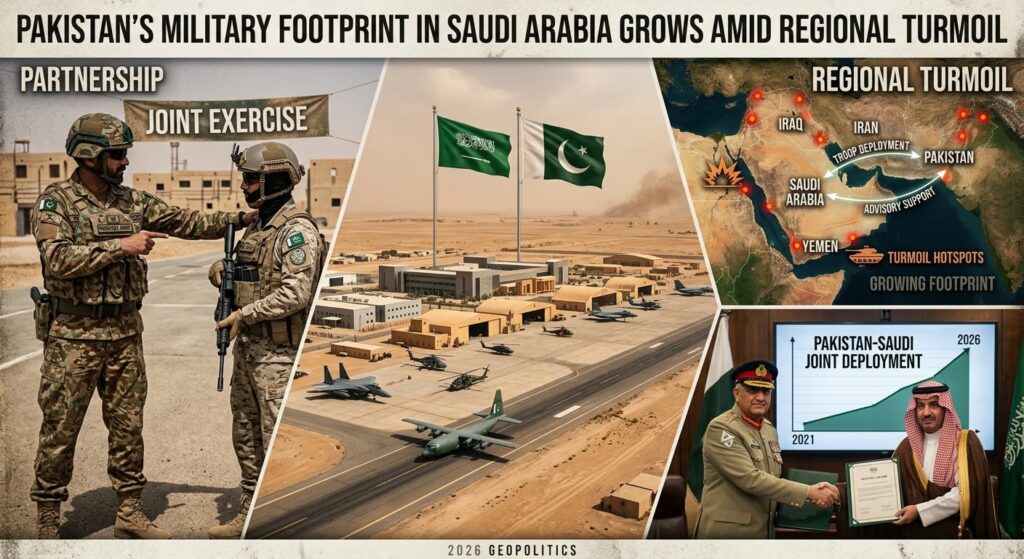
ISLAMABAD/RIYADH — Pakistan’s military presence in Saudi Arabia has expanded dramatically in 2026, evolving from a longstanding advisory mission into a substantial combat-capable deployment that underscores the deepening strategic alliance between Islamabad and Riyadh. With thousands of troops, advanced fighter jets, and Chinese-made air defence systems now stationed in the kingdom, Pakistan has become a central pillar of Saudi Arabia’s defensive architecture at a moment of heightened regional insecurity.
The full scale of the deployment was first revealed by Reuters in May, which reported that Pakistan had sent approximately 8,000 troops, a squadron of around 16 JF-17 fighter jets, two squadrons of drones, and a Chinese HQ-9 air defence system to Saudi Arabia. All equipment is operated by Pakistani personnel, with Saudi Arabia financing the deployment . According to security officials and government sources cited by Reuters, the force is “substantial” and “combat-capable,” intended to support Saudi Arabia’s military if the kingdom comes under further attack .
The deployment occurred in early April, during the height of the Iran war, after Iranian strikes hit key Saudi energy infrastructure and killed a Saudi national. Pakistan’s decision to send jets at that juncture signalled a willingness to defend its Gulf ally even as Islamabad simultaneously served as the principal mediator between Washington and Tehran . One government source, who has seen the confidential defence pact between the two countries, said the agreement provides for the possibility of up to 80,000 Pakistani troops being deployed to Saudi Arabia to help secure the kingdom’s borders .
More recent reports suggest the deployment has grown considerably larger. According to a Pakistani official cited by Reuters in early October, between 30,000 and 40,000 Pakistani military personnel are now stationed in Saudi Arabia. The troops arrived in several phases, beginning last year, with additional forces dispatched following recent escalations. Their stated mission is to defend Saudi Arabia’s land borders and assist in intercepting missiles and drones . A Pakistani official emphasized that Islamabad has not yet decided to deploy troops to Yemen for combat roles, drawing a clear distinction between defensive operations in Saudi Arabia and engagement in the Yemen conflict .
The Makkah Joint Defence Agreement
The legal foundation for Pakistan’s military presence is the Makkah Joint Defence Agreement, signed on 7 August 2026 by Saudi Crown Prince Mohammed bin Salman, Turkish President Recep Tayyip Erdogan, and Pakistani Prime Minister Shehbaz Sharif. The agreement stipulates that an armed attack against any one of the three countries will be considered an attack against all . Saudi Deputy Minister for Public Diplomacy Rayed Krimly stated that the agreement “does not represent an effort to establish a military axis or a sectarian bloc. Nor is it linked to any nuclear ambitions or arms race, rather it is focused on building sustainable capabilities” .
The trilateral pact brings together three potent middle powers: Pakistan, a nuclear-armed state with extensive military experience; Saudi Arabia, an energy giant with substantial financial resources; and Türkiye, NATO’s second-largest military and a rapidly developing defence-industrial powerhouse . Analysts note that the agreement reflects the growing strategic agency of regional powers amid shifting geopolitical dynamics in the Middle East .
Pakistan’s Parliament was informed that the agreement marks “the beginning of a new era of unity, trust and collective security” among the three countries. Parliamentary Secretary for Information and Broadcasting Barrister Danyal Chaudhry stated that Saudi Arabia’s economic strength, Türkiye’s defence technology, and Pakistan’s experienced armed forces would collectively provide a strong foundation for regional peace and security .
Driving Factors: Houthi Threats and Regional Instability
The immediate catalyst for Pakistan’s expanded deployment is the deteriorating security situation in Yemen and the Houthi threat to Saudi territory. Since mid-2026, the Houthis have significantly intensified attacks on Saudi Arabia. In September, the group launched ballistic missiles and drones targeting Riyadh for the first time, as well as an Aramco facility in Yanbu. Saudi air defences intercepted the attacks, but the strikes marked a major escalation .
On 3 October, the Houthis claimed another attack on an Aramco facility near Riyadh, with fires visible at the site. The group said the strikes were in retaliation for dozens of Saudi airstrikes on Sanaa . Earlier in September, Houthi attacks on civilian and economic sites in Abha, Khamis Mushait, Jazan, and Najran injured 73 people and caused fires at energy facilities .
The Houthis have also targeted the holy cities of Mecca and Medina. Saudi Arabia reported three Houthi attempts to target the Two Holy Mosques over nine years, including two incidents in September 2026 alone. On 16 September, Saudi air defences intercepted a Houthi drone south of Mecca before it entered the city’s restricted airspace. The Saudi-led coalition described the attacks as “an extension of this extremist militia’s approach in attempts to target the Two Holy Mosques” .
In this context, Pakistan’s military capabilities—particularly its air defence systems and fighter aircraft—are viewed as critical to bolstering Saudi Arabia’s ability to protect its territory and critical infrastructure. The HQ-9 air defence system, operated by Pakistani personnel, represents a significant enhancement to Saudi air defence capabilities, particularly given the kingdom’s concerns about Iranian and Houthi missile threats .
Pakistan’s Dual Role: Defender and Mediator
Pakistan’s position in the current regional conflict is uniquely complex. Even as it deployed combat-capable forces to Saudi Arabia, Islamabad simultaneously served as the principal mediator between the United States and Iran. Pakistan hosted the only round of US-Iranian peace talks and helped broker a ceasefire that held for six weeks . This dual role—defender of Saudi Arabia and mediator between Washington and Tehran—reflects Pakistan’s effort to maximize its strategic value while managing its relationships with competing regional powers.
Defence analysts in Pakistan have framed the Makkah agreement as a recognition of Pakistan’s military and diplomatic strength. Brigadier (Retd) Syed Ghazanfar Ali noted that “the world pays heed to only those countries which have military power,” pointing to Pakistan’s display of military capability during Operation Bunyan Un Marsoos against India and its successful mediation between the US and Iran . Former diplomat Amb. Waheed Ahmad described the pact as “a win-win situation for all three countries” and predicted that other nations might seek to join .
Strategic Implications and Uncertainties
The long-term implications of Pakistan’s military expansion in Saudi Arabia remain uncertain. While the Makkah agreement carries symbolic weight—signed in Islam’s holiest city and bringing together three significant regional powers—analysts caution that previous regional defence pacts have often failed to deliver on their promises. The International Institute for Strategic Studies noted that despite their newly minted defence agreement, Pakistan did not come to Saudi Arabia’s aid during the first phase of the 2026 Iran war, deploying troops only after a ceasefire was agreed .
The question of whether Pakistan would extend nuclear deterrence to its allies also remains unresolved. Pakistan’s Defence Minister Khawaja Asif initially suggested that Pakistan’s nuclear capabilities “will absolutely be available under this pact,” only to backtrack days later by stating that nuclear weapons were “not on the radar” . This ambiguity may serve Pakistan’s strategic interests by injecting uncertainty into the regional security calculus.
What is clear is that Pakistan’s military footprint in Saudi Arabia has become a defining feature of the region’s security landscape in 2026. With tens of thousands of troops, advanced fighter jets, and sophisticated air defence systems now stationed in the kingdom, Islamabad has signalled that its alliance with Riyadh is not merely symbolic but operational. As Houthi attacks continue and regional tensions persist, Pakistan’s role as a security guarantor for Saudi Arabia appears set to deepen further—carrying both the benefits of enhanced strategic partnership and the risks of entanglement in a volatile and unpredictable conflict.