

Introduction
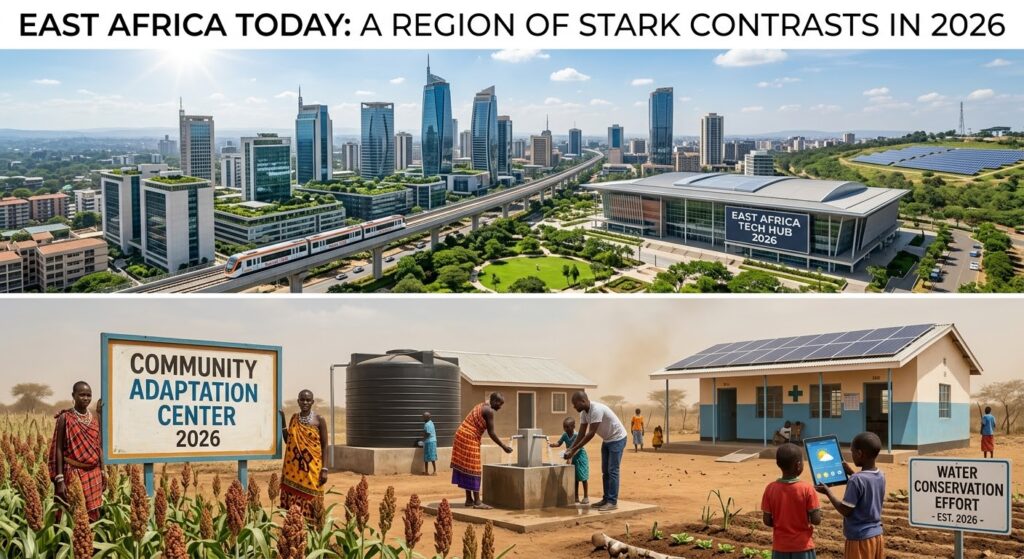
East Africa in 2026 presents a paradox. It is simultaneously the fastest-growing economic region on the African continent and the site of one of the world’s most severe humanitarian crises. While regional GDP is projected to expand by nearly six per cent, more than 40 million people across six countries are facing high levels of acute food insecurity, and millions are displaced by conflict and climate shocks. This duality—between economic dynamism and human suffering—defines the region’s current moment. From the bustling One Stop Border Posts at Sirari and Busia to the drought-stricken pastoral lands of Somalia and northern Kenya, East Africa is a region navigating extraordinary opportunities alongside profound vulnerabilities.
Economic Growth Amid Fiscal Strain
The African Development Bank’s 2026 East Africa Economic Outlook confirms that the region remains the continent’s fastest-growing economic bloc for the second consecutive year. Regional growth accelerated from 4.3 per cent in 2024 to an estimated 6.6 per cent in 2025, with projections moderating to 5.9 per cent in 2026. The United Nations Economic Commission for Africa (ECA) similarly projects Eastern Africa’s growth at around 5.8 per cent in 2026, compared to 4.0 per cent for Africa as a whole and just 1.6 per cent for developed economies globally.
This growth is driven by resilient private consumption, increased public and private investment, stronger agricultural production, and a continuously expanding services sector. Rwanda recorded 10 per cent GDP growth in the first quarter of 2026, while Tanzania grew by 5.7 per cent, Kenya by 5.3 per cent, and Uganda by 5.8 per cent.
However, beneath these headline figures lies a more troubling reality. The region faces an annual development financing gap of $119 billion. Policymakers are grappling with severely constrained budgets, elevated debt burdens, and a highly uncertain international environment. As Andrew Mold, Director of the ECA Office for Eastern Africa, warned, “Eastern Africa remains one of the world’s fastest-growing regions, but sustaining that momentum requires navigating increasingly tight fiscal conditions”.
Inflation has moderated significantly across much of the region, with rates stabilizing in the single digits in Kenya (4.7 per cent), Tanzania (4.2 per cent), and Uganda (3.2 per cent). Yet the region remains vulnerable to external shocks. Disruptions affecting the Strait of Hormuz and instability along the Red Sea and Bab el-Mandeb corridor threaten maritime routes that East Africa depends on for fuel, food imports, and humanitarian logistics.
A Deepening Hunger Crisis
The most alarming dimension of East Africa’s current situation is the scale of food insecurity. According to the 2026 Global Report on Food Crises, more than 40.3 million people across six IGAD member states—Djibouti, Kenya, Somalia, South Sudan, Sudan, and Uganda—are facing high levels of acute food insecurity. This means that more than one in three people in the analysed population require urgent food and livelihood assistance.
The crisis is not uniform. South Sudan has the region’s highest prevalence of acute food insecurity, with 55 per cent of its population in IPC Phase 3 (Crisis) or above between April and July 2026. Sudan remains the region’s largest food crisis, with 19.5 million people facing high levels of acute food insecurity and famine projected in 14 areas across North Darfur, South Darfur, and South Kordofan. In Somalia, nearly 6.5 million people—one in three—faced crisis-level hunger between February and March 2026, an increase of 1.9 million from the previous year’s peak.
The drivers are multiple and overlapping. Conflict and insecurity continue to disrupt livelihoods and food production, particularly in Sudan and South Sudan. Poor rainfall and weather extremes have devastated agricultural production across the region. In Kenya’s arid and semi-arid lands, 4.1 million people faced high levels of acute food insecurity, driven primarily by one of the driest October–December seasons on record.
The human cost is measured in the lives of the most vulnerable. More than nine million children aged between six and 59 months require treatment for acute malnutrition across the six countries, with about 2.3 million suffering from severe acute malnutrition—a condition that can be fatal without immediate intervention.
Climate Migration: A Lived Reality
The drought that has gripped East Africa since around 2020, exacerbated by climate change, has become a powerful driver of migration and displacement. A 2023 appeal by the World Health Organization noted that 13.5 million people were internally displaced in the Greater Horn of Africa, while 4.5 million were refugees abroad.
At a recent conference in Jigjiga, Ethiopia, researchers and policymakers acknowledged that “climate-induced migration is no longer a distant concern; it is a lived reality for millions of families in pastoral, agro-pastoral, rural and urban settings”. The conference, attended by representatives from Ethiopia, Somalia, Djibouti, Kenya, South Sudan, Rwanda, and Burundi, emphasized that addressing climate migration requires transnational cooperation and locally grounded solutions.
The complexity of climate impacts is striking. Droughts, severe floods, and environmental degradation all drive displacement, often in ways that are intertwined with political and social pressures. Climate stress, conflict, and governance gaps interact to create “cascading” risks that affect food security, health, and political stability.
For those already displaced, the situation is particularly precarious. A rapid needs assessment by the Danish Refugee Council in Beledweyne and Baidoa, Somalia, found that 74 per cent of surveyed internally displaced people were living in shelters made from sticks, plastic sheeting, and corrugated iron, and that 92 per cent were already struggling to access enough food before seasonal rains had even begun.
Regional Integration: Progress and Persistent Barriers
Against this backdrop of humanitarian crisis, the East African Community (EAC) continues to advance its integration agenda. In July 2026, EAC Secretary General Amb. Stephen P. Mbundi conducted a high-level mission to the Sirari-Isebania (Tanzania-Kenya) and Busia (Kenya-Uganda) One Stop Border Posts, assessing progress in trade facilitation.
The mission confirmed that flagship initiatives—including the One Stop Border Post concept, Coordinated Border Management, and the EAC Customs Bond—are delivering tangible results. “Border clearance has become faster, cooperation among border agencies has improved, cargo movements have become more predictable and businesses are benefiting from lower transaction costs,” Mbundi stated.
The EAC’s budget for the 2026/2027 financial year amounts to $110.9 million, with the largest allocation of $70.5 million earmarked for institutional capacity and coordination. A key priority is the Eastern Africa Regional Digital Integration Project (EARDIP), which aims to create a Single Digital Market by expanding affordable broadband connectivity, strengthening regional digital infrastructure, and promoting interoperable digital payment platforms.
However, significant challenges remain. Stakeholders at the border posts raised concerns about inadequate infrastructure, congestion, inconsistent implementation of 24-hour operations, overlapping regulatory procedures, and slow integration of digital systems. Cross-border traders, particularly women and youth, called for greater awareness of the Simplified Trade Regime and stronger support to transition small businesses into formal regional trade.
The EAC has set an ambitious target of increasing intra-EAC trade to 50 per cent by 2030. Achieving this will require not only infrastructure improvements but also the elimination of non-tariff barriers and harmonization of domestic regulatory measures.
A Region at a Crossroads
East Africa today stands at a crossroads. The region’s economic trajectory is genuinely impressive—it is outpacing the rest of Africa and much of the world. Regional integration is deepening, digital infrastructure is expanding, and trade facilitation is improving. Yet these gains coexist with a humanitarian crisis of staggering proportions. The 40.3 million people facing acute food insecurity are not abstract statistics; they are families in Somalia who have watched their livestock die, farmers in Kenya whose crops have failed, and refugees in Uganda whose rations have been cut due to funding shortfalls.
The region’s leaders face an urgent choice. They can continue to pursue growth while allowing millions to slide deeper into hunger and displacement, or they can recognize that sustainable prosperity requires addressing the root causes of vulnerability—conflict, climate shocks, and inadequate social protection. As IGAD Executive Secretary Dr. Workneh Gebeyehu observed, “Hunger crosses borders with people, livestock, pests, and prices, and our answers must do the same”.
The coming months will test whether East Africa can translate its economic momentum into tangible improvements in people’s lives. The region’s future depends on it.