

Introduction
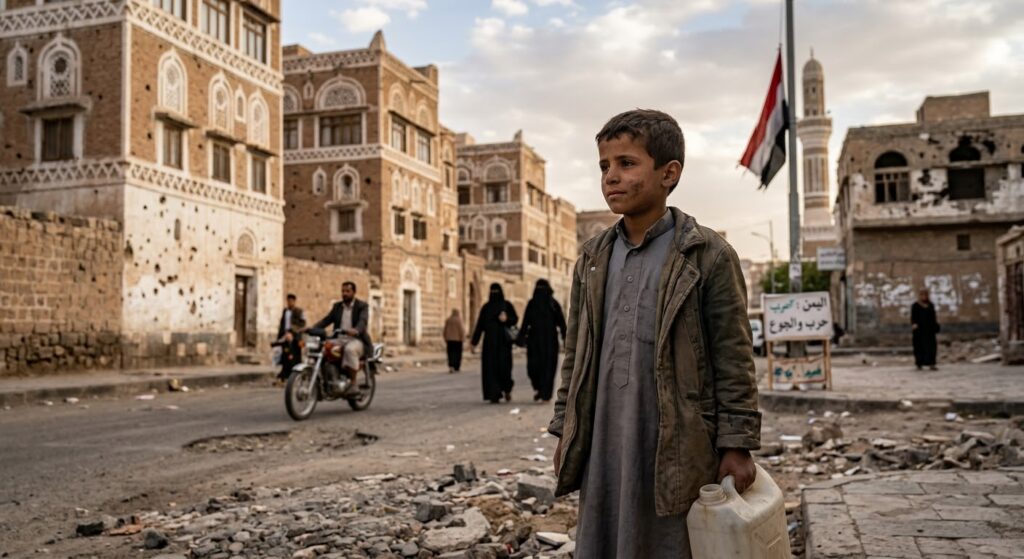
More than a decade after the Houthi movement seized the capital Sanaa in 2014, Yemen remains trapped in a protracted crisis that has shattered its economy, destroyed its infrastructure, and left millions of people dependent on humanitarian aid for survival. In 2026, the country faces a convergence of threats: renewed conflict, mass displacement, a collapsing health system, and a funding shortfall that is forcing aid agencies to make impossible choices. The war in Yemen is no longer merely a domestic conflict—it has become entangled in wider regional hostilities, with the Bab el-Mandeb Strait transformed into a flashpoint that threatens global trade. For the Yemeni people, however, the most pressing reality is simpler and more brutal: hunger, disease, and displacement on a scale that the world has grown dangerously accustomed to ignoring.
A Humanitarian Crisis at Breaking Point
Yemen enters 2026 with more than 22 million people—roughly half the population—requiring humanitarian assistance and protection services. This represents an increase of 2.8 million people compared to the previous year. Among them are 5.2 million internally displaced people, 329,000 migrants, and 63,000 refugees and asylum seekers.
Acute food insecurity remains one of the most alarming dimensions of the crisis. According to the latest Integrated Food Security Phase Classification analysis, 18.3 million people are acutely food insecure, with some districts shifting from crisis to emergency levels and pockets of catastrophic conditions affecting the most fragile communities. In government-controlled areas alone, nearly 5 million people—one in two residents—experienced high levels of acute food insecurity between March and May 2026, and this figure is projected to rise to 5.4 million in the following months.
Malnutrition levels are equally devastating. Over 2.2 million children under five are acutely malnourished, including 516,157 suffering from severe acute malnutrition—a condition that can be fatal without immediate treatment. An additional 1.3 million pregnant and breastfeeding women are expected to be malnourished in 2026. Nearly one in two children in Yemen is stunted, and wasting rates remain among the worst in the world.
The health system, already shattered by years of conflict, is collapsing under the combined weight of funding shortfalls and escalating violence. Only 59.3 per cent of health facilities are fully functional, and complete vaccination coverage stands at just 63 per cent. Yemen recorded more than 18,600 measles cases and 188 deaths between January and September 2025—among the world’s highest—and registered the third-highest cholera caseload globally, with 350,000 suspected cases and 1,100 associated deaths. The World Health Organization has warned that two out of every five health facilities are either not functioning or only partially functioning, leaving millions at risk of losing access to essential care.
Displacement: A Crisis Within a Crisis
The escalating conflict along Yemen’s western coast has triggered fresh waves of displacement that are outstripping aid agencies’ ability to respond. By mid-September 2026, the International Organization for Migration recorded more than 104,000 people displaced across 17,461 households, with Taiz remaining the epicentre. Over 63,000 people were displaced across Taiz’s districts, while Lahj recorded nearly 26,400 displaced, and Aden over 3,500.
Aid workers describe families moving under fire, often at night, carrying little more than what they can hold. The pace of displacement has forced humanitarian agencies to acknowledge that their tracking systems cannot keep up with the reality on the ground. As IOM Director General Amy Pope stated, “Yemen is a country torn by war, displacement, poverty, and climate impacts. Overlooking the suffering of civilians is not acceptable as needs continue to rise”.
The displacement crisis has also spilled across Yemen’s borders. More than 2,700 people have crossed the Bab el-Mandeb Strait to Djibouti, with more than 60 per cent being women, children, and older people. UNHCR’s representative in Djibouti warned that the response is already under pressure and that more support is urgently needed before needs outpace capacity.
Economic Collapse and the Struggle for Survival
Yemen’s economy remains in freefall. According to the World Bank’s latest Yemen Economic Monitor, national real GDP declined by 1.5 per cent in 2025 and is projected to contract by a further 0.5 per cent in 2026. Oil exports remain blocked, fiscal revenues have fallen to just 5.6 per cent of GDP, and nearly three-quarters of the population is estimated to live below the poverty line.
The humanitarian funding situation has compounded the economic crisis. Funding for the UN Response Plan covered only 28 per cent of needs in 2025—down from 56.5 per cent in 2024—forcing aid agencies to scale back critical life-saving programmes. The resulting reduction in expenditure has affected salary payments, subsidies, and essential spending, underscoring the country’s severely limited fiscal space.
While the Yemeni rial in Aden has stabilized following Central Bank measures and Saudi financial support, the situation remains fragile as remittances, exports, and aid—the country’s main income sources—remain weak. The World Bank has warned that Yemen is highly exposed to rising global prices, supply disruptions, and increased shipping costs, all of which are expected to increase inflation and further erode household purchasing power.
The Regional Dimension: Yemen as a Battleground
The conflict in Yemen has become increasingly entangled in broader regional hostilities. The Houthis’ maritime embargo against Saudi Arabia, declared in July 2026, has disrupted shipping through the Bab el-Mandeb Strait, a critical corridor linking the Red Sea with the Gulf of Aden. Shipping traffic through the strait has fallen by more than 50 per cent since earlier Houthi attacks, with an average of 32 ships per day passing through in August 2026, down from 50 before the blockade.
The human cost of this maritime dimension was made brutally clear on August 10, 2026, when a suspected Houthi attack on the Egyptian-owned cargo ship Tihamah killed four crew members and injured several others. The vessel was carrying food supplies when it was struck by projectiles while at anchor north-east of Perim Island. The International Maritime Organization’s head, Arsenio Dominguez, expressed his condolences, stating that “it is particularly troublesome that the most recent attack has taken place in the Red Sea and Gulf of Aden area,” and warning that continuing attacks “only serve to escalate tensions and threaten global supply chains on which everyone depends”.
The disruption to shipping has had far-reaching consequences. The Strait of Hormuz, another critical waterway, has seen near-total shipping freezes, with only around seven ships passing through on a recent day—almost 20 times lower than the pre-war daily average. The IMO has reported that 65 confirmed incidents have occurred in the region since early March, with 17 seafarers killed. Some 6,000 crew members and 500 vessels remain trapped in or near the Strait of Hormuz, with evacuations on hold.
Diplomatic Efforts and Obstacles
Against this backdrop of escalating humanitarian and military crises, diplomatic efforts have continued but struggled to achieve a breakthrough. UN Special Envoy Hans Grundberg has engaged in shuttle diplomacy across the region, meeting with Houthi negotiators in Muscat, Yemeni government officials in Riyadh, and representatives of the five permanent members of the Security Council. The discussions have focused on the need for immediate de-escalation and establishing an agreed way forward to preserve the relative calm Yemen has experienced since the 2022 truce agreement.
However, these diplomatic efforts have been overshadowed by the military escalation and by the de facto authorities’ continued obstruction of humanitarian operations. As of February 2026, 73 UN staff remained arbitrarily detained by the Houthi de facto authorities, along with dozens of others from NGOs and civil society. The de facto authorities have repeatedly entered UN offices in Sanaa without permission, commandeering equipment and vehicles, and have withheld clearances for UN Humanitarian Air Service flights to Marib.
The humanitarian community has also had to contend with a severe funding crisis. The 2026 Yemen Humanitarian Needs and Response Plan requests US$2.16 billion to reach 12 million people, including 9.4 million prioritized for targeted assistance based on severity. As of early 2026, the appeal remained severely underfunded, forcing agencies to make impossible choices about which life-saving programmes to cut.
Conclusion: A Nation at the Crossroads
Yemen today stands at a critical juncture. The Houthis’ military successes have strengthened their position, but they have also deepened the country’s isolation and intensified the humanitarian crisis. The internationally recognized government, backed by Saudi Arabia, is struggling to mount an effective response, while its authority is further undermined by internal divisions and a lack of resources.
For the 22 million Yemenis who depend on humanitarian assistance for survival, the international community’s response remains inadequate. As OCHA has warned, “humanitarian action alone cannot reverse the drivers of Yemen’s crisis”. Without sustained support and a genuine political solution, millions of people will remain at risk of deepening hunger, preventable illnesses, and protection threats.
The coming months will determine whether Yemen moves toward de-escalation and a negotiated settlement or descends further into a protracted conflict that threatens not only its own people but regional stability and global commerce. What is certain is that the status quo is untenable: a nation cannot endure indefinitely on the knife’s edge between war, famine, and geopolitical ambition. The world must not look away.