

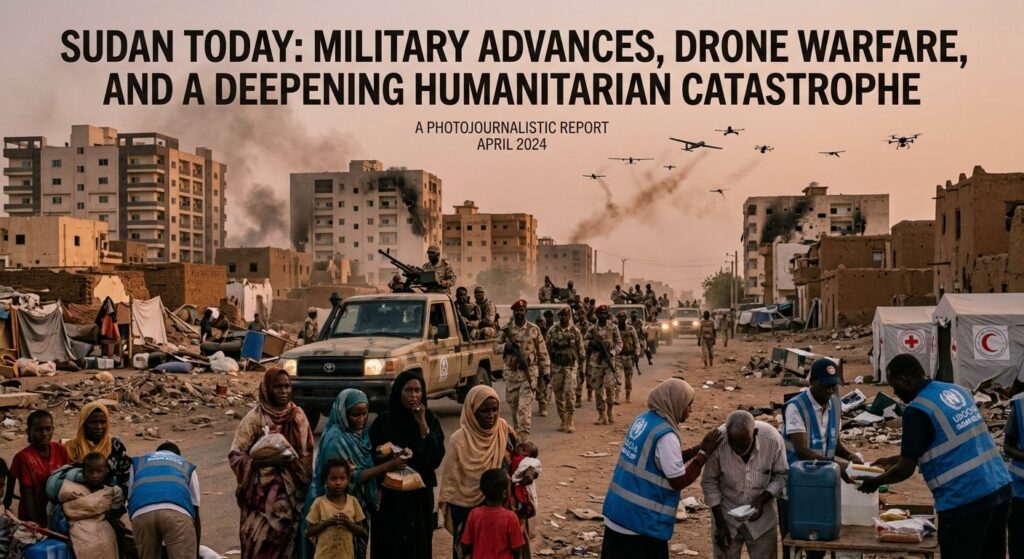
On September 25, 2026, the Sudanese army announced it had seized control of Sodiri, a strategic city in North Kordofan state, following fierce clashes with the Rapid Support Forces (RSF). The army claimed it inflicted “heavy losses in personnel and equipment on the terrorist militia,” a term it routinely uses to describe the paramilitary group. The capture marked the latest in a series of territorial gains by the army across North Kordofan since late July, including the recapture of Bara and key positions around Jabra al-Sheikh and Umm Sayala.
Yet even as the army advances on the ground, the nature of this war has fundamentally changed. Sudan’s conflict is now being fought as much from the air—by drones striking far behind front lines—as it is by soldiers on the ground. And the human cost of this evolution is measured not only in battlefield casualties but in destroyed hospitals, shuttered markets, and a population pushed to the brink of famine.
The Drone War
The United Nations fact-finding mission on Sudan released a report in early September documenting a stark transformation in the conflict’s character. Foreign weapons, military technology, and logistical networks are sustaining the war and expanding both parties’ ability to strike distant civilian areas with drones. The mission found that more than 1,000 people were killed in drone strikes in the first five months of 2026 alone, accusing both sides of conduct amounting to war crimes.
The report identified a network involving individuals and entities in the United Arab Emirates, Chad, Libya, and Somalia that supplied the RSF with weapons, equipment, logistics, training, and foreign personnel. It stated that up to 2,000 Colombian contractors had helped operate and maintain drone systems for the RSF, with some present during operations around El Fasher in Darfur. The UAE has consistently denied military backing for the RSF.
The scale of drone attacks has been devastating. Between May and July 2026, repeated RSF drone strikes damaged electricity and fuel facilities in El Obeid, the North Kordofan capital, disrupting water supplies, healthcare, and transport in a city already under partial siege. On September 19, RSF drone attacks on residential areas in El Obeid killed two people and injured twenty. On September 27, Sudanese authorities accused the RSF of targeting civilian facilities including a sports city and a university college in El Obeid, though no casualties were reported.
The Committee for Justice, a Sudanese human rights organization, documented that by early August, at least 141 drone attacks had been recorded in North Kordofan during 2026, most affecting El Obeid and the main road to the city. At least 12 health facilities and a commercial market were destroyed or forced to close.
Attacks on Health and Justice
The targeting of civilian infrastructure has extended to hospitals, courts, and schools. The Sudan Doctors Network accused the RSF of looting Sodiri Rural Hospital after the army recaptured the town, destroying medical equipment and leaving the facility in ruins. The hospital had served more than 50,000 families before the war.
On September 8, a drone strike on Um Rawaba Court in North Kordofan killed 10 people and injured dozens more, an attack attributed to the RSF. The Committee for Justice condemned the targeting of a judicial facility, noting it endangered judges, court staff, and litigants. In a separate incident, the UN children’s agency UNICEF reported that two warehouses in North Kordofan’s Shikan region were struck in drone attacks, destroying learning materials intended for distribution at the start of the school year.
The Humanitarian Abyss
Behind these military developments lies what UN officials describe as the world’s worst humanitarian crisis. Approximately 20 million people in Sudan suffer from acute food insecurity, and 14 million have been displaced—more than the entire population of several European countries.
Carl Skau, acting executive director of the World Food Programme, described conditions after an eight-day visit to Sudan. About five million people are facing emergency food insecurity at IPC Phase 4, while nearly 200,000 are at Phase 5—famine conditions. The journey between El Obeid and El Fasher, which took roughly six hours before the conflict, now requires up to three days.
El Fasher, once home to nearly a million people, endured an 18-month siege marked by famine and grave humanitarian violations before falling to the RSF in October 2025. The WFP now reaches approximately 950,000 people there monthly, but Skau acknowledged the assistance remains insufficient. Families receive only half-rations, barely covering two weeks of needs. Many households are headed by women who have lost their husbands or sons.
A drought unprecedented since 1984 is compounding the crisis in Darfur, raising fears about agriculture and livestock as the rainy season unfolds. In Tawila, North Darfur, bread has been unavailable in local markets for four consecutive days. The World Food Programme reported that the cost of the local food basket rose by 13 percent from the previous month.
Detention and Abuse
Conditions for detainees remain alarming. The Committee for Justice documented deteriorating health conditions in Shalla Prison in El Fasher, based on testimonies from three former detainees released between June and August 2026. Hundreds of detainees, mostly civilians, face limited access to medication. A healthcare source reported symptoms suggestive of tuberculosis among several detainees, with no diagnostic tools available to confirm or treat suspected cases.
The Committee also documented deaths in Dagris Prison in Nyala, including inadequate medical care, food shortages, and prolonged detention without legal procedures. It received preliminary information concerning a possible mass extrajudicial killing of detainees at a facility in Wad Madani. The space for journalists and humanitarian actors continues to contract, with arrests of journalists and the detention of ten humanitarian workers in South Kordofan.
The Diplomatic Track
Against this backdrop of military escalation and humanitarian collapse, diplomatic efforts continue with limited visible progress. On September 29, Saudi Crown Prince Mohammed bin Salman received a phone call from Sudanese Transitional Sovereignty Council Chairman Abdel Fattah al-Burhan. Bin Salman reaffirmed Saudi Arabia’s support for Sudan’s stability, sovereignty, unity, and territorial integrity, and expressed hope that stability would “pave the way for comprehensive development and enable displaced people and refugees to return to their homes”.
Earlier in September, the international Quintet Mechanism on Sudan—comprising the UN, African Union, EU, Arab League, and IGAD—concluded a good-office mission to Khartoum. The mechanism rejected parallel governing structures and stressed that there is no military solution to the war. It called for an inclusive, credible, Sudanese-led political process leading to a transition toward a democratic civilian government.
The Nordic and Baltic countries, speaking at the Human Rights Council on September 7, called for an immediate end to external financing and support that enables the continuation of the conflict. They expressed particular alarm at reports of widespread and systematic sexual violence against women and girls, and emphasized that “there can be no sustainable peace in Sudan without accountability”.
A War Without Winners
The army’s territorial gains in North Kordofan represent real battlefield progress. But the drone war has made geography less relevant to the suffering of civilians. A hospital in Sodiri, a court in Um Rawaba, a market in El Obeid—these are not military objectives, yet they have become targets. The distinction between front lines and civilian life has collapsed.
Sudan’s war has now displaced more people than any other current conflict on earth. It has pushed hundreds of thousands into famine conditions. It has destroyed the infrastructure of health, education, and justice in regions that were already among the world’s most vulnerable. As the army advances and the RSF strikes back from the air, the question that hangs over Sudan is not who will win the next city, but whether there will be anything left of the country to govern when the fighting finally stops.