

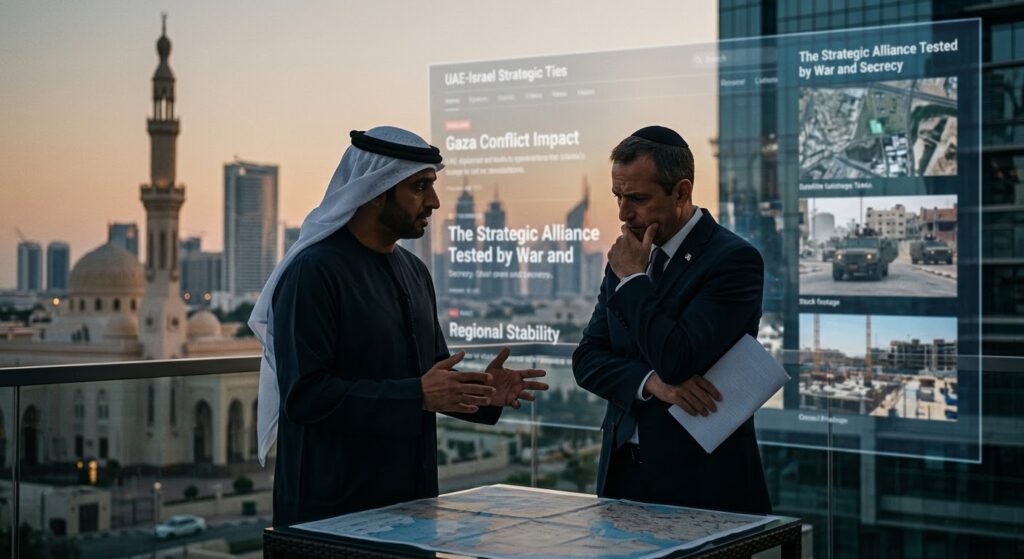
On September 27, 2026, Israeli Prime Minister Benjamin Netanyahu boarded a private plane for a four-hour visit to Abu Dhabi. He met with UAE President Sheikh Mohamed bin Zayed Al Nahyan at the airport, largely in private, before returning to Israel the same evening. The trip was reported by Israeli Channel 12 before Netanyahu’s plane had even landed back home, triggering a formal complaint from Israel’s Shin Bet security agency, which argued the disclosure endangered the prime minister and exposed operational methods.
The visit, confirmed by UAE state news agency WAM the following day, represents the latest chapter in a relationship that has evolved from a diplomatic normalization agreement into something far more consequential: a de facto military alliance operating in the shadow of regional war.
The Economic Foundation
The Abraham Accords, signed in 2020, transformed UAE-Israel relations from quiet intelligence cooperation into formal diplomatic and commercial partnership. The economic data tells a story of sustained growth. Bilateral trade reached $3.209 billion in 2025, roughly consistent with $3.254 billion in 2024. Cumulative trade from September 2020 to May 2026 totaled approximately $14.53 billion.
The composition of trade reflects complementary economies. Israeli exports to the UAE are concentrated in precious stones and metals, optical and medical equipment, and electrical machinery—these sectors alone accounted for 77 percent of Israeli exports in 2025. UAE exports to Israel are more diversified, including grains, iron and steel, mineral fuels, and industrial products.
The Comprehensive Economic Partnership Agreement (CEPA) between the two countries has provided a framework for reducing barriers and creating a more predictable business environment. Air connectivity has expanded dramatically: weekly flights reached a peak of 136, with approximately 1.53 million passengers traveling between the two countries in 2025, a 71.3 percent increase over 2024.
The Security Dimension: From Intelligence to Deployment
The relationship’s most significant evolution has occurred in the security domain. What began as intelligence sharing has become direct military cooperation, accelerated by the US-Israeli war against Iran that began in late February 2026.
Israel deployed its Iron Dome air defense system to the UAE, along with Israeli operators to maintain and operate it. US Ambassador to Israel Mike Huckabee confirmed the deployment publicly in May 2026, calling the UAE “the first country to sign the Abraham Accords” and citing the Iron Dome deployment as evidence of the benefits. Israel also sent the “Iron Beam” laser defense system and the “Spectro” lightweight surveillance system, capable of detecting incoming drones from 20 kilometers away.
The scale of the threat these systems were deployed to counter became clear during the Iran conflict. According to the Financial Times, more than 500 ballistic missiles and 2,000 drones were launched toward the UAE, which used Israeli-made equipment to intercept them. Israel also shared real-time intelligence on Iranian short-range missile preparations.
The deployment of Israeli military personnel on UAE soil represented an unprecedented level of security cooperation. As one regional official described it, this was “one of the first examples of significant defense cooperation” between the two countries.
The Politics of Silence
What makes the current moment particularly revealing is the contrast between the substance of the relationship and its public presentation. When Netanyahu’s office claimed in May 2026 that he had secretly visited the UAE during the Iran war, the UAE Foreign Ministry promptly denied it, stating that relations with Israel were “public and conducted under the Abraham Accords” and were not based on “non-transparent or unofficial arrangements”.
This September, however, Abu Dhabi itself confirmed the visit. The UAE’s official WAM news agency reported that Sheikh Mohamed received Netanyahu and that the two discussed “bilateral relations and ways to strengthen and develop them”. The shift from denial to confirmation suggests a recalibration: the relationship’s strategic value now outweighs the diplomatic cost of acknowledging it.
That cost remains significant. The UAE was one of only two Arab countries whose representatives remained in the UN General Assembly hall during Netanyahu’s September address, as dozens of other delegations staged a walkout in protest of Israel’s ongoing military campaign in Gaza. Emirati social media figures celebrated the decision, with one prominent influencer posting, “THE UAE IS IN THE HALL. We show up. We do not run”. The celebratory posts drew sharp condemnation from other users, who accused the UAE of complicity “while Gaza burns”.
The Iran Factor and Regional Calculus
The driving logic behind the deepening alliance is shared threat perception. Both Israel and the UAE view Iran as their primary strategic adversary, and the Iran war demonstrated that the UAE’s security concerns are not theoretical. The missile and drone attacks on Emirati territory during the conflict underscored the vulnerability of Gulf states to Iranian retaliation.
But the alliance carries risks. Critics argue that the UAE’s close partnership with Israel complicates collective Gulf diplomacy, particularly when regional stability requires coordination rather than competing security arrangements. The Gulf Cooperation Council’s effectiveness depends on consultation and mutual confidence, and if individual members pursue competing regional strategies, the collective capacity to address common challenges could weaken.
There is also the question of legitimacy. The necessity of conducting high-level meetings with secrecy—using private jets and unannounced schedules—exposes the fragility of the normalization project in the eyes of regional public opinion, which remains overwhelmingly sympathetic to the Palestinian cause. The UAE’s public positioning as a modern, diplomatically agile state coexists uneasily with its role as Israel’s closest Arab partner during a period of intense regional conflict.
The October Election and Beyond
Netanyahu’s visit came exactly one month before Israel’s October 27 election, and domestic politics inevitably colored the trip. Israeli media reported that Netanyahu asked Sheikh Mohamed to refute a Haaretz report claiming the UAE had warned Israel about Hamas’s October 7 attack preparations approximately ten days before it occurred. Netanyahu has threatened to sue Haaretz over the report, calling it “fabricated and politically motivated”.
The timing suggests that the Abu Dhabi visit served multiple purposes: reinforcing the strategic alliance, coordinating on Iran, and providing Netanyahu with a foreign policy achievement to present to Israeli voters. For Sheikh Mohamed, the meeting offered an opportunity to reaffirm a relationship that has delivered tangible security benefits during a period of direct threat.
A Relationship Under Strain
The UAE-Israel relationship today is both deeper and more exposed than at any point since normalization. Trade has plateaued rather than grown, but security cooperation has expanded into territory that would have been unimaginable in 2020: Israeli air defense systems protecting Emirati cities, Israeli operators stationed on UAE soil, and real-time intelligence sharing during active hostilities.
Whether this alliance can be sustained depends on factors beyond the control of either government. The trajectory of the Iran conflict, the outcome of Israel’s election, and the evolution of Arab public opinion toward Gaza will all shape the parameters of what is possible. For now, Abu Dhabi has made its calculation: the security benefits of alignment with Israel outweigh the diplomatic costs. The question is whether that calculation will hold as the regional war continues to unfold.