

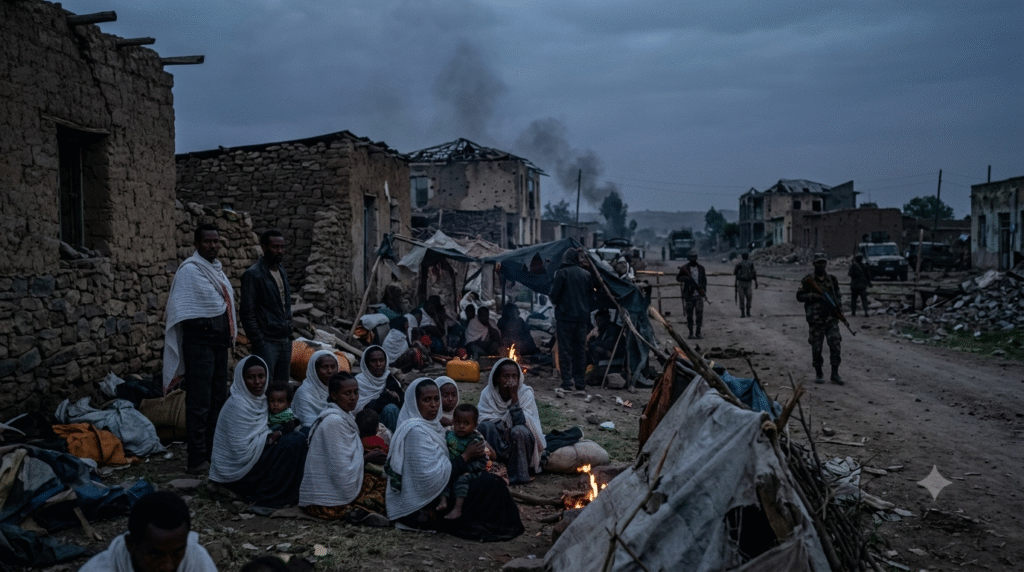
ADDIS ABABA — As Ethiopia sleeps, the sounds of war are returning. In the northern highlands of Tigray, residents report hearing the distant thud of artillery and the tell-tale whine of drones overhead. In the central town of Walga, families mourn the dead from a massacre that left at least 14 people killed and more than 10 abducted. And along the border with Sudan, hundreds have fled their homes, carrying whatever they could grab as they crossed into an uncertain exile. Ethiopia, a nation of 130 million people and Africa’s second most populous country, is once again staring into the abyss of conflict—and this time, the warning signs suggest it could spread far beyond its borders.
A Fragile Peace Unravels
The 2022 Pretoria Agreement, brokered by the African Union, was supposed to end a two-year civil war that killed an estimated 600,000 people and displaced millions. For a time, it held. But the agreement’s core provisions—the withdrawal of Eritrean and Amhara forces from disputed territories, the return of displaced communities, and the reintegration of Tigray’s forces—remain largely unimplemented. The unresolved status of Western Tigray, a fertile strip of land claimed by both Tigray and Amhara, has become a festering wound that neither side can afford to ignore.
The current escalation began on August 1, 2026, when fighting erupted in Shererina, near the Sudan border. Intense clashes broke out between Tigrayan forces and the Ethiopian National Defense Force, with reports of heavy artillery and drone strikes . The violence continued into the weekend, forcing hundreds of civilians to flee across the border into Sudan, where medical sources reported receiving wounded fighters and traumatized families.
Since then, the government has launched near-daily drone strikes across Tigray, targeting what it describes as military positions but what local officials and rights groups say increasingly includes civilian infrastructure. A strike on Merewa Secondary School in Raya Alamata district damaged the building and killed three Tigrayan fighters, according to Tigrayan military sources, while a district governor claimed one civilian was killed and four wounded . On September 8, a series of drone strikes reportedly killed three people, including a two-year-old child, and injured four others in Hintalo District, southeast of Mekelle .
The Tigray Education Bureau has accused the government of systematically targeting schools, alleging that airstrikes in 2026 destroyed classrooms, damaged facilities, and injured teachers and their families. “The primary reason for intensifying airstrikes targeting schools and teachers specifically this week is that the registration period for the upcoming 2026/2027 academic year has arrived,” the bureau stated, alleging that preventing students from returning to school was being used as a weapon of war .
Mass Surrender or Mass Defection?
In a development that both sides are interpreting differently, Ethiopia’s federal army announced on September 18 that nearly 300 TPLF fighters had surrendered along the Tekeze corridor in northwestern Tigray. The army published photos of soldiers and weapons, claiming the fighters included divisional officers who handed over more than 280 individual and crew-served weapons .
According to the army’s statement, the surrendering fighters said they disagreed with what they described as TPLF leaders’ efforts to recruit young Tigrayans and send them to war “to protect themselves from accountability” . The TPLF’s vice president, Amanuel Assefa, declined to comment on what he called “this kind of military issue” .
Whether this represents a genuine rupture within TPLF ranks or a tactical surrender by fighters caught between competing pressures remains unclear. But it underscores a broader reality: after decades of war and years of uneasy peace, Tigray’s population is exhausted, and the appetite for another round of bloodshed is far from universal.
Beyond Tigray: A Nation Ablaze
The crisis in Tigray is not isolated. Across Ethiopia, multiple armed conflicts are simmering—and in some cases, boiling over. In the central town of Walga, an armed group identifying itself as the Fano militia attacked on Monday, killing between 14 and 17 people and abducting more than 10, according to the conflict-monitoring group ACLED . A local resident told AFP that 16 people had been killed and around 16 women and children were still in captivity, with captors demanding ransoms of 150,000 to 800,000 birr—roughly $918 to $4,900 .
The attack underscores the fragmentation of Ethiopia’s security landscape. The Fano militia, an Amhara nationalist force that began an insurgency against the federal government in April 2023, has itself splintered, with criminal gangs operating under its banner while the main leadership distances itself from such actions. Kidnapping for ransom has become a grim growth industry across several regions, a phenomenon observers say has expanded dramatically since late 2022 .
In the south, violence erupted along the boundaries of Konso, Alle, and South Omo zones, leaving four dead and several injured. Armed men entered Kolme District looking for stolen cattle, then returned the next morning to launch a surprise attack, burning homes, grain stores, flour mills, and places of worship. More than 500 people fled their homes, and 21 structures—including health and educational facilities—were destroyed .
The Global Centre for the Responsibility to Protect, a coalition of civil society organizations, issued a stark warning on September 9: “We express our grave concern over escalating violence, instability and mass atrocity crimes across Ethiopia.” The statement catalogued abuses by government forces, Fano militias, and the Oromo Liberation Army, including unlawful killings, arbitrary detention, sexual violence, forced conscription, and the recruitment of children .
The Regional Dimension
Ethiopia’s internal conflicts are increasingly entangled with regional rivalries, raising the specter of a broader Horn of Africa war. The government accuses Eritrea—once its ally in the Tigray war—of backing the TPLF, an allegation Asmara denies. Prime Minister Abiy Ahmed told parliament in July that the TPLF was preparing for war in collaboration with Eritrea, and the government has framed the current security environment as an “anti-federal military movement” involving Eritrea, Sudan, the OLA, Tigray forces, and Fano .
The war in neighboring Sudan has added another layer of complexity. Sudanese authorities have accused Ethiopia and the UAE of facilitating drone attacks and supporting the Rapid Support Forces, allegations both governments deny. Separate reporting has raised concerns about an alleged RSF training facility inside Ethiopia . The risk, analysts warn, is that these conflicts become mutually reinforcing—a cascade of instability that could engulf the entire region.
The Information Blackout
Compounding the crisis is the government’s crackdown on independent media. On August 1—the same day fighting erupted in Tigray—security personnel abducted Yonas Kedir, editor-in-chief of the independent Addis Standard, assaulted him, blindfolded him, and held him for 24 hours. While he was detained, security forces raided the Addis Standard office, seizing cameras and newsroom equipment, and searched his home .
The detention is part of a broader pattern. Journalists in Ethiopia operate in an environment of fear and uncertainty, facing arrest, harassment, surveillance, and restrictions on access to conflict areas. This encourages self-censorship, leaving Ethiopians with fewer ways to understand what is happening in their own country. “There’s a growing tendency to treat independent journalism as a national security threat,” Yonas told CIVICUS. “Government officials often call on the media to prioritise the national interest and national unity, while treating critical reporting on sensitive issues as inherently harmful to the country” .
A Precipice, Not a Predestination
The UN High Commissioner for Human Rights, Volker Türk, has called on all parties to urgently de-escalate tensions and prevent a relapse into violence . But with trust between the federal government and Tigrayan authorities at rock bottom, with the Pretoria Agreement’s core provisions unfulfilled, and with multiple armed conflicts metastasizing across the country, the path back from the brink is narrow and treacherous.
What makes this moment particularly dangerous is the convergence of unresolved grievances. The Tigray war’s atrocities—documented by human rights groups as including war crimes and crimes against humanity—have never been addressed. Accountability mechanisms have been dismantled rather than strengthened. The mandates of the UN International Commission of Human Rights Experts on Ethiopia and the African Commission’s Commission of Inquiry on Tigray were terminated despite continuing violations, leaving survivors of sexual violence and other abuses with little hope of justice .
As night falls over Addis Ababa, the capital remains calm—for now. But the sounds of war are growing louder in the north and center, and the international community’s attention is divided between Gaza, Ukraine, and a dozen other crises. Ethiopia’s long night may be just beginning. The question is whether anyone will act before the darkness spreads.