

NAIROBI — East Africa’s health landscape this week reveals a region grappling with interconnected challenges: border communities stepping up as disease sentinels, Uganda launching a nationwide emergency care transformation, and Somalia’s malnutrition crisis deepening as funding evaporates. Across the region, health authorities are simultaneously managing outbreak preparedness, capacity building, and the stark consequences of resource shortfalls.
Kenya’s Western Border: Communities as First Line of Defense
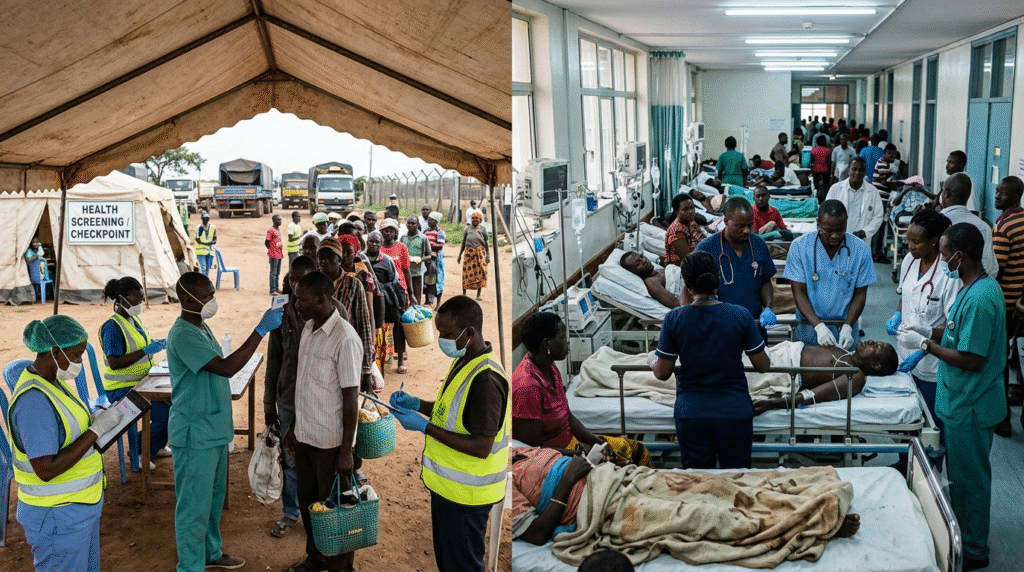
At the Busia One-Stop Border Post on Kenya’s western frontier, more than 3,000 people cross daily along the Northern Corridor that runs from Mombasa through Uganda to Rwanda, Burundi, South Sudan, and the Democratic Republic of the Congo. This constant movement makes border workers and communities an essential component of Kenya’s early warning system.
In August 2026, the Kenya National Public Health Institute, with support from WHO and the International Organization for Migration, trained 35 health workers and engaged 45 border stakeholders from three priority points of entry: Busia and Malaba One-Stop Border Posts in Busia County, and Lwakhakha in Bungoma County . The training focused on recognizing Ebola symptoms, applying suspect case definitions, reporting protocols, and risk communication.
“The people who work at this border see travellers long before we do. When a trader notices someone who is unwell and knows exactly who to call, that is early detection,” said Oliver Atsing’a, a port health officer at the Kenya National Public Health Institute .
While Kenya has recorded no Ebola cases, transmission continues in the DRC. Uganda’s outbreak was declared over on August 26, 2026. The Busia border currently screens small-scale traders from 08:00 to 18:00, staffed by county health personnel and Kenya Red Cross. Night-time screening remains a gap, and traders have recommended round-the-clock coverage .
Uganda: Transforming Emergency Care Nationwide
Uganda has launched the Acute Care Transformation through Basic Emergency Care (ACTxBEC) Initiative, a nationwide effort to strengthen frontline emergency services. The initiative comes as Uganda’s 2024/25 financial year recorded 855.6 emergency cases per 100,000 population, with more than half trauma-related. Pneumonia remains a leading cause of death among children under five, while postpartum haemorrhage continues to claim mothers’ lives .
The initiative will roll out across 200 health facilities in 85 districts over three years, reaching approximately 2,400 healthcare providers. Participating facilities will establish trained champions to lead regular simulation exercises and continuous learning . Studies from previous Basic Emergency Care implementations in Uganda and other low- and middle-income countries found reductions in hospital mortality ranging from 34% to 50% .
“When we manage emergency as well, we prevent 50% of the poor outcomes,” said Dr. Charles Olaro, Director General for Health Services, speaking on behalf of the Health Minister . Uganda is implementing the initiative alongside Ethiopia, Rwanda, and Tanzania, providing opportunities to generate regional evidence on strengthening emergency care systems.
Somalia: Malnutrition Crisis as Funding Collapses
In central Somalia’s Mudug region, the inpatient malnutrition ward at Mudug Regional Hospital in Galkayo has been operating beyond its 28-bed capacity since early April 2026. At its peak in late May, nearly twice that number of children were being treated. Between January and July, Médecins Sans Frontières admitted 1,389 children for inpatient treatment of acute malnutrition and medical complications, 809 of them severely malnourished .
Between May and July, 1,322 children were admitted to outpatient malnutrition treatment, compared with 788 over the same period in 2025—an increase of nearly 60 percent. Critically, of eleven children newly admitted over one week in June, ten had already attended a health facility closer to home. Their caregivers brought them to the MSF-supported hospital because there was no medication or therapeutic milk, or because the child was not improving .
“The caregivers of most of these children have already sought care somewhere else first,” said Emmanuel Omale, MSF project coordinator in Somalia. “They are not arriving late because their families waited. They are arriving late because there was nothing left closer to home. An inpatient ward is the last step in a chain. It cannot replace the rest of it, and it is already full” .
Somalia’s humanitarian response plan was reduced to US$852 million for 2026 and was less than one third funded by July. The World Food Programme has cut emergency food assistance from more than two million people to just over 600,000, and more than 70 health facilities in Puntland have closed . Rainfall has been substantially below average across Mudug, and pastoral families have moved in search of water and pasture, taking them further from functioning facilities.
El Niño Flooding Threatens Somalia’s Health Infrastructure
Compounding Somalia’s crisis, heavy rainfall linked to El Niño has already disrupted operations at the IRC-supported Ariif Health Centre in Mogadishu. Forecasters put the chance of above-normal rainfall across central and southern Somalia at more than 90%, with parts of the country potentially receiving more than 400 millimetres between October and December .
“We are deeply alarmed to already be seeing the intensity of the impact of El Niño in Mogadishu,” said Richard Crothers, IRC Somalia Country Director. “This week’s heavy rain has disrupted operations at the Ariif Health Centre, a facility local families depend on for essential care, and communities here have little room left to absorb another shock” .
The IRC has worked with communities and Somalia’s disaster management agency to identify at-risk families and provide cash assistance. In Beledweyne, where the Shabelle river bursts its banks repeatedly, the IRC and partners are ready to transfer $190 to 1,100 households the moment the river reaches agreed levels .
Cross-Border Cooperation: South Sudan and Uganda
South Sudan and Uganda signed a Memorandum of Understanding on September 7 to facilitate rapid movement of health personnel, medical vehicles, and emergency supplies across their shared border during health emergencies. The agreement institutionalizes cross-border disease surveillance, joint outbreak response, and real-time epidemiological data exchange .
Uganda’s Health Minister Chris Baryomunsi noted that Uganda contained its recent Ebola outbreak within about 73 days, recording 20 confirmed cases, 18 recoveries, and two fatalities . He proposed creating a standby regional health workforce, similar to regional security arrangements, that could be rapidly deployed to countries facing outbreaks. South Sudan has identified 15 high-risk counties and 22 priority entry points as key components of its preparedness strategy .
Kenya’s Maternal Health: Kisumu Partnership
Kisumu County has partnered with Lwala Community Alliance for a five-year initiative to reduce maternal and infant mortality. Maternal mortality in Kisumu stands at 344 deaths per 100,000 live births, while neonatal mortality is about 12 deaths per 1,000 live births. Only about 70 percent of expectant mothers attend antenatal care .
The partnership will cover 315 public and private health facilities, linking community-level interventions to hospital care. Community health promoters will be supported to identify pregnant women early, ensure early antenatal care initiation, and promote skilled delivery. Within facilities, Lwala will support training on obstetric emergencies, strengthen referral systems, and improve commodity supply .
“Behind that data is a mother, is a child, is a human, is a family, is a community, and that is what has brought us together,” said Sandra Muzune, Lwala’s Chief Programme Officer .
Regional Capacity Building and Partnerships
Rwanda’s Minister of Health Dr. Sabin Nsanzimana and Police Chief Felix Namuhoranye joined youth in Karongi District for community work, urging them to avoid illicit alcohol and drugs and report hidden stocks of prohibited beverages . The Rwandan government continues nationwide enforcement, including closing non-compliant distilleries and revoking unauthorized spirit licenses.
In Tanzania, the 35th Chinese medical team in Zanzibar concluded its one-year mission, having completed a nine-month laparoscopic minimally invasive surgery training course for 13 local doctors and conducted 27 free medical outreach clinics across the islands . The 28th Chinese medical team in mainland Tanzania provided specialized training in minimally invasive brain surgery at Muhimbili Orthopedic Institute, using a portable visualization device that reduces intraoperative bleeding and infection risks while lowering treatment costs .
Burundi is launching a new project with action medeor aimed at improving healthcare, hygiene, and sanitation for children under five and pregnant women in Bujumbura and Burunga provinces. The project will refurbish seven healthcare facilities, train 35 community health workers, and establish 20 women’s income-generating groups to improve access to community health insurance .
Looking Ahead
The convergence of these developments illustrates a fundamental truth about East Africa’s health systems: progress in one area can be undermined by fragility in another. Uganda’s emergency care initiative and Kenya’s border preparedness demonstrate what sustained investment and political commitment can achieve. But Somalia’s malnutrition crisis—where children arrive at hospitals too late because primary care has collapsed—shows the human cost when funding dries up and health systems are allowed to deteriorate.
As El Niño rains intensify across the region, the coming months will test whether these systems can absorb the shocks ahead. For now, health workers, communities, and partners are working to close the gaps—one border screening at a time, one emergency simulation at a time, one child admitted to a crowded ward at a time.
