

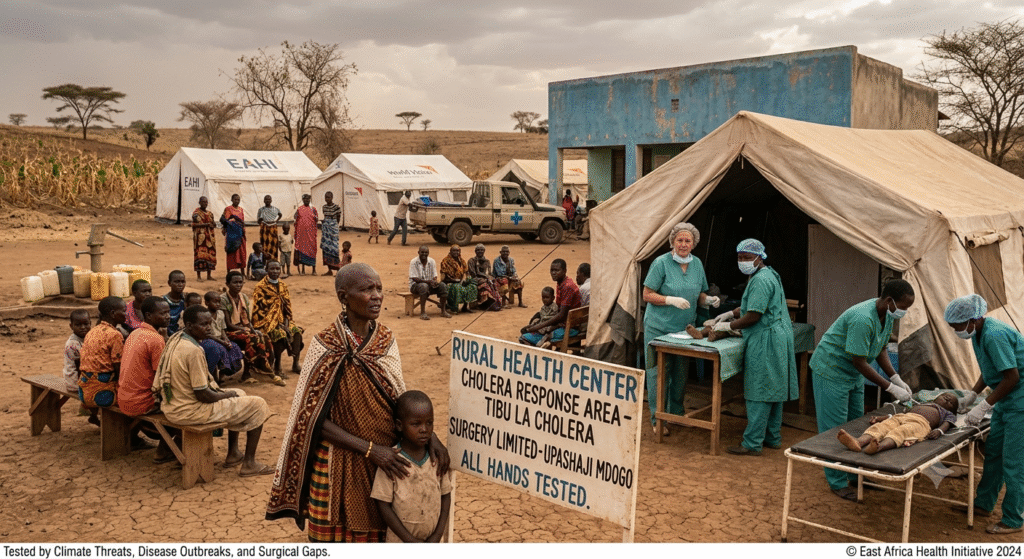
From Kenya’s El Niño preparations to Uganda’s surgical camps and Rwanda’s digital health revolution, the region confronts converging health challenges with a mix of innovation and grit
East Africa’s health landscape today presents a study in contrasts: governments racing to prepare for climate-driven disease outbreaks, volunteer surgeons traveling to underserved communities, and a quiet digital revolution transforming how nations track and respond to health threats. Yet beneath these efforts lies a persistent truth—the region’s health systems remain strained, under-resourced, and vulnerable to the shocks that seem to arrive with increasing frequency. From the flood-prone plains of Kenya to the island communities of Uganda’s Lake Victoria and the refugee camps of Somalia, the work of healing East Africa is a daily struggle against both ancient foes and emerging threats.
Kenya: Racing Against the Rains
With El Niño conditions expected to bring heavy rainfall across the region, Kenya’s Ministry of Health has activated contingency measures to strengthen disease surveillance and prevent outbreaks. Public Health Principal Secretary Mary Muthoni announced that health facilities had been directed to verify their stocks and ensure adequate supplies to respond quickly to potential outbreaks, particularly in flood-prone areas .
The risks are well-documented. Kenya’s previous El Niño episodes—most notably the 1997-98 event—triggered major outbreaks of cholera, malaria, and Rift Valley fever, displacing communities and overwhelming health infrastructure . This time, authorities are attempting a more proactive approach, working with county administrations to protect water sources from contamination and improve waste management, particularly in informal settlements. Fifteen counties still practice open defecation, a situation Muthoni described as a major public health concern that could worsen during heavy rains .
The government’s preparations extend beyond waterborne diseases. Kenya is simultaneously battling multiple outbreaks: as of mid-September, the country had recorded 1,309 confirmed Mpox cases and 19 deaths across 40 counties, 469 measles cases including one death, and one circulating vaccine-derived poliovirus type 2 case in Dadaab, Garissa County . The Ministry of Health has also activated four laboratories for Ebola testing and strengthened surveillance at points of entry, even as it confirmed no positive cases within its borders. The ongoing Ebola outbreak in the Democratic Republic of Congo—which has accumulated 7,200 cases and 3,475 deaths since May—remains a pressing concern, particularly given Uganda’s recent experience with imported cases .
The World Bank is supporting Kenya’s preparedness with approximately $400 million in emergency financing, with El Niño-related disruptions among the crises covered . Yet the scale of the challenge is immense, and the window for preparation narrows with each passing day.
Uganda: Surgical Camps Bridge the Gap
In Uganda, a different kind of health crisis is being addressed—not through emergency response, but through sustained volunteer effort. The Association of Surgeons of Uganda, supported by the Ministry of Health, launched a week-long surgical camp on September 12, providing free operations to more than 3,000 patients across ten Central Region districts including Wakiso, Mukono, and Kayunga .
For patients like Ronald Kizza, 40, a resident of Buvuma Islands, the camp represents a rare opportunity. Diagnosed with an umbilical hernia in 2016, Kizza was advised to undergo surgery at a cost of 500,000 shillings—an amount he could not afford. He is among thousands for whom specialized surgical care has remained out of reach, forcing them to live with conditions that are treatable but financially inaccessible .
The Ministry of Health provided medical supplies worth 700 million shillings to support the camps, which bring together approximately 600 health workers across 52 health facilities. The supplies include surgical gowns, antibiotics, anaesthetic medicines, medical gases, and other essentials . Permanent Secretary Dr. Diana Atwine praised the surgeons’ contribution but expressed concern about inconsistent support from local leaders in some hosting districts, noting that accommodation and logistical support had not been provided in all areas .
The camps highlight a broader truth about Uganda’s health system: while progress has been made, access to essential surgical care remains profoundly unequal. Dr. Charles Olaro, Director General of Health Services, emphasized that surgery and anaesthesia are essential components of universal health coverage, noting that “you cannot achieve universal health care without them” .
Complementing these efforts, the Ministry of Health commissioned 134 Community Health Extension Workers (CHEWs) in Buikwe district on Monday, challenging them to contribute to cancer prevention and to identify and report unexplained community deaths—a critical function for early outbreak detection . Each CHEW received a new bicycle for office duty, a practical recognition of the mobility challenges facing community health workers in rural areas .
Rwanda: The Digital Health Revolution
While its neighbors grapple with immediate crises, Rwanda is quietly building what may be the region’s most sophisticated health intelligence infrastructure. The National Health Intelligence Centre (NHIC), launched in April 2025, centralizes health data from across the country, processing and analyzing it in real time to provide a comprehensive view of the national health situation .
The results have been tangible. According to the Ministry of Health, the platform has enabled health officials to shift “from reactive decision-making to proactive decision-making,” reducing waiting times in health facilities, improving emergency coordination and ambulance response times, strengthening disease surveillance, and enabling more targeted allocation of health resources .
Bill Gates visited the NHIC in July during a broader tour of Rwanda’s health initiatives, meeting with community health workers who deliver care at people’s doorsteps. In Mwulire alone, community health workers provided up to 65% of malaria screenings and up to 82% of malaria treatments over a six-month period, empowered by community electronic medical records that enable real-time digital reporting . Gates also visited the TKMD syringes manufacturing plant, a Rwanda-based manufacturer of auto-disable syringes that exports to multiple countries through UNICEF .
The next phase of Rwanda’s digital health strategy involves expanding the NHIC’s capabilities to develop predictive health intelligence, with support from the Gates Foundation. This would allow the country to anticipate epidemics, issue smart early warnings, and prevent health threats before they escalate . Rwanda’s partnership with the Gates Foundation has also positioned it as the first beneficiary of the Horizon1000 initiative—a $50 million AI program launched in collaboration with OpenAI to help African countries use artificial intelligence to strengthen health service delivery .
Tanzania and Somalia: Partnerships Fill Critical Gaps
In Tanzania, the 28th Chinese medical team provided free healthcare services to frontline staff working in the Ngorongoro Conservation Area on Saturday, offering consultations and specialized care in cardiology, neurosurgery, hand and foot surgery, and traditional Chinese medicine . The team also conducted training on cardiopulmonary resuscitation and emergency treatment, recognizing that conservation staff who conduct field patrols face unique health risks and often struggle to access care due to the nature of their work .
Somalia continues to rely heavily on international partnerships to meet basic health needs. Kenya Defence Forces personnel serving under the African Union Support and Stabilisation Mission in Somalia provided medical services and clean drinking water to residents of Hoosingo Town, treating common ailments and delivering health education on disease prevention and hygiene . Qatar Charity launched the “Creating Smiles” initiative to provide free treatment for Somali patients with cleft lip and palate, with 23 procedures already performed. Over the past year, the organization implemented 24 health projects benefiting more than 143,000 people at a total cost of approximately QR 10 million .
Ethiopia: Volunteerism as Preventive Medicine
Ethiopia has taken a distinctive approach to preventive health, mobilizing a national culture of volunteerism to extend health services to communities across the country. State Minister of Health Frehiwot Abebe said the volunteer movement, launched by Prime Minister Abiy Ahmed, has become a national tradition, with massive free screening and treatment campaigns conducted during four consecutive rainy seasons .
Last year alone, the Ministry of Health treated nearly 15 million citizens for conditions such as hypertension and diabetes, helping individuals manage their health before complications arise. This year, the ministry plans to extend free treatments to 20 million people . Volunteers also clean the homes of elderly residents, unblock drainage systems, fill stagnant water pools, and disinfect health facilities—a comprehensive approach to environmental health that addresses the root causes of seasonal disease.
The government has distributed more than 13 million insecticide-treated mosquito nets this year and maintains stocks of diagnostic kits and medicines, tracking disease trends weekly down to the kebele (neighborhood) level through a digital surveillance system . “If data indicates an increase in cases in a specific area due to stagnant water, we intervene immediately,” Frehiwot explained, describing a feedback loop that combines environmental sanitation, net distribution, and rapid treatment .
The Road Ahead
East Africa’s health challenges are as varied as its landscapes—from the flooded informal settlements of Nairobi to the remote islands of Lake Victoria, from the refugee camps of Dadaab to the conservation areas of Ngorongoro. What unites these disparate contexts is a common recognition: health is not merely the absence of disease, but the presence of systems capable of anticipating, absorbing, and responding to shocks.
The region’s governments are demonstrating that they understand this. Kenya’s El Niño preparations, Uganda’s surgical camps, Rwanda’s digital intelligence, Ethiopia’s volunteer mobilization—each represents a different piece of a larger puzzle. Yet the gaps remain glaring. Surgical care is still rationed by poverty. Outbreak surveillance is still reactive in too many places. And the climate shocks that drive disease outbreaks show no signs of abating.
For the health workers, volunteers, and patients navigating these systems, the daily reality is one of improvisation and endurance. The surgeon who operates without proper equipment, the community health worker who walks miles to reach a single patient, the mother who travels hours to a clinic that may or may not have the medicine she needs—these are the human faces of East Africa’s health struggle. Their resilience is remarkable. But resilience alone cannot substitute for systems that work.
