

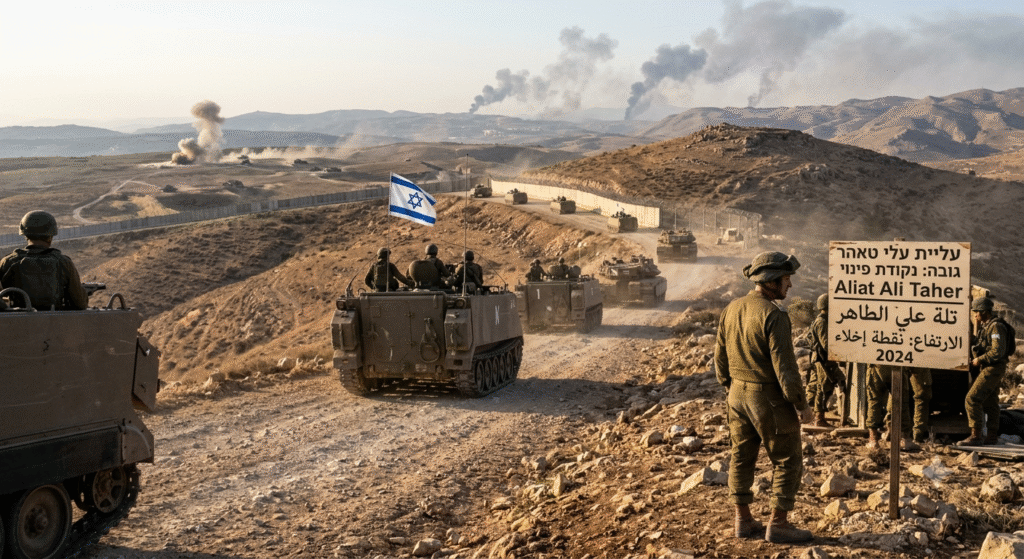
As Israeli forces pull back from a key southern Lebanese ridge, military operations intensify in Syria and Gaza while a domestic firestorm erupts over a documentary critical of the army
Israel is executing a complex military recalibration across the Middle East today, simultaneously withdrawing from a contested position in southern Lebanon, expanding operations into Syrian territory, and confronting a domestic political crisis over a documentary film that accuses the military of approving mass civilian casualties in Gaza. The convergence of these developments paints a picture of a state navigating multiple strategic fronts while grappling with internal divisions that threaten to undermine its international standing.
Withdrawal from Ali Taher Heights
The most visible movement came on Sunday, September 13, when Israeli forces withdrew several kilometers south from the Ali Taher Heights in southern Lebanon to the Beaufort Ridge, according to Israel’s public broadcaster . The withdrawal is part of a planned reduction of Israeli troops in the so-called “security zone” it maintains in southern Lebanon, with one brigade expected to be pulled out in the near future .
The pullback followed a massive demolition operation just days earlier. On September 10, Israeli Prime Minister Benjamin Netanyahu and Defense Minister Israel Katz issued a joint statement announcing the destruction of Hezbollah underground facilities beneath the Ali Taher ridge . The Israeli military stated it used over 1,100 tons of explosives to destroy a tunnel network belonging to Hezbollah’s Badr Unit, which operates in the area north of the Litani River. The network comprised eight passages totaling 5.4 kilometers in length and was described as the unit’s “nerve center” . The blasts were so powerful that they registered as a 4.1 magnitude earthquake .
Despite the withdrawal, Israel has made clear it does not intend to fully relinquish control. Defense Minister Katz stated on Sunday that Israeli forces plan to maintain control of the Ali Taher Heights as part of the security zone, declaring that “anyone who approaches the heights will be eliminated” until Hezbollah is disarmed throughout Lebanon . Israeli forces continue to conduct strikes on the area and nearby villages to prevent Hezbollah fighters from re-entering, while coordinating with the Lebanese government to deploy its army in evacuated areas .
The withdrawal, however, has not brought calm. Israeli artillery and airstrikes continued across southern Lebanon through the weekend. On Monday morning, Israeli warplanes bombed the Ali Taher Heights and surrounding areas, with multiple strikes reported on Kfar Tibnit and artillery shelling targeting Zautar al-Sharqiyah . Earlier in the week, a public school in Mansouri was destroyed overnight, and Israeli forces conducted 35 explosions in a single town . A drone strike on a motorcycle killed one person on the Marj Harouf-Zebdine road, despite ongoing US-mediated negotiations aimed at securing an Israeli withdrawal and extending Lebanese state authority across the south .
Expanding Operations into Syria
While pulling back in Lebanon, Israel is deepening its military presence in neighboring Syria. Israeli forces conducted incursions into the southern Syrian governorates of Rural Damascus, Quneitra, and Deraa, according to Al Jazeera . The operations represent a significant expansion of Israel’s activities beyond the Golan Heights, where it has maintained a presence since 1967.
The Syrian incursions follow a high-profile visit by Netanyahu and Katz to the Syrian border on Wednesday. Speaking from the summit of Mount Hermon, Netanyahu declared: “We will not allow any terror army to establish itself on our border. We are committed to defeating the terror regime in Iran—and we will do it” . Katz added a pointed message to Syrian President Ahmed al-Sharaa, stating: “We are here on Mount Hermon, we are in the security zone, and we are not moving from here—in order to defend against threats from any jihadist element on this side of the border and within Syria itself” .
The visit and the incursions signal Israel’s determination to establish a permanent security buffer in southern Syria, mirroring its approach in southern Lebanon. The operations come amid broader regional tensions, with the Arab League adopting a resolution rejecting Iranian influence in Lebanon and Hezbollah’s military activities .
Domestic Firestorm Over Gaza Documentary
On the domestic front, Israel’s government is confronting a political crisis triggered by the international success of a documentary film that accuses the military of systematically approving mass civilian casualties in Gaza. The film, titled NAZA, won the jury’s special prize at the Venice Film Festival on Saturday .
Based on anonymous interviews with 24 Israeli intelligence officers and soldiers, NAZA alleges that the Israeli military routinely approves mass civilian deaths when targeting militants in Gaza. The title refers to a Hebrew acronym said to be used for counting the number of civilians estimated to be killed in a military strike .
Culture Minister Miki Zohar responded with fury, threatening to strip the filmmakers—Yuval Abraham and Rachel Szor—of their Israeli citizenship. “I will act immediately to revoke the Israeli citizenship of these despicable creators for treason against the state,” Zohar wrote on X, accusing them of being willing to “harm their homeland in order to receive applause from anti-Semites around the world” .
Far-right National Security Minister Itamar Ben-Gvir echoed the sentiment, calling the pair “a disgrace and an embarrassment” to Israel and suggesting that “your friends, that is to say our enemies Hamas in Gaza, will welcome you with open arms” .
The Israeli army rejected the film’s allegations, with a spokesman accusing Hamas of deliberately embedding military infrastructure in civilian areas. More than 20,000 children have been killed in Gaza since October 2023, according to UN figures . The film also addresses the Hamas attacks of October 7, 2023, which killed around 1,200 people in Israel and prompted Israeli aerial strikes that leveled much of Gaza.
The threat to revoke citizenship represents an extraordinary escalation in Israel’s internal debate over the war and its conduct—a debate that is increasingly being criminalized by government ministers.
Continued Strikes in Gaza
Meanwhile, Israeli operations in Gaza continue despite the fragile ceasefire that has been in place since October. On Sunday, two Palestinians were killed and 13 others injured in an Israeli airstrike targeting a vehicle in Gaza City . Earlier in the week, an Israeli strike on Beit Lahiya in northern Gaza killed at least four people, including two children, according to Shifa Hospital . The Israeli military said its forces struck Hamas weapons storage facilities in three areas across Gaza, describing the operations as responses to perceived threats against troops .
Regional and Diplomatic Dimensions
The military movements come amid a broader regional realignment. The Arab League adopted a resolution affirming solidarity with Lebanon and rejecting Hezbollah’s continued military activities, endorsing Beirut’s decision to establish a state monopoly over weapons . Eight Organization of Islamic Cooperation member states—Indonesia, Egypt, Jordan, Pakistan, Qatar, Saudi Arabia, Türkiye, and the UAE—issued a joint statement condemning Israeli ministers’ calls for the forced displacement of Palestinians from Gaza . Indonesia’s parliament is pushing for a Boycott, Divestment and Sanctions bill against Israel, with the deputy speaker calling for concrete economic measures rather than repeated statements .
Israel’s Foreign Minister Gideon Sa’ar, however, stated that Israel is not planning to expel Palestinians from Gaza, saying “we are not planning to expel or to deport anyone from the Gaza Strip” .
A State Navigating Multiple Fronts
Israel today presents a paradox: a military power capable of projecting force across multiple borders—from the hills of southern Lebanon to the outskirts of Damascus—yet one increasingly isolated diplomatically and riven by internal dissent. The withdrawal from Ali Taher Heights suggests a tactical recalibration rather than a strategic retreat, as Israel seeks to consolidate defensible lines while maintaining the capacity for offensive operations.
The threats against filmmakers, the continued strikes in Gaza despite a ceasefire, and the expansion into Syrian territory all point to a government that feels simultaneously embattled and empowered. How long Israel can sustain this posture—militarily, diplomatically, and domestically—remains the defining question of the region’s unfolding future.
