

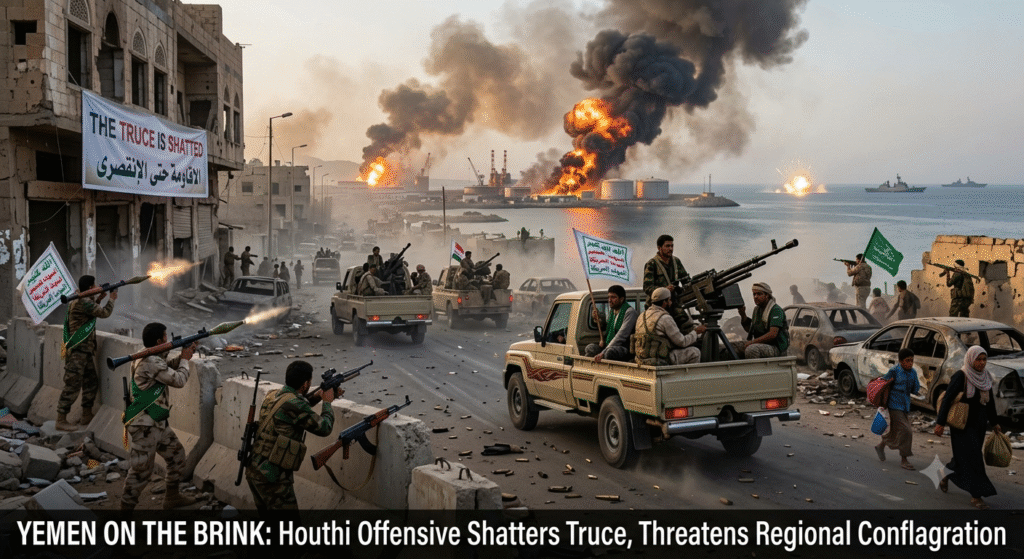
The Strategic West Coast Falls as UN Warns of “New and More Dangerous Phase” in Yemen’s Decade-Long War
Yemen has plunged back into full-scale war. In a dramatic escalation that has shattered more than four years of relative calm, Houthi forces have launched a sweeping offensive along Yemen’s western coast, capturing the strategic port city of Mokha and advancing to the very approaches of the Bab al-Mandeb Strait—one of the world’s most critical maritime chokepoints. The offensive, which unfolded over the past week, has triggered a humanitarian emergency, drawn in regional powers, and prompted stark warnings from the United Nations that Yemen is sliding toward a “wider and unresolved regional confrontation with global repercussions” .
The Fall of Mokha and the Strategic Calculus
The Houthi advance culminated on September 10, when the group’s forces seized Mokha, a historic port city in southwestern Taiz province, along with the strategic Hanish Islands in the Red Sea . The capture of Mokha—located roughly 75 kilometers from the narrowest point of the Bab al-Mandeb Strait—gives the Houthis a direct presence on the approaches to a waterway through which a substantial share of global trade and energy passes .
“Over the past twenty-four hours, the fighting has intensified across multiple frontlines, especially the strategic west coast,” UN Special Envoy for Yemen Hans Grundberg told the Security Council on Thursday. “As of right now, they have gained control of Mokha, giving them a direct presence on the approaches to one of the world’s most vital straits, although fighting is ongoing and the situation remains fluid” .
The Houthis have sought to reassure the international community that navigation remains safe. Mohammed Abdul-Salam, a spokesman for the group, stated on social media that “freedom of navigation in the Red Sea and Bab al-Mandab remains safe and regular,” insisting that the group’s military operations are “defensive” in nature and pose no threat to international shipping . However, the group has maintained its prohibition on Saudi shipping, announced in July, and has claimed a series of attacks on Saudi oil tankers since imposing a naval blockade .
Yemeni government forces, which withdrew from Mokha, have designated a strip of territory along the western coast as a “dead zone,” warning they will use “all types of weapons and firepower” against advancing Houthi fighters. A military official told Xinhua that government forces have regrouped near Bab al-Mandab and are preparing to launch a counteroffensive “within the coming hours” .
A Nation Displaced
The human cost of the offensive is mounting by the hour. The International Organization for Migration (IOM) reported Friday that at least 46,000 people have been displaced since fighting escalated last week, with the figure rising “by the hour” . According to the UN’s humanitarian update, some 11,442 households have been newly displaced countrywide since September 3, the majority in Taiz and southern Al Hodeidah .
“Families are being forced to flee for the second or third time in this conflict, with almost nothing left,” said IOM Director General Amy Pope. “As fighting spreads, reaching people with lifesaving assistance is becoming harder. We urgently need safe, unimpeded access” .
Entire villages in Maqbanah, Jabal Habashi, and Al-Ma’afer have reportedly been emptied as clashes approached populated areas. The Mokha–Taiz road, a key supply route, has been cut off, placing additional pressure on host communities receiving displaced families . Existing IDP sites are overwhelmed, with at least 908 households identified as families who were already displaced and have fled again . The UN Office for the Coordination of Humanitarian Affairs (OCHA) reported that humanitarian access deteriorated sharply on September 9, with movement temporarily suspended between Al Makha, Al Khukhah, and Hays .
Cross-Border Escalation and Regional Entanglement
The Houthi offensive has been accompanied by a sharp escalation in cross-border attacks on Saudi Arabia. Houthi military spokesman Yahya Sarea reported that “Saudi enemy warplanes” had carried out 55 airstrikes over a 12-hour period, hitting Al-Jawf, Saada, Marib, Al-Bayda, Taiz, and Hodeidah . The Houthis, in turn, launched missile and drone attacks against targets in southern Saudi Arabia, including energy facilities and a military air base. Saudi authorities reported that 73 people were injured and fires broke out at several facilities .
A particularly deadly incident occurred on Monday when airstrikes hit a prison in Hazm, the capital of Al-Jawf province, killing at least 23 people. Rescuers pulled more bodies from the rubble on Wednesday, including those of four individuals found that day. Seven people were injured, and seven remained missing . Houthi spokesman Brig. Gen. Yahya Saree claimed the strike was carried out by a Saudi F-15SA aircraft that took off from King Khalid Air Base in Khamis Mushait .
The escalation has drawn in the United States, albeit cautiously. According to Axios, Saudi Crown Prince Mohammed bin Salman contacted President Donald Trump twice on Thursday to request direct American air operations as Houthi forces pushed toward Bab al-Mandab. Trump declined the request, opting to maintain strategic focus on Iran and the Strait of Hormuz and to avoid opening an additional combat theater . Washington did agree to provide non-kinetic assistance, authorizing the transfer of actionable intelligence and targeting information to Saudi forces. Approximately 200 US military personnel are already stationed in the kingdom for advisory and liaison duties . US Central Command Commander Adm. Brad Cooper was dispatched to Saudi Arabia on Thursday for consultations .
The End of the Truce
The renewed fighting effectively marks the end of the relative calm Yemen has experienced since the UN-brokered truce of April 2022. Although the truce formally expired six months later, large-scale fighting remained largely contained until the recent flare-up. The escalation began in early September when the Houthis launched extensive attacks in Taiz and Hodeidah, setting off increasingly intense confrontations with government forces. Fighting has since spread to Marib, al-Jawf, and al-Bayda .
“This renewed war should alarm us all,” Grundberg told the Security Council. “It not only threatens to plunge Yemen into a prolonged and expanding war, but also risks yet again dragging the country into the wider and unresolved regional confrontation, with global repercussions” .
The UN envoy emphasized that the situation was not inevitable. “Yemeni demands can be addressed at the negotiation table, and in the lead-up to the escalation, I tabled proposals that offered a credible alternative,” he said. “I will continue to engage the Government of Yemen and Ansar Allah to identify feasible ways forward and to keep open options for off-ramps” .
A Precipice of Far Greater Conflict
The strategic implications extend far beyond Yemen’s borders. The Bab al-Mandab Strait, which connects the Red Sea to the Gulf of Aden, is a vital artery for global trade and energy shipments. With the Strait of Hormuz on the opposite side of the Arabian Peninsula already under threat amid the broader US-Iran confrontation, the prospect of both chokepoints being simultaneously compromised represents a potential catastrophe for the global economy .
Chinese analysts note that the timing of the Houthi offensive is not coincidental. Li Zixin, a Middle East expert at the China Institute of International Studies, observed that the escalation is the product of both Yemen’s internal political-military divisions and the spillover effects of the US-Iran conflict. Saudi Arabia, as a key pillar of America’s Middle East security architecture, cannot afford a comprehensive defeat in Yemen. Should US military advisors deploy in formation to Saudi Arabia, it would signal an American strengthening of the southern flank of Iran’s so-called “Axis of Resistance,” further compressing Iran’s military buffer space .
“The question before the international community is no longer whether Yemen’s war will resume, but how to address a new and more dangerous phase—one whose consequences, if left unchecked, will not stay within Yemen’s borders,” Grundberg warned. “Yemen cannot be allowed to slip from the Council’s attention. It needs the active investment of every member of this body to contain what could be the precipice of a far more dangerous conflict” .
As night falls over the Red Sea coast, the people of Yemen face a familiar and terrifying uncertainty. For a nation already bearing the scars of a decade-long war that has killed at least 150,000 people and pushed millions to the brink of famine, the return of full-scale hostilities represents a catastrophe in the making. The international community’s ability—and willingness—to pull Yemen back from the abyss will determine whether the country’s suffering remains contained or spreads beyond its borders with consequences no one can fully predict.