

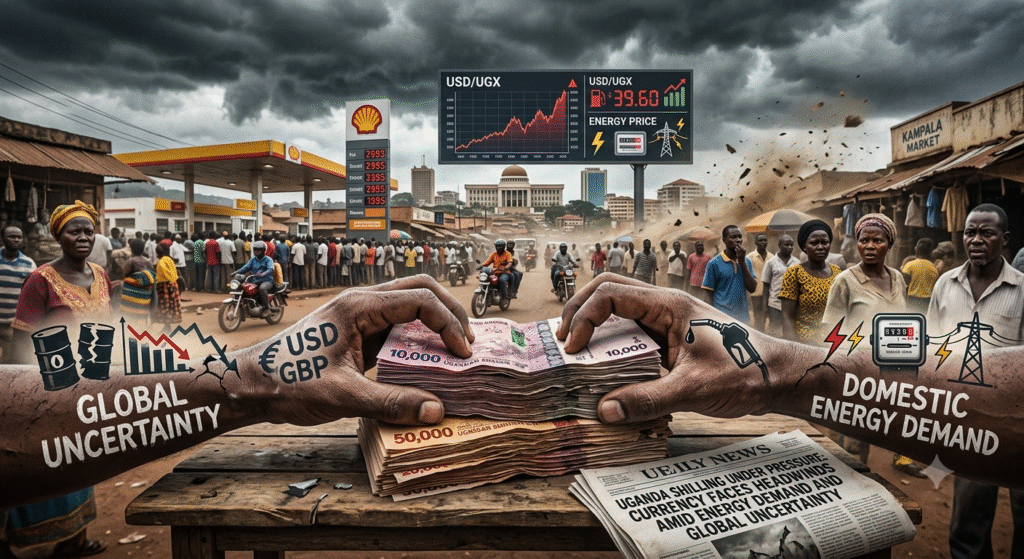
Kampala — The Uganda shilling has found itself navigating turbulent waters in recent weeks, weakening past key psychological thresholds against the US dollar as powerful forces converge to test the resilience of one of East Africa’s most closely watched currencies. The local unit’s performance reflects a complex interplay of domestic demand pressures, regional geopolitical tensions, and long-term structural shifts that could reshape Uganda’s economic trajectory in the months ahead.
Breaking Through the 3,800 Barrier
The most immediate story is the shilling’s depreciation against the greenback. Commercial banks quoted the shilling at 3,820/3,830 to the US dollar in early September, a notable weakening from the previous week’s close of 3,775/3,785 . The currency’s slide past the 3,800 mark represents a significant psychological breach, driven primarily by robust dollar demand from energy importers and commercial banks strategically bolstering their hard-currency positions.
Traders speaking to Reuters painted a picture of persistent pressure. “We think this energy-related appetite will continue to manifest based on the events unfolding in the Middle East,” one trader noted, adding that the shilling could test 3,850 to the dollar in the near term . The reference to Middle Eastern tensions underscores how global geopolitical dynamics transmit directly to Uganda’s foreign exchange market, particularly through the oil import channel.
The Energy Import Conundrum
At the heart of the shilling’s recent weakness lies Uganda’s structural dependence on imported refined petroleum products. Despite the country’s significant oil reserves beneath Lake Albert, the absence of domestic refining capacity means Uganda must purchase refined fuels on international markets—transactions denominated in US dollars. When global energy prices rise or supply concerns emerge, the demand for dollars from fuel importers intensifies, placing immediate downward pressure on the shilling.
This dynamic has been particularly acute in recent weeks. Market participants report that commercial banks have also contributed to the demand pressure by accumulating dollar positions, a defensive strategy against further currency volatility . The combination of genuine import needs and speculative positioning creates a feedback loop that can accelerate depreciation beyond what underlying economic fundamentals might justify.
Yet the picture is not uniformly bleak. The Bank of Uganda has continued its active management of market liquidity, conducting Open Market Operations to mop up excess shillings and prevent disorderly currency movements . This interventionist approach, combined with Uganda’s substantial foreign exchange reserves—which have grown dramatically from approximately $3.3 billion in January 2025 to around $6.1 billion by May 2026—provides a formidable buffer against excessive volatility .
Monetary Policy Holds Steady
The Bank of Uganda has maintained its benchmark Central Bank Rate at 9.75 percent, marking the eighth consecutive meeting without adjustment . This steady-handed approach reflects a careful balancing act: inflation remains relatively contained despite rising energy costs, but the central bank is wary of potential spillover effects from global price pressures.
Annual headline inflation rose to 4 percent in July 2026, up from 3.7 percent in June, driven primarily by increases in energy, fuel, and utility prices alongside rising food-crop costs . While this remains below the central bank’s 5 percent medium-term target, the upward trend has caught policymakers’ attention. The Bank of Uganda projects core inflation will average between 4.0 and 4.5 percent over the next twelve months, with headline inflation potentially reaching 5.5 to 6.0 percent .
Governor Michael Atingi-Ego has been notably cautious in his public statements, emphasizing the need to assess developments in international energy prices and exchange-rate movements before adjusting policy . The central bank’s decision to raise the Cash Reserve Requirement to 11 percent from 9.5 percent earlier in 2026 represents an alternative approach to managing liquidity, signaling a preference for macroprudential measures over blunt interest rate adjustments .
Structural Headwinds and High Lending Rates
Beyond the immediate currency dynamics, the shilling’s environment is shaped by deeper structural challenges. Governor Atingi-Ego recently linked Uganda’s persistently high interest rates to heavy government borrowing from the domestic financial market, telling Parliament’s COSASE committee that government demand for funds competes directly with the private sector for available capital .
“When the government borrows heavily from the domestic financial system, it competes with businesses and individuals for funds that could otherwise be available for private-sector lending,” Atingi-Ego explained . Domestic debt accounted for 54.5 percent of Uganda’s total public debt by December 2025, equivalent to $19.02 billion, while external debt stood at 45.3 percent, or $15.84 billion .
The governor also identified government arrears as a contributing factor to elevated borrowing costs. When government cannot pay its suppliers promptly, those businesses may struggle to repay bank loans, increasing non-performing loans and prompting banks to charge higher rates to other borrowers to compensate for potential losses . This creates a cycle where the cost of credit remains elevated despite relatively accommodative monetary policy.
A Constructive Long-Term Outlook
While near-term pressures dominate market attention, longer-term fundamentals for the shilling are becoming increasingly favorable. Uganda stands on the cusp of a transformative economic shift as first oil production draws closer, with the East African Crude Oil Pipeline progressing toward completion .
The commencement of crude oil exports is expected to mark a turning point for Uganda’s external accounts. Although the absence of domestic refining capacity means Uganda will continue importing refined fuels in the near term, the export earnings from crude oil should strengthen foreign-exchange inflows and improve the current account deficit . The reserve position, already substantially strengthened, is expected to improve further as oil revenues begin flowing.
The Ministry of Finance has projected GDP at $68.4 billion by the end of June 2026, with GDP per capita reaching $1,399 . With oil production commencing, double-digit growth is projected for the financial year 2026/27 . The government’s decision to import refined petroleum products directly from producers has also contributed to strengthening the shilling, according to Ministry of Finance assessments .
Economists at MCB Group note that “the medium-term outlook for the Ugandan shilling is becoming increasingly constructive,” citing higher export receipts from oil, stronger reserve buffers, and continued multilateral financing as factors that should reduce depreciation pressures and provide a firmer anchor for the currency . They caution, however, that periods of volatility are likely in response to shifts in global risk sentiment and regional security developments.
Navigating the Path Forward
The Uganda shilling’s current trajectory reflects the inherent tensions facing a frontier economy in an interconnected world. The currency must absorb external shocks—from Middle Eastern geopolitical tensions to global energy price swings—while simultaneously supporting domestic economic activity and maintaining price stability.
The Bank of Uganda’s substantial reserve buffer and demonstrated willingness to intervene provide important support. The central bank’s cautious monetary stance, while frustrating to those hoping for rate cuts to stimulate borrowing, reflects a prudent assessment of inflation risks. And critically, the approaching oil era offers a potential structural transformation of Uganda’s external position.
Yet the path forward will not be linear. The shilling may test 3,850 against the dollar in coming weeks if energy-related demand persists . Commercial banks’ dollar accumulation strategies could amplify short-term volatility. And the broader global environment—marked by geopolitical uncertainty, volatile oil prices, and uneven growth prospects—will continue to shape Uganda’s currency dynamics.
For now, the shilling’s journey reflects a nation in transition: still vulnerable to external shocks, yet increasingly positioned to benefit from its resource wealth. The coming months will reveal whether these long-term strengths can overcome the near-term pressures that continue to test one of East Africa’s most resilient currencies.
