

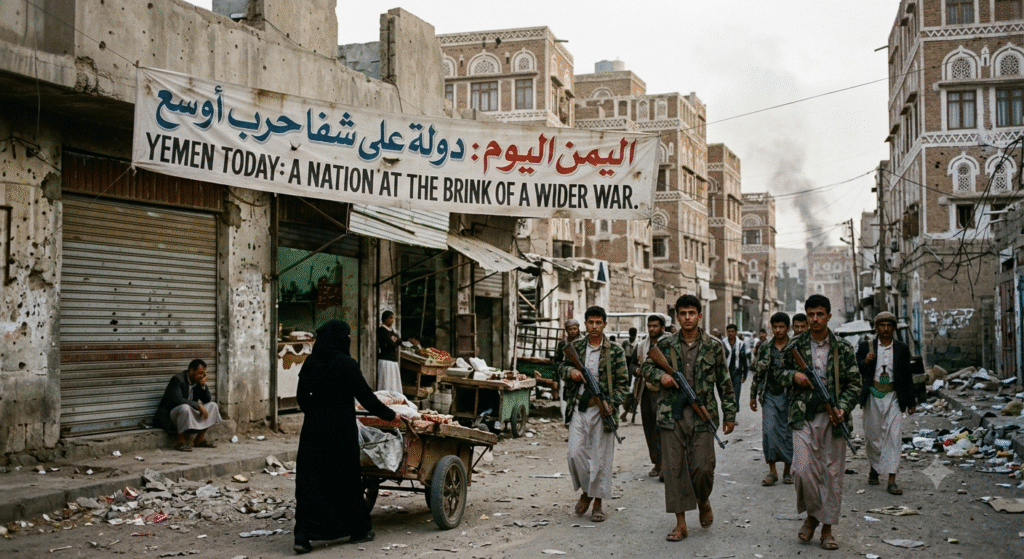
Yemen stands at its most dangerous moment in nearly five years. The fragile calm that held since the 2022 UN-brokered truce has collapsed, replaced by a rapidly expanding military confrontation that has already killed hundreds, displaced tens of thousands, and pushed the country to the edge of a full-scale return to civil war. What began as localized clashes in the western province of Taiz has metastasized into a multi-front conflict that now threatens one of the world’s most critical maritime chokepoints.
The Fall of Mokha and the Battle for Bab al-Mandab
The most dramatic development this week was the Houthi capture of Mokha, a strategic port city on Yemen’s Red Sea coast located roughly 70 kilometers from the Bab al-Mandab Strait . The Houthis also seized the Hanish Islands, extending their reach directly to the approaches of the strait that connects the Red Sea to the Gulf of Aden—a waterway through which a substantial share of global trade and energy passes .
The significance of this advance cannot be overstated. As Aden-based political analyst Muqbil Naji told Xinhua, “The battle for Bab al-Mandab is not simply about gaining territory inside Yemen. Whoever can threaten this waterway acquires leverage that extends well beyond Yemen’s borders” .
Government forces have designated a strip of territory along the western coast as a “dead zone,” vowing to use “all types of weapons and firepower” against Houthi fighters advancing toward it . A military official said government forces that retreated from Mokha have regrouped near Bab al-Mandab and are preparing a counteroffensive .
A Multi-Front War Unfolds
The fighting has not remained confined to the west. Government forces launched a major offensive in Al-Jawf, a northern province bordering Saudi Arabia, while clashes also intensified in Marib, Hodeidah, and al-Bayda governorates . This multi-front strategy appears designed to stretch Houthi forces thin.
“The opening of multiple fronts by Yemen’s government will weaken the Houthis,” said Abdul-Salam Mohamad, chairman of the Abaad Studies and Research Center .
The human cost has been staggering. In just four days of fighting in Taiz and Hodeidah alone, at least 117 people were killed—54 government soldiers and 63 Houthi fighters . This represents one of the most violent episodes of ground combat in western Yemen in years .
The Regional Dimension: Attacks on Saudi Arabia
As military pressure mounted inside Yemen, the Houthis expanded the confrontation beyond the country’s borders. The group fired dozens of ballistic missiles and drones at military and energy facilities across southern Saudi Arabia, with attacks reported in Abha, Khamis Mushait, Jazan, and Najran . Saudi authorities reported 73 people wounded and fires at several energy facilities .
“The attacks on Saudi Arabia should not be viewed separately from what is happening on the ground in Yemen,” Naji said, adding that by increasing the costs for Riyadh, the Houthis could be seeking to create a new equation in which Saudi Arabia has greater incentive to restrain military pressure from Yemeni government forces .
The Humanitarian Catastrophe Deepens
The military escalation is compounding what was already one of the world’s worst humanitarian crises. The UN Office for the Coordination of Humanitarian Affairs (OCHA) reported that 18,000 households have been displaced since the start of September—up from an initial estimate of 11,400—with people fleeing toward Taiz, Aden, Lahj, and Abyan governorates . The International Organization for Migration (IOM) put the figure at 46,000 people displaced across Taiz and Hodeidah .
“Civilians are bearing the brunt of renewed frontline warfare, airstrikes, shelling, and large-scale displacement,” said Joe Lowry, IOM’s Middle East and North Africa spokesperson. “Many of those fleeing have arrived with very few belongings after leaving suddenly” .
The aid infrastructure itself is under attack. The UN reported that eight UN vehicles were seized from its humanitarian hub in Mokha, and that some facilities in the compound appear not to be under UN control . The Al Makha seaport sustained significant damage, and operations there are suspended .
Meanwhile, the World Food Programme’s Executive Director Carl Skau painted a devastating picture after visiting Yemen. “I spoke to women who were not eating more than once or maybe not even once a day,” he said. “We used to provide them food and cash. The food is now gone. And the cash is only every other month” .
WFP has been forced to drastically cut its reach. “We assisted some 3 million people a year ago. We’re now down to 1 million,” Skau said . In the north, WFP faces even more severe constraints: 73 UN colleagues have been detained by the Houthis, 38 of them from WFP, and their offices have been occupied and assets confiscated .
A Peace Process in Ruins
The diplomatic architecture that maintained the fragile calm for four years now lies in tatters. Yemen’s Minister of State Walid al-Ibara stated bluntly that “the lines of communication related to the peace process have reached a dead end,” accusing the Houthis of undermining settlement opportunities through regional escalation and threats to international navigation .
UN Special Envoy Hans Grundberg told the Security Council that “the question before the international community is no longer whether Yemen’s war will resume, but how to address a new and more dangerous phase—one whose consequences, if left unchecked, will not stay within Yemen’s borders” .
Grundberg warned that the renewed war “risks dragging the country into the wider and unresolved regional confrontation, with global repercussions” .
Global Implications: The Threat to Trade
The strategic stakes extend far beyond Yemen’s borders. The Bab al-Mandab Strait is a critical artery for global commerce—approximately 12 percent of world trade passes through the waters off Yemen . With the Strait of Hormuz already disrupted by the Iran conflict and the Black Sea route affected by the Ukraine war, the potential closure or disruption of Bab al-Mandab would represent a third major chokepoint crisis for global trade .
“If this is not brought under control, it’s going to have a massive impact on stability across the world,” Skau warned .
The Path Forward
The international community is scrambling to respond. China’s representative to the UN called for all parties to achieve a ceasefire as soon as possible and to resolve differences through dialogue . OCHA has renewed its appeal for all parties to protect civilians, respect international humanitarian law, and facilitate safe and unimpeded humanitarian access .
But with the Houthis now in control of Mokha and positioned near Bab al-Mandab, with Saudi Arabia absorbing missile attacks, and with the humanitarian system collapsing under the weight of displacement and funding cuts, Yemen appears to be entering a new and more dangerous chapter. The relative calm that held for four years is gone. What replaces it remains to be seen—but the signs point toward a prolonged and expanding war with consequences that will ripple across the region and the world.
