

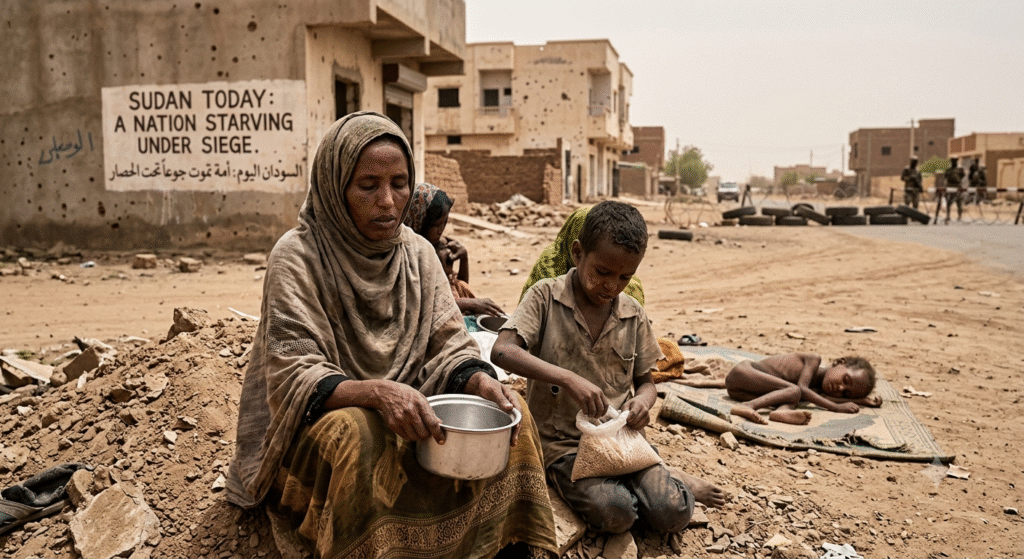
The news from Sudan in September 2026 reads like a chronicle of a country collapsing. A devastating famine is spreading, and the lifeline of humanitarian aid is being systematically bombed. It is a humanitarian catastrophe measured in numbers, but each number is a person slowly starved by war. While the world looks away, the men, women, and children of Sudan are locked in a desperate struggle for survival.
💥 The War Intensifies
The conflict, which has raged for over three years, shows no signs of abating. Violence continues to tear through the country’s south. Over the first weekend of September, the southern state of South Kordofan was rocked by attacks. On September 3rd and 4th, the paramilitary Rapid Support Forces (RSF) and their allies, the Sudan People’s Liberation Movement-North (SPLM-N), launched coordinated assaults on the towns of Kauda and Dilling. The attacks, which included indiscriminate shelling of residential areas, killed at least 26 civilians, including women and children .
These attacks are not isolated events. The SPLM-N has been locked in a long-standing conflict with the Otoro tribe over land disputes, and the RSF has used its influence to broker fragile truces . The war economy continues to function, with the army and its allies locked in a fierce struggle for control of strategic areas, such as the key road connecting Dilling to the state capital, Kaduqli. This ongoing fighting is devastating for civilians trapped in the crossfire.
🍞 A Man-Made Famine Under the Bombs
The most immediate and devastating consequence of the war is the collapse of the food supply. The World Food Programme (WFP) has issued a chilling warning, revealing that the aid pipeline is about to run dry. The agency, which is the main provider of food for millions of Sudanese, has announced that its cash assistance will be exhausted by the end of September, and its food reserves are expected to be depleted shortly after .
The situation is compounded by the fact that the aid that does make it through is under direct attack. On August 30th, two WFP trucks, clearly marked with the UN agency’s logo, were struck by an airstrike while transporting over 50 tonnes of food. The emergency supplies were meant to sustain 5,800 people for a month and were en route to Kaduqli, where about 58,000 residents are currently facing emergency levels of food insecurity . The attack on the humanitarian convoy is part of a disturbing pattern. The WFP has confirmed that this was the eighth time this year that its staff or supplies have been targeted by one of the warring parties .
💰 The Fragile Threads of Hope
Despite the overwhelming challenges, some institutions and critical infrastructure are still functioning. The government has been working to stabilize the economy and maintain essential services. In early September, a high-level delegation visited Saudi Arabia to meet with the Islamic Development Bank, seeking financial support to address the country’s debts and secure funding for reconstruction, infrastructure, and priority development projects .
There are also signs of a tentative economic recovery. The Sudanese Central Bank has resumed accepting older 2009 edition US dollar bills, a decision that will help ease currency shortages in the formal banking sector . In a move to increase fiscal independence, Sudan’s central bank has also required oil importers to pay a deposit of 200 kilograms of gold to obtain an import license . Furthermore, a Sudanese bank has opened a Renminbi account with a Chinese bank, allowing for trade settlement in Chinese currency . These are clear attempts to bypass a Western financial system that has become largely inaccessible.
🔮 Conclusion
Sudan’s situation is critical. The military conflict is intensifying, and its byproduct—starvation—is being used as a weapon of war. The systematic bombing of clearly marked food convoys is a grave violation of international humanitarian law . The international community faces a stark choice: act decisively to protect civilians and fund the humanitarian response, or watch as an entire nation is starved into submission. For the people of Sudan, the future hangs in the balance.
