

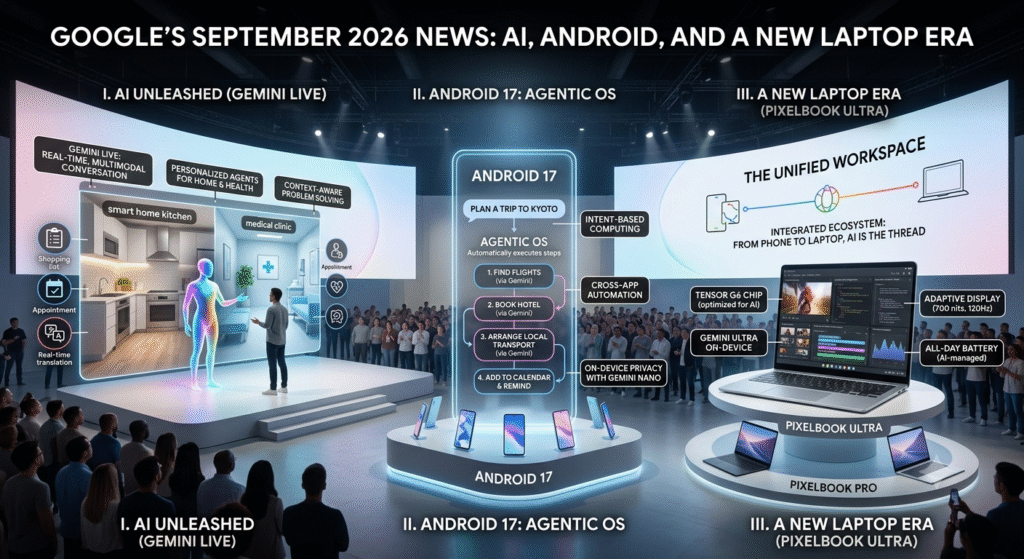
September 2026 has positioned Google at the center of the technology world, with a series of interconnected announcements spanning artificial intelligence, Android devices, and the highly anticipated entry into the premium laptop market.
🧠 Gemini 3.8: AI Models with Purpose
Google has significantly advanced its AI strategy with the introduction of Gemini 3.8 Flash, a model focused on reasoning and programming. Building on the release of Gemini 3.7 Flash just three weeks earlier, the 3.8 version delivers superior performance in software engineering and agent-based tasks at a competitive price point.
The model excels at autonomous task execution, handling complex engineering problems and professional benchmarks involving legal and financial reasoning. Google has also introduced Gemini 3.8 Flash Cyber, a specialized version for cybersecurity that autonomously detects vulnerabilities and generates fixes across more than 20 programming languages. For example, the model has demonstrated the ability to produce 2.6 times more correct solutions than other large models when used by Chrome’s security team.
Alongside these models, Google introduced the Fairwind program, a selective-access initiative for governments, cybersecurity authorities, and critical infrastructure operators. The program represents a commitment to proactive digital defense, working with over 650 collaborating entities globally and backed by more than $100 million in Google.org financing for cyber resilience.
🤖 Android Gets Smarter: The September Drop
The September 2026 Android Drop is one of the most comprehensive feature releases in recent memory, weaving Gemini deeply into the mobile experience.
Find Hub: Remembering the Un-Trackable
One of the most practical additions is the integration of Gemini into Find Hub, allowing users to ask the assistant to remember where they left items that don’t have a Bluetooth tracker attached. A user can simply say, “Hey Google, remember in Find Hub that I put my passport in my bedroom drawer,” and the location will be saved to a new “Remembered” tab in the app. Users can also add a photo for extra context.
Guided Vision: Accessibility Through AI
Gemini Live is adding Guided Vision, an accessibility feature providing verbal descriptions of what’s in front of the phone’s camera. This tool is designed to assist blind and low-vision users with everyday tasks like reading fine print on food labels, ordering from a dimly lit menu, or locating household objects. If the camera isn’t properly aligned, the assistant provides voice guidance to reframe or pan across a space.
Motion Assist: Curing Car Sickness
Android 17 devices will receive Motion Assist, a feature that helps reduce motion sickness for passengers using their phones in moving vehicles. A subtle bubble overlay on the screen moves with the vehicle, designed to bridge the gap between what the eyes see and the motion the body feels. Users can customize the color, shape, and opacity of the bubbles.
Google Messages and Keep Integration
Google Messages now integrates directly with Google Keep, allowing users to create and edit shared lists, such as shopping lists or vacation notes, directly within a chat conversation. The feature appears as a shortcut in the message composition menu, and the list will appear inline as a shared note.
🖥️ Googlebook: The Android-Powered Laptop
Google is preparing a major shift in the laptop market with the official announcement of Googlebook, a premium laptop category built around Android technology. The event is scheduled for September 15, 2026, in New York City.
A Hybrid Approach
The platform combines the web-focused productivity of ChromeOS with Android’s native technology base. The company is not producing its own Googlebook hardware for this initial range; instead, products will be manufactured by five partners: Acer, Asus, Dell, HP, and Lenovo. Approximately eight devices are expected to be showcased, mostly traditional clamshell laptops alongside at least one tablet.
Design and Features
All devices are built around Gemini AI and feature a distinctive lid-mounted “Glowbar” (also known as HiLight), a glowing design element that has appeared on other Google products. The laptops are expected to feature the Aluminium operating system, a hybrid built from Chrome OS and Android elements.
Chips and Performance
Googlebook will support processors from Intel, Qualcomm, and MediaTek. Code references suggest models using Qualcomm’s eight-core Snapdragon X Plus X1P-42-100 processor, as well as potential designs running on the more powerful Snapdragon X Elite. An Acer model is also rumored to offer up to 32GB of RAM and a 2.8K OLED display.
The launch could mark a major change in Google’s laptop strategy, positioning Googlebook as more than a Chromebook refresh and aiming to bring Android’s large app ecosystem closer to traditional desktop computing. However, an official statement clarifies that the September 15 event is an embargoed preview, and “nothing will be announced on September 15”.