

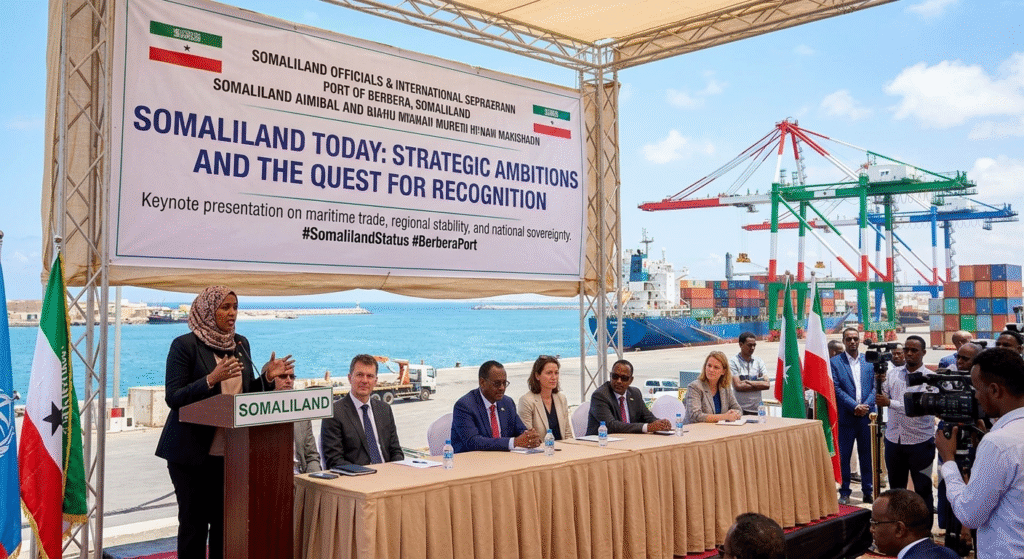
As of September 2026, Somaliland is navigating a complex new era in its three-decade struggle for international recognition. A historic diplomatic breakthrough with Israel, a high-stakes visit to the United States, and a strategic offer to host foreign military bases have placed the breakaway region firmly on the global stage, but have also drawn fierce opposition from Somalia and the wider region.
A Diplomatic Breakthrough and the Israel Factor
The defining event of Somaliland’s recent history was Israel’s decision in December 2025 to become the first United Nations member state to formally recognize the region as an independent sovereign state . For a territory that had been seeking recognition for over 35 years, this was an unprecedented diplomatic victory, instantly transforming the emotions of the population and shifting their perception of Israel “from hatred to trust and partnership” .
In June 2026, President Abdirahman Mohamed Abdullahi (known as Irro) made the first state visit by a Somaliland leader to Israel, receiving a lavish state welcome and honours rarely accorded to a leader of a territory unrecognised by other countries . A strategic cooperation agreement was signed, and Somaliland formally opened its embassy in West Jerusalem, a move that departed from international practice and drew condemnation from Palestine, the Organisation of Islamic Cooperation, and the Arab League .
The move has created a strategic alignment based on mutual need. Israel gained a foothold at the Bab el-Mandab Strait, the narrow gateway linking the Red Sea to the Indian Ocean and a critical artery for global trade, at a time when it faces “greater regional isolation after successive conflicts with Iran and its allies” . For Somaliland, Israel’s recognition provides diplomatic momentum, though it has also created internal divisions over the embassy’s location in Jerusalem, which opposition figures have rejected as inconsistent with the Somaliland constitution and its deep Islamic faith .
A Strategic Offer: The Berbera Model
President Irro is explicitly leveraging Somaliland’s strategic location to attract international support. In a recent interview with The Economist, he suggested that Somaliland could follow a model similar to Djibouti—using its coastline to host foreign military bases and developing the port of Berbera as a major trade gateway for the Horn of Africa .
Irro said Somaliland would be willing to offer military bases to the United States and Israel, stating: “Our message is that we are a responsible partner” in security and trade . He denied that an Israeli or American military presence already exists at Berbera, but added: “If they are interested” .
This strategic pitch carries risks. The Houthis in Yemen have threatened to target any Israeli military presence in Somaliland, which could expose the territory to attacks and undermine its relative peace and stability . Moreover, Somalia vehemently rejects any foreign military presence in the region without the federal government’s consent, viewing it as a violation of its sovereignty and territorial integrity .
The Washington Gambit
President Irro departed on September 3 for his first official working visit to the United States, a trip described by his administration as “historic” and intended to strengthen diplomatic relations and expand cooperation in security and economic development .
The visit represents a significant moment in Somaliland’s recognition campaign. Somaliland’s Information Minister, Barkhad Jaamac Batuun, declared: “It is a victory that the Somaliland case is now on the table of the United States today” . The president aims to meet with U.S. officials and legislators, and possibly President Donald Trump, to present Somaliland’s interests, priorities, and long-term aspirations .
To date, the United States continues to recognise the sovereignty and territorial integrity of the Federal Republic of Somalia, which includes Somaliland . However, senior officers from U.S. Africa Command have visited Hargeisa, and some analysts argue that American strategic interests—particularly Red Sea security and countering Iranian influence—may align with engaging Somaliland .
A Region on the Brink
Somaliland’s ambitions are intensifying an already volatile geopolitical competition. Turkey, a close ally of Somalia, has attempted to mediate between Mogadishu and Hargeisa, but multiple rounds of talks have failed . A joint statement by foreign ministers from twelve countries, including Saudi Arabia, Turkey, Egypt, and Pakistan, condemned Israel’s recognition of Somaliland as a “flagrant violation of the sovereignty of the Federal Republic of Somalia” .
The political situation inside Somaliland also remains delicate. President Irro has reported integrating over 6,000 clan-based militia members into the security forces and pursuing dialogue to resolve clashes in western parts of the territory . However, opposition parties have criticised the government for not sharing strategic decisions more inclusively . As one analysis noted, “Somaliland sits at the center of a cycle—not as a passive recipient but as the territorial platform through which the cycle operates” .
Conclusion
Somaliland today is a nation using every tool at its disposal—strategic geography, diplomatic engagement, and a new alliance with Israel—to break its decades-long isolation. Its leadership is willing to take risks, including hosting foreign military bases, to achieve international recognition. However, the path forward is fraught with challenges: fierce opposition from Somalia and regional powers, internal political divisions, and the threat of becoming entangled in broader Middle Eastern conflicts. For now, as President Irro stated, “There is nothing free in the world” .