

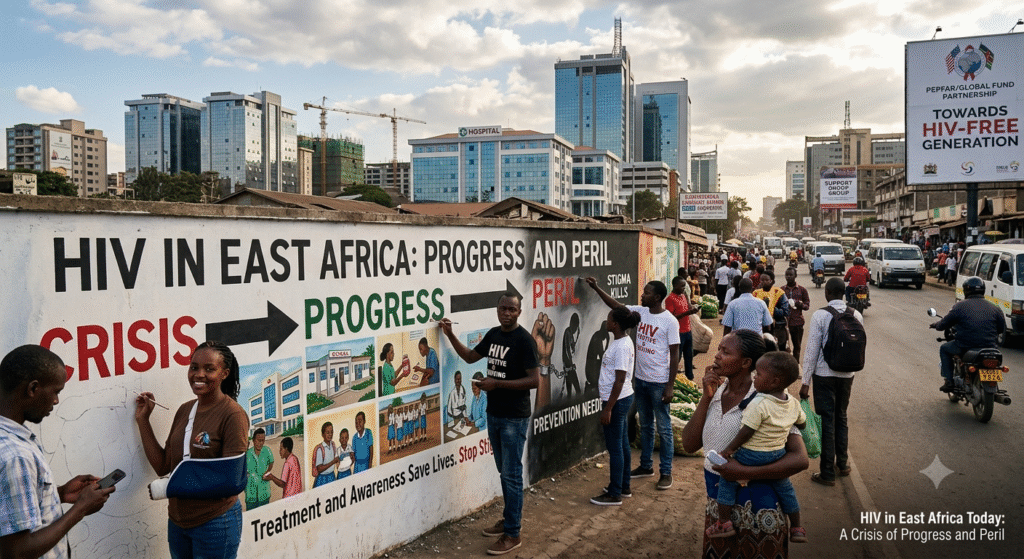
East Africa stands at a pivotal moment in its fight against HIV/AIDS in September 2026. A new generation of highly effective prevention tools, including a twice-yearly injectable drug that offers near-perfect protection, is being rolled out across the region . However, this historic advance is being overshadowed by a devastating funding crisis. The withdrawal of U.S. support has crippled health systems, threatening to undo decades of progress and potentially doubling the number of new infections and deaths in some countries . This is the story of a region at a crossroads, caught between a revolutionary breakthrough and a catastrophic funding gap.
💊 A New Era of Prevention: Lenacapavir Arrives
The arrival of lenacapavir (brand name Yeytuo®), a long-acting injectable PrEP (pre-exposure prophylaxis) administered every six months, is being hailed as a game-changer in the fight against HIV . Its promise is unparalleled.
Near-Perfect Efficacy: Clinical trials have demonstrated lenacapavir provides 100% protection against HIV infection when used as PrEP, an unprecedented level of effectiveness .
Overcoming Adherence Barriers: Unlike daily oral PrEP pills, which can be challenging for many to take consistently, the twice-yearly injection simplifies prevention, reduces the risk of forgetfulness, and offers greater discretion .
Kenya became the first East African country to receive and administer lenacapavir . In February 2026, Kenya received an initial batch of 21,000 doses , and its Ministry of Health has already integrated it into official clinical guidelines . Uganda followed shortly after, receiving its first shipment of 19,200 doses in late February, targeting high-burden districts .
Health officials celebrated the rollout as a new chapter in prevention, particularly for high-risk groups like young women and key populations . The drug is being made available at a dramatically reduced cost of approximately $60 per person per year, following an agreement between Gilead Sciences, the Global Fund, and governments .
The impact in Kenya has been significant. In Busia County alone, over 1,000 residents received the new injectable PrEP within just three weeks of its launch in April 2026 .
📉 The Funding Collapse: Reversing Hard-Won Gains
While the future of prevention is being shaped by scientific innovation, the present crisis is defined by a funding collapse. The January 2025 decision by the Trump administration to withdraw U.S. foreign assistance has had a catastrophic impact on HIV programs, which are heavily reliant on U.S. support, particularly PEPFAR (President’s Emergency Plan for AIDS Relief) and USAID .
The near-total loss of this funding has triggered an immediate and severe crisis:
📊 Shocking Drop in Enrollment and Testing
A study led by UCSF researchers, using patient-level data from nearly 103,000 people at 189 HIV clinics in Kenya, Uganda, and Tanzania, revealed the stark reality:
- New patient enrollment fell by 59% in the weeks following the funding pause .
- Viral load testing dropped by 33% .
Young people and men, who were already less likely to access HIV services, experienced the steepest declines .
⚕️ Health System Collapse
USAID funding supported approximately 80% of the total HIV budget in some East African countries . In Kenya, nearly 18% of the health sector workforce was supported by U.S.-funded programs, and many health workers lost their jobs almost immediately . This has led to widespread shortages of life-saving antiretroviral drugs and personnel .
📈 A Resurgent Epidemic
Estimates suggest that the number of new infections and AIDS-related deaths could double. This follows a period of decline, with approximately 20,000 new infections and 20,000 deaths reported in Kenya in 2024 . The presentation at the International AIDS Society (IAS) Conference in Rio de Janeiro (AIDS 2026) was unequivocal: the funding crisis is a critical turning point that threatens to reverse decades of progress .
⚖️ A Region at a Crossroads
East Africa is now at a critical juncture. The introduction of lenacapavir represents hope and the potential to drastically reduce new infections . Yet, its rollout is occurring against a backdrop of a collapsing healthcare system.
Data reveals the scale of the challenge:
- An estimated 5 million people living with HIV in Kenya, Tanzania, and Uganda face a shortage of life-saving antiretroviral drugs .
- The Global Fund, another major donor, has also reduced allocations for HIV by an average of 18% across 13 Sub-Saharan African countries, compounding the crisis .
The success of new prevention tools is directly threatened by the inability to deliver them through the same systems they were designed to support. As one analysis warned, the funding cuts are “not simply financial decisions” but translate into “reduced services, weakened community systems, loss of skilled personnel, disruptions in prevention programmes” . The situation is being described by experts as an “emergency” that has “exploded” as a direct result of the aid cuts .
This moment demands urgent reflection and action to ensure that the promise of prevention is not lost in a crisis of funding .
