

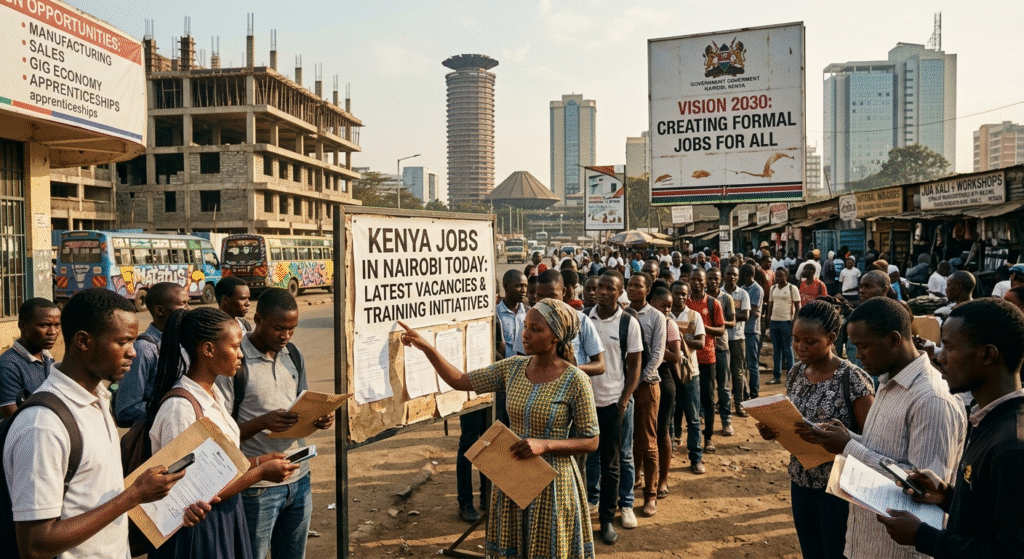
Nairobi’s job market in August 2026 presents a complex landscape of cautious hiring, government intervention, and persistent structural challenges. While official data and recent announcements point to targeted job creation and specific sectoral demand, these opportunities are unevenly distributed and often fail to reach the city’s most vulnerable populations.
📊 Demand-Driven Sectors: Where the Jobs Are
A recent Central Bank of Kenya (CBK) Market Perceptions Survey has highlighted a starkly uneven hiring landscape. The strongest hiring intentions are concentrated in the banking and financial services sector, where 36% of respondents said they would “definitely” hire in 2026, and 39% said they would “probably” hire . This demand is linked to the expansion of digital lending products, fintech collaborations, and a rising need for cybersecurity infrastructure to support ongoing digital transformation .
Agriculture also reports resilient hiring prospects, supported by above-normal rainfall and government fertilizer subsidies . However, the tourism and hospitality sector shows only moderate sentiment. While forward bookings for the May to August period improved compared to the previous year—driven by business tourism and Meetings, Incentives, Conferences and Exhibitions (MICE)—only 5% of respondents in the sector indicated they would “definitely” hire . Meanwhile, sectors like transport and construction recorded no respondents indicating “definite” hiring plans, attributed to high fuel costs and weak aggregate demand .
🏛️ Government-Led Job Creation Initiatives
President William Ruto has announced specific interventions targeting Nairobi’s informal sector and youth. During a meeting with over 5,000 mechanics and artisans at State House, the President outlined a Ksh 80 million fund to support artisans and mechanics in Nairobi County to acquire modern equipment and tools . The government also highlighted that 36 Affordable Housing Programme projects are underway in Nairobi County, set to deliver more than 180,000 units while creating “tens of thousands of jobs” .
Further, more than 40,000 Kenyans have registered under the Recognition of Prior Learning programme, which will train and issue certificates to artisans, formally recognising their experience . Additionally, 15 Nairobi-based companies received certification under the Nairobi International Financial Center (NIFC) in July 2026, projected to mobilize over US$200 million and create more than 1,000 direct and indirect jobs in sectors including fintech, artificial intelligence, and climate finance .
A notable trend from the CBK survey is a shift toward permanent employment, with firms increasingly converting contract workers into permanent roles to strengthen staff retention and operational stability, rather than expanding headcount through large-scale recruitment . Specific job postings for accountants in Nairobi offer a glimpse of salaries, with one management accountant position advertising a salary of Ksh 55,000 .
⚠️ The Reality for Nairobi’s Youth: Skills Alone Are Not Enough
For young people from Nairobi’s informal settlements, the gap between government promises and lived reality remains vast. At the International Youth Day celebrations, youth activists delivered a powerful message: skills training alone is not enough to secure sustainable livelihoods .
Jacob Omondi from Mathare noted that young people lack access to basic equipment like cameras, laptops, and internet access, limiting their ability to turn skills into income. Camila Gojobe from Mukuru Kwa Njenga highlighted that even when jobs are found, they are often insecure casual positions, leaving youth in “survival mode” . This is reflected in stark statistics: approximately 11.9% of Kenyan youth face visible underemployment, while roughly 75% experience invisible underemployment (working adequate hours but earning insufficient income) .
👩⚕️ Labour Tensions: The Nurses’ Strike and Salaries Crisis
Nairobi’s job market is also defined by industrial action and financial distress. The month has seen a major nurses’ strike, with the Kenya National Union of Nurses (KNUN) maintaining that its members will not return to work until the Council of Governors signs a negotiated Collective Bargaining Agreement (CBA) . The union is demanding an increase in uniform allowance from Sh10,000 to Sh15,000 in the first quarter, a nursing allowance of Sh30,000 from Sh20,000, and a monthly risk allowance of Sh10,000 .
Compounding this, Nairobi County employees have gone for two months without salaries, with the county government citing a delay in the approval of the County Budget by the Treasury as the cause . The delay has forced some employees to turn to online credit companies, highlighting the fragility of public sector employment in the capital.
🔮 Conclusion
The job market in Nairobi today is a story of targeted growth amid systemic fragility. While the financial services, agriculture, and construction sectors show promise, and the government is intervening with targeted funds and infrastructure projects, the gains are concentrated and often fail to reach the city’s most vulnerable youth. For many young Nairobians, the path to decent work remains blocked by lack of equipment, capital, and access to information, leaving them in a state of “survival mode” . As the government pushes for formalization and job creation, the real test will be whether these initiatives translate into the kind of stable, dignified employment that the youth of Nairobi are demanding.
