

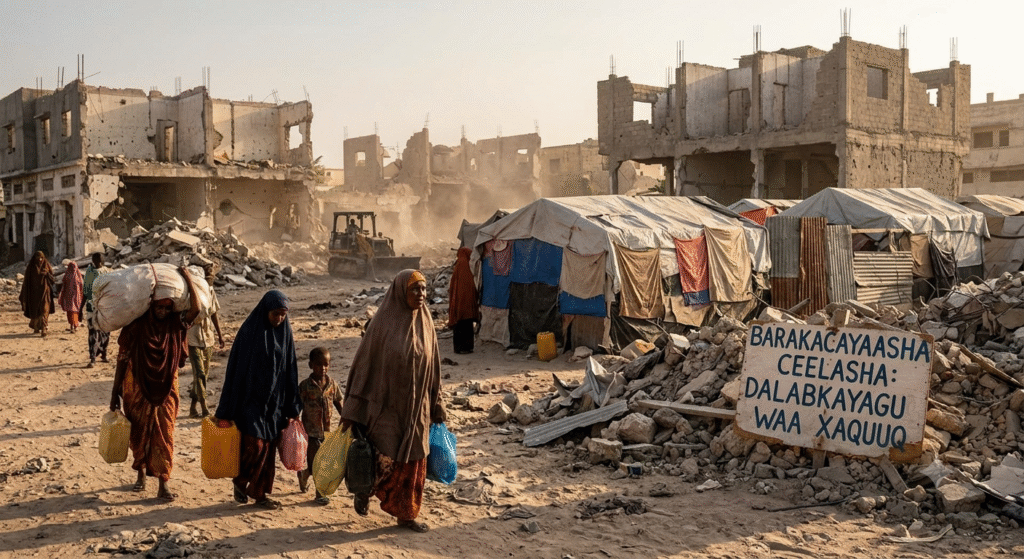
Mogadishu, Somalia’s sprawling capital, is experiencing a deepening housing crisis in August 2026. The city is simultaneously confronting a wave of government-led demolitions and forced evictions and the devastating aftermath of militant attacks, leaving thousands homeless and sparking violent protests. This dual crisis has become a defining challenge for the federal government as it attempts to assert control and redevelop the city.
The Government’s Demolition Campaign
A controversial government campaign to reclaim public land in Mogadishu has resulted in the destruction of hundreds of homes, fueling violent clashes between residents and security forces. The operations, which the government justifies as urban redevelopment projects and clearance of illegally built structures, have displaced families across several districts, including Wabari, Hamar Jajab, Daynile, and Yaqshid .
The violence escalated sharply on August 23, when clashes erupted in the Tookiyo neighbourhood of Yaqshid district. Residents resisting home demolitions reportedly exchanged fire with government forces, with witnesses describing deaths and injuries . Angry protesters burned tyres in the streets as authorities moved in, and security forces were heavily deployed to quell the unrest .
On August 13, similar protests in the Wabari district turned violent when residents accused government forces of using live ammunition against civilians resisting evictions. At least one civilian was wounded and taken to hospital, according to protesters . Residents and opposition figures have accused the administration of President Hassan Sheikh Mohamud of facilitating land grabs for private business interests rather than public benefit .
Humanitarian and Legal Consequences
The demolition campaign has deepened a pre-existing displacement crisis. The United Nations has warned that more than 142,000 internally displaced people have been forcibly removed from temporary shelters in Somalia since the beginning of 2025 . Many of Mogadishu’s residents live in informal settlements, and rapid urbanization driven by the displacement of over 3.5 million people across Somalia has placed immense pressure on housing and land in the capital .
The actions have drawn strong criticism from religious and legal authorities. On August 19, the Union of Somali Ulema Councils condemned the government’s approach, calling for an independent investigation into land disputes and demolitions . The scholars stated that “property should not be taken away from citizens without justice and a proper legal process” and warned businesspeople and property brokers against involvement in transactions involving land acquired through oppression .
A Ray of Hope: The Garasbaley Housing Project
Amid the violence and displacement, the International Organization for Migration (IOM) has completed a significant housing project in the Garasbaley district, offering a model for sustainable housing solutions. The project provides improved shelter for 600 vulnerable families, including 400 transitional housing units, water access points, solar lighting, drainage systems, all-weather roads, and a community multipurpose centre .
Funded by the European Union, the initiative is notable for its focus on land tenure security, providing participating households with at least five years of protection against forced eviction . “Access to housing is much more than a roof over someone’s head. It is about safety, dignity, stability, and the opportunity for families to rebuild their lives,” said Prestage Murima, Deputy Chief of Mission of IOM Somalia .
Conclusion
Mogadishu’s broken homes reflect a city under siege from multiple fronts—the bulldozers of its own government and the bombs of militants. The Garasbaley project demonstrates that sustainable, rights-based housing solutions are possible . However, without addressing the underlying issues of land governance, legal accountability, and transparency in urban development, the cycle of demolition, displacement, and protest is likely to continue, deepening the trauma of a city already scarred by decades of conflict .
