

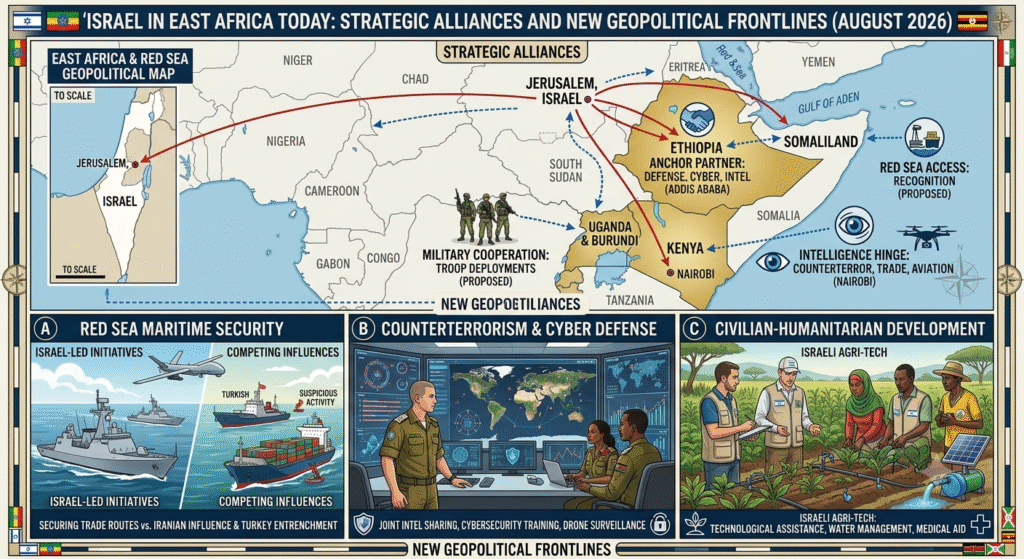
Israel’s presence in East Africa has entered a transformative phase in August 2026, marked by deepening military cooperation, a highly controversial diplomatic gambit in the Horn of Africa, and the emergence of a new strategic role for East African forces in the Gaza Strip. This multifaceted engagement reflects Israel’s broader strategy of diversifying its alliances and securing strategic footholds in a region that sits at the crossroads of global maritime trade and Middle Eastern conflict .
A Controversial Gambit: The Somaliland Recognition
The most consequential and contentious Israeli action remains its formal recognition of the breakaway region of Somaliland as an independent state in December 2025. This made Israel the first UN member state to extend such recognition, triggering immediate condemnation from Somalia and reverberating across the region .
Israel’s Strategic Calculus: The motivation is widely seen as strategic rather than humanitarian. Israeli Defence Minister Israel Katz confirmed that Israel has cooperated with Somaliland “for years” in classified activities and is now committed to taking security cooperation “to a new level” . The region’s Berbera port, located near the strategic Bab el-Mandeb strait—a chokepoint for global maritime trade—is the key prize. A presence in Somaliland would place Israel less than 400 miles from Houthi military assets in Yemen, offering significant advantages for intelligence gathering and countering threats to shipping .
Regional Backlash: Somalia has vehemently rejected the recognition and the subsequent opening of a Somaliland embassy in Jerusalem, calling it a “flagrant violation of international law” and an attack on its sovereignty and territorial integrity . Mogadishu has warned it reserves the right to “adopt all necessary legal and diplomatic measures” to protect its unity . The African Union and Arab League have also condemned the move, aligning with Somalia’s position .
Internal Divisions: Within Somaliland itself, the decision has sparked political and ideological divisions. Opposition leaders have rejected the embassy’s location in Jerusalem, citing the Somaliland constitution’s commitment to international law and the deep Islamic faith of the population, which regards Al-Aqsa Mosque as inviolable . This division threatens the long-term sustainability of the Israel-Somaliland partnership .
Deepening Security Cooperation with Regional Powers
Beyond Somaliland, Israel is quietly but effectively reinforcing its longstanding military and security partnerships with key East African nations .
Ethiopia: A Strategic Reset: In February 2026, Israeli President Isaac Herzog made a state visit to Ethiopia, marking a significant moment in the 70-year-old partnership . Israel is attracted to Ethiopia as an observation post on Somali militants and their ties to Iran-backed Houthi militias . For Ethiopia, cooperation with Israel serves its regional ambitions, including its quest for access to the Red Sea . Analysts note that Ethiopia is a key point of intersection in the regional rivalry, attempting to balance relations between competing external actors .
Uganda and Burundi: From East Africa to Gaza: In a development with profound implications, military officials from Uganda and Burundi visited Israel in late August 2026 to discuss deploying troops to Gaza as part of a proposed international stabilisation force . Uganda has committed around 1,200 personnel, while Burundi is finalising its participation .
Ugandan military chief Gen. Muhoozi Kainerugaba has previously expressed readiness to send forces to fight alongside Israel, underscoring the depth of military ties . Both countries have gained considerable peacekeeping experience through long-term deployments in Somalia and have shown they are willing to tolerate high casualties without withdrawing .
Kenya: A Crucial Security Partner: Kenya remains a vital security partner for Israel, with cooperation spanning defence, intelligence sharing, and counter-terrorism . Recent meetings between Kenyan and Israeli officials have focused on deepening strategic cooperation in key sectors, including defence, agriculture, food security, and renewable energy .
East Africa as a New Geopolitical Frontier
Israel’s engagement in East Africa cannot be separated from the broader geopolitical context. The Iran war has brought Africa into the spotlight of the military calculations of both Israel and Iran . Israel’s network of military relationships in the region—dating back to the 1960s and 1970s—includes training, arms deals, surveillance systems, and airport security .
This regional security architecture is now being tested. Uganda’s public declaration of readiness to support Israel is the most visible sign of this network’s activation . Reports indicate that Israeli commandos are training local forces in “urban combat” across 12 African countries, including Ethiopia, Rwanda, Kenya, and Tanzania . These programmes, coordinated by the military, Mossad, and the Shin Bet, serve a dual purpose: strengthening diplomatic relations and creating a network of forces that could potentially support UN peacekeeping missions on Israel’s borders .
Conclusion
Israel’s presence in East Africa today is a complex, multi-layered strategy that combines diplomatic gambits, security cooperation, and military engagement. The Somaliland recognition represents a high-risk gamble, drawing condemnation and threatening to destabilise the region, while the deepening ties with Uganda, Burundi, Ethiopia, and Kenya represent a sustained effort to build a reliable network of strategic partners. As East Africa becomes increasingly intertwined with Middle Eastern conflicts, the coming months will reveal whether Israel’s ambitions in the region will lead to long-term influence or become entangled in a broader regional confrontation.
