

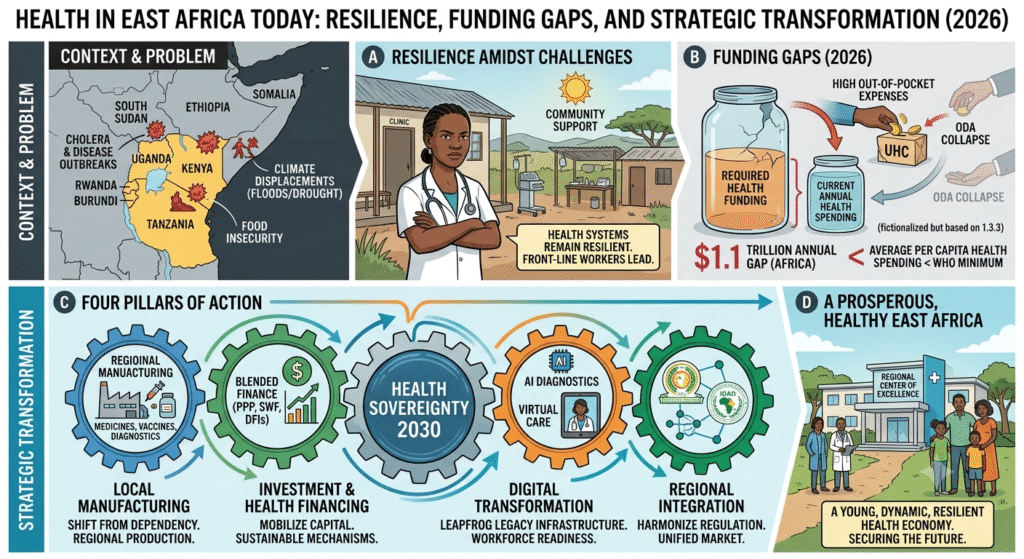
East Africa’s healthcare sector is at a pivotal moment in August 2026, confronting the dual pressures of an ongoing Ebola outbreak and the long-term fallout from reduced international funding. Yet, health leaders are also advancing a forward-looking agenda aimed at transforming healthcare from a story of vulnerability into a source of regional strength through local manufacturing, digital innovation, and deeper integration.
🚨 Ebola: A Region on High Alert
The immediate and most urgent public health threat is the ongoing Ebola outbreak caused by the rare Bundibugyo virus strain, for which there is currently no licensed vaccine or targeted treatment . First declared on May 15, 2026, in the Democratic Republic of Congo’s Ituri province, the outbreak has tested the region’s collective capacity for cross-border response .
The EAC has activated mobile laboratories at strategic border points, deployed over 180 rapid response experts, and convened emergency ministerial meetings to coordinate regional action . Uganda’s rapid containment of local transmission has been praised as a success story, but the DRC faces far greater challenges, with the outbreak now spanning 51 health zones across five provinces .
However, the regional response faces a critical funding wall. With approximately $80 million of the 2025/26 EAC budget still unpaid, the financial resources to sustain the Ebola response are not yet in place . The EAC hopes that Kenya’s increased contribution under a new funding formula, coupled with European Union support, will unlock the resources needed. Africa CDC has warned that only about 12 percent of expected Ebola contacts are currently under active follow-up, creating significant transmission risks .
💰 A Health System at a Crossroads: The Funding Gap
Beyond the immediate crisis, the region’s health systems are grappling with a structural funding gap following the withdrawal of US government support . The closure of USAID has eliminated approximately 80% of US humanitarian assistance for sub-Saharan Africa, including its contribution to health financing in the region .
Kenya provides a stark illustration of the impact. External funding for health fell from Sh126 billion to Sh54 billion in the 2025/26 financial year, following the withdrawal of US government support and a decline in government funding . Reports indicate that vulnerable populations, including pregnant women, children, and adolescents, are likely to be disproportionately affected, with the 41,170 PEPFAR-supported staff across the country facing an uncertain future . The funding gap has also impacted commodities for HIV, TB, and malaria, with the commodity funding gap alone widening to Sh34.655 billion .
“External funding has long played a significant role in Kenya’s health sector, but it is unpredictable and unsustainable,” said Dr David Khaoya of the University of Nairobi’s Centre for Epidemiological Modelling and Analysis. “This funding shock is a wake-up call” . The HIV and AIDS crisis illustrates the human cost: an estimated 5 million people living with HIV across Kenya, Tanzania, and Uganda face shortages of life-saving antiretroviral drugs .
🏗️ Building Resilience: Local Manufacturing and Strategic Investment
In response to these vulnerabilities, health leaders are pushing for a fundamental shift toward local production and regional integration. Speaking at the 13th East African Health Federation Conference in Addis Ababa in August, IGAD Executive Secretary Workneh Gebeyehu called for expanded domestic medical manufacturing, enhanced public-private partnerships, and accelerated cross-border integration .
Ethiopian Deputy Prime Minister Temesgen Tiruneh captured the ambition clearly: “Resilience cannot mean simply recovering from the last crisis. It must mean preparing for the next one by building our capacity to act and turning health from a story of vulnerability into a source of African strength” .
The numbers explain the urgency. Africa currently produces only about 1 percent of the vaccines it needs, and the continent has set a target of producing 60 percent locally by 2040 . The African Continental Free Trade Area is seen as a key opportunity to expand the pharmaceutical market and encourage greater investment .
📊 Maternal and Child Health: Progress Amid Pressures
Despite the funding challenges, Kenya continues to advance targeted interventions to reduce preventable maternal and newborn deaths. The government has launched the Every Woman Every Newborn Everywhere (EWENE) Acceleration Plan 2026–2028 . The initiative includes a KSh4 billion allocation through the Social Health Authority to expand maternal healthcare coverage, KSh1 billion for essential commodities, and recruitment of 5,000 nurses and midwives .
In August 2026, Health Cabinet Secretary Aden Duale announced the establishment of 10 comprehensive maternal and newborn health facilities in counties with the highest burden, supported by a KSh4.4 billion grant from the Amsons Group through the Mama na Mtoto Kwanza initiative . Each 250-bed facility will integrate antenatal and postnatal care, obstetric and neonatal intensive care, and surgical services, creating a comprehensive continuum of care .
🖥️ Digital Health: The Future of Surveillance and Care
The future of East Africa’s health systems is increasingly digital. The LINDA-FAMILIA project, a €4.9 million Horizon Europe-funded digital health initiative, is being implemented across Ethiopia, Rwanda, Tanzania, and Uganda . The project will capture pregnancy, postpartum, neonatal, and paediatric data, including infectious diseases and vaccinations, supporting disease surveillance and clinical research .
The EAC has also launched the TEACH programme to strengthen clinical management capacities for High Consequence Infectious Diseases through training in critical care, infection prevention, and personal protective equipment protocols .
🩺 Conclusion: A Region on the Move
East Africa’s health sector is navigating a complex transition. The immediate Ebola crisis exposes ongoing vulnerabilities in cross-border surveillance and response capacity , while the withdrawal of US funding highlights the fragility of systems built on international aid . Yet, health leaders are also seizing the moment to pursue a different vision: one of local manufacturing, regional integration, strategic investment, and digital transformation .
The challenge of the coming months will be to translate the ambitious declarations at forums like the Addis Ababa Health Federation Conference into tangible investment, while ensuring that the immediate health needs of the region’s most vulnerable populations are not forgotten in the push for long-term structural change.
