

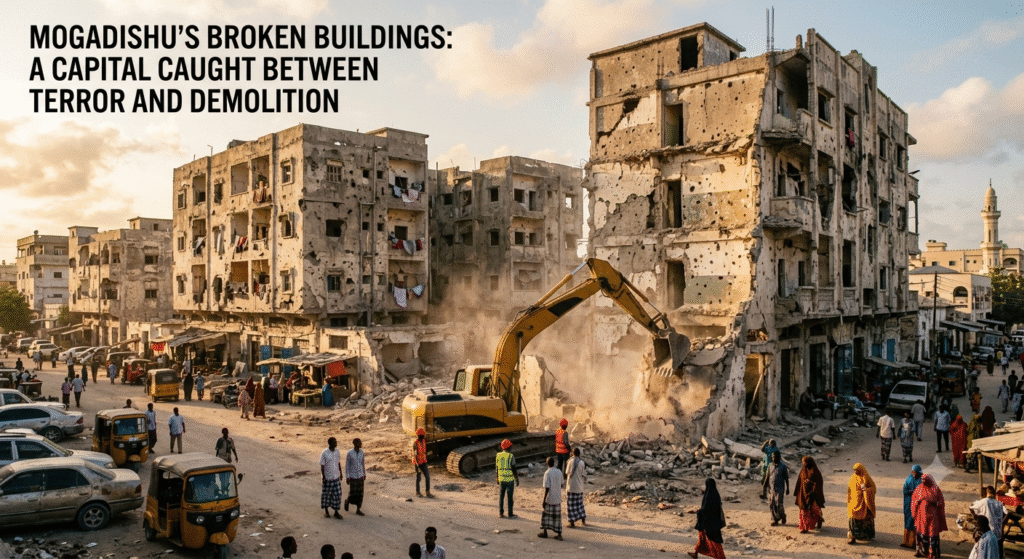
Mogadishu’s skyline tells a story of a city under siege—not just from militants, but from its own government’s push to reclaim land. From bombed-out hotels and collapsed council buildings to homes reduced to rubble by state-sanctioned bulldozers, the Somali capital is witnessing a relentless cycle of destruction that has left hundreds dead and thousands displaced.
💥 Terror Attacks: Bombs and Buildings in Ruins
The most visible cause of destruction is Al-Shabaab’s sustained campaign of bombings targeting Mogadishu’s key infrastructure. In a devastating attack this March, a lorry packed with explosives detonated near the entrance of the Safari Hotel in the Hodan district, killing at least 30 people. The hotel collapsed, with people feared trapped under the debris . Residents described it as “the biggest blast I have ever witnessed, it destroyed the whole area” .
Days earlier, an attack on the Mogadishu municipality building killed six people, including the deputy mayors and three department heads, and wounded the mayor himself. A suicide bomber infiltrated the building by disguising himself as a staff member. The UN’s James Swan, who had left the building shortly before the blast, condemned the “despicable attack” .
In April, a 30-hour siege of the popular Hayat Hotel left parts of the building in ruins, killing 21 people and wounding 117. Emergency workers had to clear debris and explosives from the premises after the gunfight. Families gathered frantically outside, desperate for news of trapped loved ones . In a separate incident, a truck bomb near the port killed at least 276 people and injured 300 .
Mortar attacks have become a near-daily occurrence. In mid-August, Al-Shabaab launched shells at Aden Adde International Airport and the heavily fortified Halane compound that houses UN and foreign missions. A Turkish plane was rerouted to Djibouti, and EgyptAir cancelled its flight .
🏚️ Government Demolitions: A Different Kind of Destruction
While Al-Shabaab strikes with car bombs, the government is carrying out its own demolition program that has sparked violent protests. On August 23, clashes erupted in Mogadishu’s Yaqshid district’s Tookiyo neighbourhood when security forces moved to demolish homes on land the government claims is state-owned. At least one person was killed and ten injured as residents resisted, burning tyres and confronting soldiers .
Witnesses said the operation began without adequate warning. Residents insist they hold legal documents proving ownership, while opposition groups accuse the government of illegally auctioning public land to businesspeople. “The recurring unrest underscores how fragile Mogadishu’s urban land governance remains, and how quickly such disputes can turn violent,” one report noted . Images circulating online showed injured young men being admitted to hospitals .
This is not the first such incident. Similar demolitions across the capital have led to protests, forced evictions, and armed confrontations—sometimes even between rival elements of the security forces themselves . Human rights advocates have repeatedly called for transparency and due process before demolitions, warning that unannounced evictions “risk further displacing already vulnerable, low-income families” .
🩸 Political Conflict: The City as Battlefield
In June, Mogadishu’s streets literally became a warzone. Government forces and opposition-aligned militias fought intense battles across the city after President Hassan Sheikh Mohamud announced a one-year extension of his mandate past its May 15 expiry. Mortar rounds struck the densely populated Bakara Market, the city’s largest business hub, and residential areas .
Residents described the fighting as the most intense in years. “I haven’t seen fighting like this in five years. In 2021 there was fighting, but this is far more intense than anyone expected,” a resident said. The violence forced civilians to flee their homes . Former President Sharif Sheikh Ahmed claimed government forces targeted his residence, while ex-Prime Minister Hassan Ali Khaire accused troops of using heavy weapons including anti-tank missiles and drones in populated areas . The UN Secretary-General condemned all acts of violence “committed for political gain” .
🌊 The Long-Term Challenge: Displacement and Fragility
Mogadishu’s broken buildings are not just physical ruins—they represent a deeper breakdown in governance, security, and the rule of law. The attacks have shattered vital infrastructure like hotels, government offices, and the airport, undermining attempts at recovery. The demolitions and land disputes reflect the government’s weak legitimacy and its inability to balance development with social protection.
As the UN has repeatedly warned, when humanitarian workers and civilians are caught between bombs and bulldozers, the ultimate cost is borne by the most vulnerable. Mogadishu’s residents continue to live in the shadow of destruction, uncertain whether the next explosion will come from a suicide bomber or a government eviction notice.
