

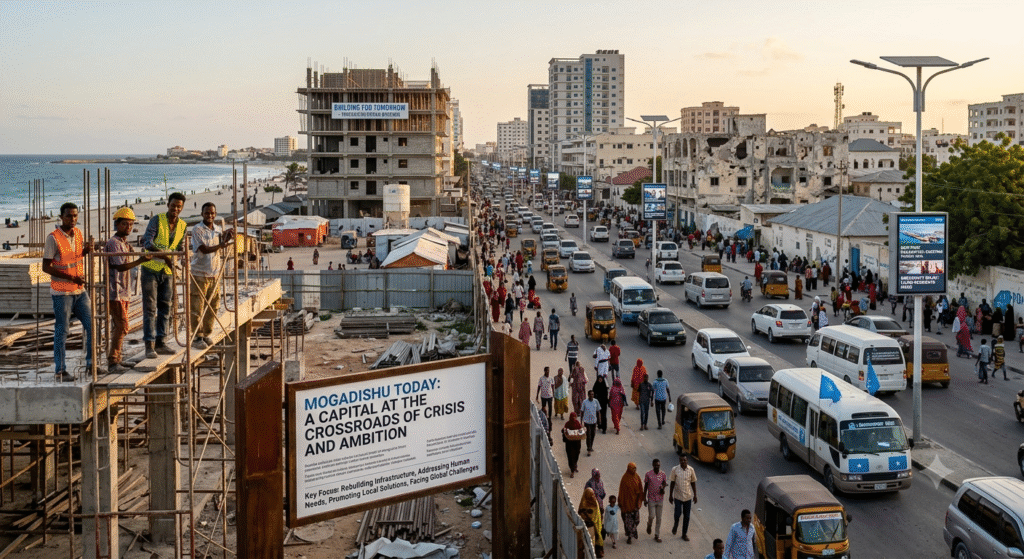
Mogadishu, Somalia’s sprawling coastal capital, is a city of stark contradictions in August 2026. As the seat of the federal government and the nation’s economic engine, it is simultaneously a hub of ambitious development initiatives and a city under siege, grappling with a deepening humanitarian crisis, a persistent security threat, and a humanitarian funding gap that is leaving millions without access to life-saving aid .
🚨 A Deepening Humanitarian Emergency
The humanitarian situation in Mogadishu and the wider country is deteriorating at an alarming rate. According to the United Nations World Food Programme (WFP), Somalia is entering a “severe new phase” of hunger, driven by a relentless combination of persistent drought, intensifying conflict, mass internal displacement, and rising food and fuel prices . The severity of the crisis has been exacerbated by a sharp reduction in international humanitarian funding.
One third of Somalia’s population is now facing acute hunger or worse, with nearly two million people experiencing emergency levels of food insecurity . These are not just statistics; they represent families who are exhausting every last option to survive.
The malnutrition crisis is particularly dire. It is estimated that 1.88 million children under the age of five will suffer from acute malnutrition in 2026. Of these, nearly 493,000 will require urgent treatment for severe acute malnutrition, the deadliest form of hunger . WFP has been forced to drastically reduce its operational reach due to severe funding shortfalls, meaning it can only assist a fraction of those in desperate need .
To address this escalating catastrophe through February 2027, WFP has urgently appealed for 198 million U.S. dollars .
🛡️ Security and Al-Shabaab Operations
While humanitarian needs mount, the security situation remains volatile. The Somali National Intelligence and Security Agency (NISA), backed by international partners, has been conducting targeted counter-terrorism operations against Al-Shabaab militants in the regions surrounding Mogadishu.
In a recent operation in the Middle Shabelle region, NISA forces killed nine Al-Shabaab militants, including two senior commanders: Ahmed Ali Jimale, the top commander for the Jowhar district, and Gedi Mohamed Nur Adde, the head of operations in the Dumaaye and Dabagaalo areas . A separate joint operation in the Tardo area of the Hiran region on August 15 successfully eliminated eight militants, including three high-ranking leaders responsible for the eastern Hiran extortion network . The Somali government has vowed to sustain these offensive operations until the security threat to the nation is fully neutralized .
Despite these tactical successes, the threat remains. The city has also experienced attacks on its security forces, a grim reminder of the insurgents’ capacity to strike at the heart of the capital .
⚓ New Maritime Ambitions and Global Attention
Amidst these challenges, Mogadishu is projecting a vision of a more prosperous future. In early August, the city hosted Somalia’s inaugural maritime conference, a landmark event aimed at unlocking the vast potential of the country’s “blue economy” .
President Hassan Sheikh Mohamud, who opened the two-day forum, called on global investors to capitalize on the nation’s extensive coastline, which is the longest in mainland Africa . The president framed the maritime sector as a vital strategic asset capable of driving economic growth, creating jobs, enhancing regional connectivity, and reshaping international perceptions of its waters away from a focus on piracy and insecurity . The conference addressed strategies to boost maritime trade and shipping, develop port infrastructure, and expand commercial fishing .
This push for economic development comes as the maritime domain itself faces renewed security challenges. The European Union’s anti-piracy naval force, Operation Atalanta, recently launched an investigation into the hijacking of an oil-products tanker off the Somali coast . The MT Sibu 1, an Eritrea-flagged vessel carrying 20 crew members, was seized by six armed pirates in the Gulf of Aden . This incident serves as a stark reminder that the threat of piracy, while diminished, has not been eradicated.
🏙️ Conclusion: A City’s Battle for Resilience
Mogadishu in August 2026 is a city fighting on multiple fronts. It faces the daily reality of a devastating hunger crisis that is pushing millions to the brink, a persistent security threat that demands constant vigilance, and a maritime domain that is both a source of potential prosperity and ongoing risk. Yet, the government is simultaneously pushing forward with a forward-looking economic agenda, seeking to transform its coastline into an engine for growth and stability . The success of this ambition, however, is contingent on overcoming the immediate crises and ensuring that the city’s most vulnerable populations are not left behind. As one UN official noted on World Humanitarian Day, “When humanitarian workers are attacked or prevented from reaching people in need, it is civilians who ultimately pay the price” .
