

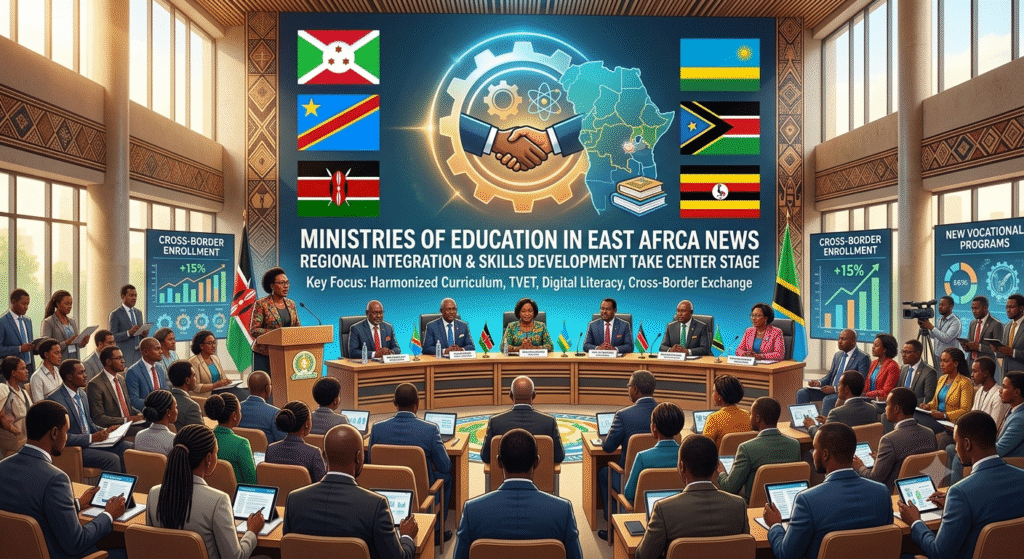
East African education ministries are actively shaping the region’s future through major policy reforms, skills development frameworks, and regional collaboration in August 2026. From Kenya’s vocational education partnership with China to Tanzania’s comprehensive skills agenda and Uganda’s enforcement of academic calendars, the region’s education landscape is undergoing significant transformation.
🔬 Kenya: Vocational Training Partnership and School Reopening Confirmed
Kenya’s Ministry of Education is deepening its partnership with China to strengthen technical and vocational education and training (TVET), a move directly linked to the country’s industrialization agenda. Esther Thaara Muoria, Principal Secretary for TVET, described the Kenya-China cooperation as a “strategic and long-term partnership” that is driving industrialization and strengthening the country’s technical workforce .
Launched in 2010 and now in its third phase, the project will equip approximately 70 TVET institutions across eight disciplines, with 1,190 trainers and technicians receiving training in Kenya and China . An innovation center at Kabete National Polytechnic will serve as a hub for training, production, and technology transfer .
The partnership has evolved significantly beyond equipment provision. According to Muoria, “the cooperation has progressed from simply providing equipment to a more comprehensive model that combines infrastructure, modern equipment, human resource development, technology transfer, innovation and institutional capacity building” . Graduates equipped with practical skills are increasingly finding employment in manufacturing, engineering, energy, transport, and renewable energy .
Priority areas for future cooperation include artificial intelligence, intelligent manufacturing, the digital economy, new energy and green technologies, as well as entrepreneurship .
On a separate front, Education Cabinet Secretary Julius Ogamba confirmed that schools will reopen for Term III on August 24 as scheduled, dismissing social media reports of a postponement as false . The term will run for nine weeks until October 23, followed by national assessments and KCSE examinations commencing October 26 .
President William Ruto directed the Ministry to provide Sh5 million to every school that participated in the Kenya Music Festival State Concert in Bungoma, a move intended to boost creative education and talent development . The President also emphasized proposed higher education reforms that would link student placement with financial support, ensuring students can pursue their chosen courses regardless of cost .
🇹🇿 Tanzania: Unified Skills Agenda for Vision 2050
Tanzania is replacing fragmented efforts with a coordinated national skills agenda, anchored in six complementary policy instruments. The shift reflects recognition that the country has sufficient frameworks but faces implementation challenges requiring stronger collaboration among government, universities, TVET institutions, and industry .
Speaking at the National Education, Skills and Innovation Week in Tanga, Permanent Secretary Prof Carolyne Nombo stated: “The issue is no longer whether we have policies. We should see how we can implement the already existing frameworks which are well articulated to improve competence at all stages of education” .
The government’s approach is anchored in six instruments covering the entire skills ecosystem:
- Tanzania Development Vision 2050: Positions human capital, science, technology and innovation as foundations of a competitive, knowledge-based economy .
- Education and Training Policy (2014, 2023 Edition): Promotes competence-based learning aligned with national development priorities .
- Second National Skills Development Strategy: Targets high-employment sectors including ICT, construction, transport, tourism, agribusiness and energy .
- National Framework for Academia-Industry Collaboration: Brings employers into curriculum design, internships, and graduate assessment .
- Tanzania Qualifications Framework: Creates pathways between vocational, technical and university education .
- TVET Quality Standards 2025: Requires providers to strengthen industry partnerships and ensure instructors keep pace with technological change .
Implementation is being accelerated through the Second Education and Skills for Productive Jobs Programme (ESPJ-II), a Sh780 billion ($300 million) six-year initiative expected to benefit more than one million Tanzanians . The government has also launched the Mama Samia skills recognition and certification programme targeting 80,000 artisans by 2027 .
Science, technology and innovation are being positioned as the engine driving Tanzania’s Development Vision 2050. Education, Science and Technology Minister Prof Adolf Mkenda linked ongoing reforms to the ambition of developing the country’s own scientists, engineers, technicians and innovators . The Samia Scholarship provides full government sponsorship for top-performing Form Six students pursuing priority science-related disciplines, with expanded programmes supporting study in advanced technologies including artificial intelligence abroad .
🇺🇬 Uganda: Enforcing School Calendars and Protecting Free Education
Uganda’s Ministry of Education and Sports has condemned the widespread practice of holiday teaching, warning that it denies learners time to rest and bond with families. State Minister for Education Peter Ogwang urged members of the public to report schools conducting unauthorized holiday teaching through a toll-free hotline (0800 377 771) .
The warning followed concerns raised in Parliament by Shadow Minister of Sports Bulasio Zambaali, who described holiday coaching as “rampant and unregulated” in both private and government-aided schools . Speaker Jacob Marksons Oboth treated the complaint as urgent, describing it as a serious matter affecting the entire country .
The State House Education Desk has also warned government school administrators against imposing illegal charges under Universal Primary Education (UPE) and Universal Secondary Education (USE) programmes. Jimmy Nambiro, head of the Education Desk, described free education as a flagship programme of the NRM government and a key intervention to ensure vulnerable children can attend school .
The government currently supports more than 12,551 primary schools and 1,615 secondary schools, with the number of children in school rising from approximately 2.5 million before the programme to roughly 10 million today . Nambiro warned that several head teachers, school inspectors, and district education officers are under investigation over alleged violations, with those found culpable facing disciplinary or legal action .
🌍 Regional Integration: EAC Advances Skills Framework and Education Conference
The East African Community has validated a revised TVET Qualifications Framework to advance regional skills mobility. Experts from EAC partner states met in Dar es Salaam from August 11 to 14 to review the framework, which aims to support comparability, portability, and mutual recognition of TVET qualifications across the region .
The framework is designed to provide a common regional reference point for qualifications while respecting national qualifications systems . Discussions focused on terminology consistency, qualifications portability and recognition, industry engagement, recognition of prior learning, credit accumulation and transfer systems, and quality assurance .
The EAC will convene the 2nd Regional Conference on Education in Nairobi from August 24 to 28, 2026. The conference, themed “Transforming Education in East Africa: From Commitments to Impact, Fostering Resilience and Future-Ready Systems for Sustainable Development,” aims to move from policy commitments to measurable and sustainable impact .
The conference will review progress since the 1st EAC Regional Conference in Arusha (August 2024), identify systemic gaps, and agree on priority actions to accelerate education transformation . Particular attention will be given to strengthening foundational learning, teacher capacity, inclusive education, future-ready skills, digitalisation and innovation, and improving education financing and governance .
Daystar University has been selected to host EAC Scholarship Programme beneficiaries for the Master of Science in Economics, starting January 2027. The scholarship, funded by a EUR 9 million grant from Germany, is available to applicants from all EAC partner states and emphasizes leadership development, mentoring, and regional integration activities .
🎯 Conclusion
East Africa’s education ministries are pursuing a multi-pronged agenda in August 2026: deepening vocational training partnerships, implementing comprehensive skills frameworks, enforcing academic calendars and protecting free education, and advancing regional qualifications mobility. The EAC Regional Conference on Education and the validated TVET Qualifications Framework represent significant steps toward harmonizing the region’s education systems and creating a competitive, skilled workforce capable of driving sustainable development . The challenge now lies in translating these frameworks and commitments into measurable outcomes for East Africa’s students.
