

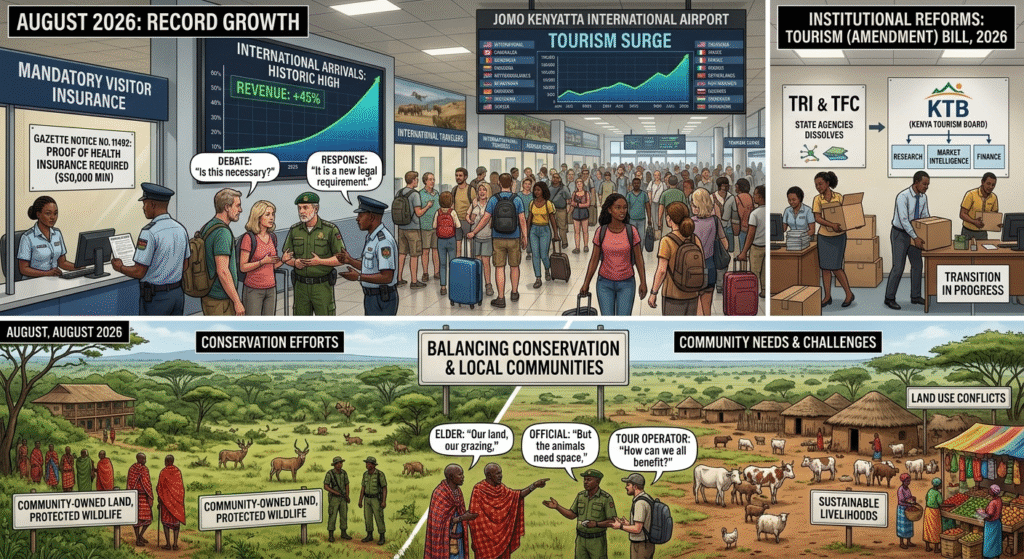
🏆 Record Growth and Economic Impact
The numbers from the 2025/26 financial year paint a clear picture of a sector in full recovery. International visitor arrivals have more than doubled since 2021/22, reaching 2.76 million, a 9.8% increase over the previous year . This surge in visitors has had a direct economic impact, with tourism revenue climbing to a record Sh564 billion, a significant jump from Sh224 billion just four years ago .
Tourism and Wildlife Cabinet Secretary Rebecca Miano credits this “radical revitalisation” of the “Magical Kenya” brand to expanded flight connectivity, targeted marketing, and a push into new segments like Meetings, Incentives, Conferences, and Exhibitions (MICE), cultural tourism, and coastal holidays . This growth is creating tangible benefits across the hospitality, transport, and conservation sectors .
⚖️ Major Reforms: Streamlining the System
As the sector expands, the government is proposing legislation to make its management more efficient. A key development is the Tourism (Amendment) Bill, 2026, which is currently being reviewed by Parliament and open for public input . The bill’s primary aim is to streamline operations by merging state agencies with overlapping functions .
Under the proposed changes, the Kenya Tourism Board (KTB) would absorb the Tourism Research Institute (TRI) and the Tourism Finance Corporation (TFC) . This would give KTB a significantly expanded mandate, centralising tourism research, marketing, data, and market intelligence in one institution . If passed, the reforms would mark the most significant change to Kenya’s tourism institutional framework in years, with a focus on consolidation and a more data-driven approach .
🚧 Challenges on the Horizon
Despite the success, two major challenges could threaten future growth.
The first is the introduction of a mandatory travel health insurance requirement for all non-Kenyans visiting for less than 12 months, as per a recent Gazette Notice . The minimum benefit limit is set at $50,000 (Sh6.5 million) to cover medical expenses, emergency transportation, and other costs . While the government argues this protects visitors and the state from being left to shoulder expensive medical bills, the move has sparked a fierce online debate . Critics worry that it will make Kenya less competitive compared to regional destinations like Tanzania, Uganda, and South Africa, particularly as many international travellers already purchase their own travel insurance at home .
The second challenge is a political one. A recent incident where a prominent Kenyan investor and politician publicly urged tourists to stay away due to political instability serves as a stark reminder of the sector’s vulnerability . As tourism is critically dependent on a perception of political stability, travel advisories from Western nations following unrest are seen as a significant threat that can lead to mass cancellations and a slow recovery .
🦁 Conservation and Community: The Elephant in the Room
At the heart of Kenya’s tourism appeal is its wildlife, and balancing conservation with community needs remains a central theme. A recent visit by a high-level delegation from the World Travel & Tourism Council (WTTC) praised Kenya’s conservation model as a “global benchmark,” highlighting the success of balancing wildlife protection with sustainable tourism .
This balance is most visible in areas like the Amboseli ecosystem, where communities, such as the Maasai, are learning to live alongside elephants . Conservation programs are helping to reduce conflict while also providing tangible benefits like water access and jobs, helping to transform elephants from a source of conflict into part of the community’s “natural heritage” . However, challenges remain, including habitat fragmentation from infrastructure projects and illegal killing, as Africa’s forest elephants remain critically endangered .
