

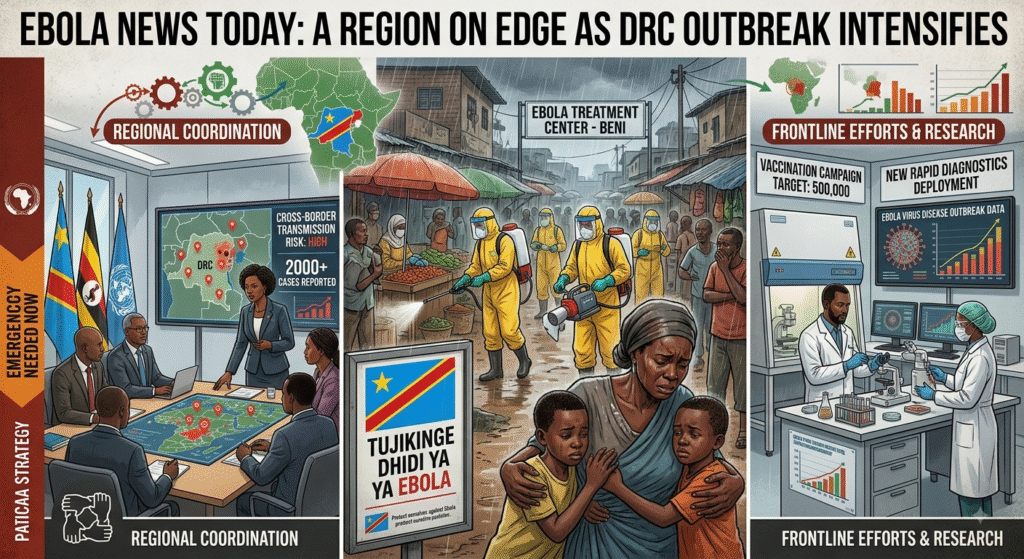
The Ebola crisis gripping East and Central Africa has entered a dangerous new phase as of August 2026. What began as a localized outbreak in the Democratic Republic of the Congo (DRC) has escalated into a regional public health emergency of unprecedented scale, with the Africa Centres for Disease Control and Prevention (Africa CDC) warning that the current outbreak “has dwarfed prior Ebola outbreaks” . With the death toll surpassing 1,800 in the DRC and confirmed cases spreading to Uganda, the region is scrambling to contain a virus that does not recognize borders .
The Epicenter: DRC’s Overwhelmed Health System
The heart of the crisis lies in the DRC’s Ituri province, where the outbreak was first declared on May 15, 2026 . As of early August, the DRC had recorded a staggering 3,973 confirmed cases and 1,801 confirmed deaths—a case fatality rate exceeding 45 percent . The outbreak is caused by the Bundibugyo strain of the Ebola virus, for which there is no approved vaccine or targeted treatment .
The situation has quickly overwhelmed the country’s fragile health system, already stretched by decades of conflict and displacement. Africa CDC officials have highlighted that the outbreak has spread from nine initially affected health zones to 51 health zones across five provinces, including Ituri, North Kivu, South Kivu, Haut-Uele, and Tshopo . The epicenter’s expansion raises profound questions about the virus’s transmission dynamics and the possibility of mutation .
Perhaps the most troubling sign of the health system’s collapse is the proportion of deaths occurring at home. The World Health Organization (WHO) has warned that between 60 and 70 percent of Ebola deaths are occurring outside treatment centers, as patients from remote communities struggle to access care in Bunia, the provincial capital . Dr. Mohamed Yakub Janabi, WHO Regional Director for Africa, noted that discussions with community leaders revealed many patients are coming from areas where treatment services are simply unavailable . He called for urgent expansion of treatment capacity, proposing an additional 400 beds for Ebola patients and another 100 for other health services to ensure routine care does not collapse amid the emergency .
Uganda: A Success Story and a Cautionary Tale
Uganda has faced the outbreak’s direct spillover, recording 20 confirmed cases and two deaths linked to cross-border transmission from the DRC . However, Uganda’s response has been widely praised as a model of effective containment. Africa CDC Director-General Jean Kaseya commended Ugandan health authorities for successfully interrupting local Ebola transmission, citing “decisive leadership, rapid detection, strong preparedness systems, and vital community engagement” .
Uganda’s success stands in stark contrast to the DRC’s struggles. The country ceased air travel to the DRC, closed multiple border crossings, and intensified screening at points of entry . Health workers were rapidly trained in infection prevention and control, and community engagement efforts were scaled up to combat misinformation .
Cross-Border Coordination: The Key to Containment
Recognizing that Ebola does not stop at national borders, regional health authorities are intensifying cross-border collaboration. On August 7, 2026, health leaders from Uganda and the DRC gathered in Vurra, Uganda, for a Cross-Border Ebola Response Meeting . The engagement brought together Africa CDC, WHO, government health teams, and implementing partners including Amref Health Africa to align response strategies and strengthen information sharing .
The meeting highlighted both successes and ongoing challenges. The Mahagi Health Zone along the Uganda-DRC border remains a concern, with persistent community resistance, misinformation, and low adherence to recommended public health measures undermining response efforts . However, signs of progress are emerging: the Aru and Ariwara health zones have recorded a reduction in new cases, with contacts in Ariwara approaching completion of the 21-day follow-up period .
Regional Response: The EAC and Africa CDC Mobilize
The East African Community (EAC) has activated a coordinated regional strategy to contain the outbreak. During the 8th Extraordinary Meeting of the EAC Sectoral Council of Ministers of Health, member states agreed to harmonize Ebola surveillance and protective measures at airports, ports, and land border crossings . They also established an EAC Regional Technical Taskforce on Ebola Response to monitor the outbreak, coordinate technical interventions, and provide regular updates to policymakers .
Partner states have been directed to strengthen monitoring at points of entry and facilitate the deployment of EAC mobile laboratories to strategic locations, including border points and identified hotspots . The EAC is also working closely with the Uganda Virus Research Institute (UVRI) as the Regional Centre of Excellence to strengthen laboratory diagnostic response .
Critical Gaps and Funding Shortfalls
Despite these efforts, the response faces several critical constraints. Africa CDC has identified limited contact tracing as a major challenge, with only about 12 percent of expected contacts currently under active follow-up . This gap is compounded by insecurity, armed conflict, and attacks on health facilities—a reality that has become “an emergency within the emergency” .
Funding remains a persistent obstacle. While African states and international partners pledged approximately $910 million for the Ebola response, only $90 million has been disbursed . The Africa CDC has called for immediate release of pledged funds, warning that the current financial shortfall is undermining the response’s effectiveness .
The Road Ahead
The coming weeks will be critical. WHO officials estimate that the next eight to twelve weeks will determine whether the outbreak can be brought under control . To succeed, health authorities must overcome community resistance, strengthen contact tracing, expand treatment capacity, and address the root causes of delayed care-seeking.
For East Africa, the stakes could not be higher. The EAC has designated 11 countries as high-risk, including South Sudan, Rwanda, Kenya, Zambia, Tanzania, Ethiopia, and Somalia . As health teams on the ground continue their tireless work, the global community faces a stark choice: invest now in the response, or pay a far heavier price later.
