

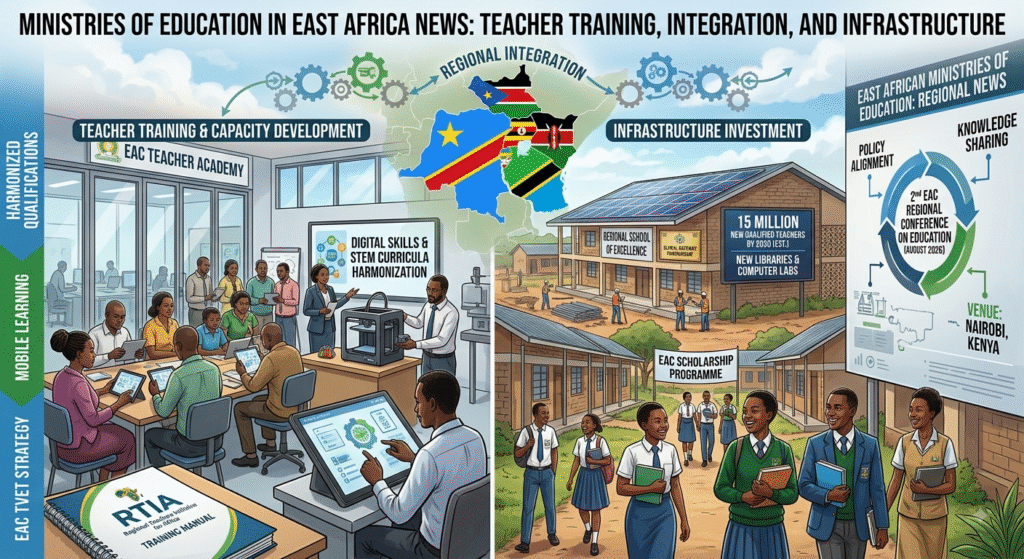
East African education ministries have been active across multiple fronts in August 2026, announcing significant reforms, launching infrastructure projects, and advancing regional integration efforts. From Rwanda’s overhaul of teacher education to infrastructure modernization in Kenya and cross-border higher education harmonization, the region’s education sector is undergoing a period of substantial transformation.
Rwanda: Comprehensive Education Reforms for Vision 2050
Rwanda’s Ministry of Education announced on August 1 a sweeping package of reforms to be rolled out from the 2026/2027 academic year, aimed at improving education quality and supporting the country’s Vision 2050 aspirations.
Teacher Training Overhaul: The most significant reform targets Teacher Training Colleges (TTCs), where new students will enroll in a five-year programme instead of the current three-year curriculum. Minister of Education Joseph Nsengimana explained that the current programme provides limited time for practical classroom experience. The revised programme will place greater emphasis on teaching methods, classroom management, child development, and school-based practice. Implementation will be gradual over a ten-year period, with the first phase upgrading teacher qualifications from A2 to A1 before progressing to A0.
School Fee Revision: After remaining unchanged for five years, school fees for public and government-aided schools will be adjusted from January 2027. The government will increase capitation grants by more than 65 percent. Under the new structure, parents of pre-primary and primary learners will contribute Rwf2,000 per term for school feeding, up from Rwf975. Day scholar secondary fees increase from Rwf19,500 to Rwf24,000 per term, while boarding school fees rise from Rwf85,000 to Rwf110,000. The ministry noted these adjustments reflect current market realities based on the Consumer Price Index.
School Day Optimization: Formal lessons will now end at 3:30 p.m., after which learners will participate in sports, clubs, and other co-curricular activities until 5:00 p.m. This change responds to research indicating that learners’ concentration declines significantly after 3:30 p.m.
Kenya: Infrastructure Modernization and Sports Funding Adjustments
Sh52 Million School Upgrade: East African Community Principal Secretary Dr Caroline Karugu broke ground on a major modernisation project at Nyaribo Primary School in Nyeri County. The project, funded by a Sh50 million grant from the M-Pesa Foundation and Sh2 million from the Ministry of Education, will construct four permanent classrooms, a science laboratory, a computer laboratory, and an Early Childhood Development Education centre. Speaking at the ceremony, Karugu noted that students had been “learning imaginary science because they don’t have a science laboratory. They have been imagining what computers are and what they look like. With these projects, they will now acquire experimental learning”.
Sports Funding Constraints: The Ministry of Education has reduced the number of Kenyan teams travelling to the 2026 FEASSA Games in Morogoro, Tanzania, citing inadequate funding. Under the revised directive, only sports in which Kenya won the overall title at last year’s championships will field three teams, with all other disciplines limited to two representatives. This decision has raised the stakes for schools competing in the national semi-finals as they fight for fewer qualification slots to the regional championships.
The Ministry revised the 2026 National School Games calendar, with the Central Region hosting the event in Kiambu County from July 31 to August 7. Participating teams then attended a training camp from August 8 to 10 before departing for the FEASSA Championships in Morogoro.
Kiswahili Council Development: In a move to strengthen language education, Kenya’s Cabinet Secretary for Education Julius Migos Ogamba announced that the country has begun the process of establishing a Kenya Kiswahili Council. At the Chakama Conference at Kisii University, Ogamba directed officials to begin preparing the first draft for the council’s establishment, aligning with regional efforts to position Kiswahili as a language of knowledge and innovation.
Regional Integration: Higher Education and Skills Development
EAC Common Higher Education Area: Higher education has emerged as a central focus for regional integration. Minister of State for Education Claudette Irere emphasized that “if we are to realise meaningful regional integration, education, particularly higher education, must play a critical and central role”. Speaking at a stakeholders’ sensitisation forum on the EAC Common Higher Education Area in Kigali, Irere stressed that universities are key to producing the skilled workforce needed to drive economic, social, and technological transformation across the region.
The forum, organized by the Inter-University Council for East Africa (IUCEA), discussed frameworks for harmonizing higher education systems, including common quality assurance frameworks, harmonised qualifications systems, and increased student and staff mobility. Irere cautioned against policies that hinder academic mobility, noting that “charging different tuition fees to students from other EAC partner states can limit access and mobility. Education should bring our people together, not create new barriers between them”.
IUCEA Acting Executive Secretary Idris Rai highlighted the growing importance of artificial intelligence in shaping higher education, stating that universities must adapt to the rapidly evolving global education landscape. IUCEA has launched training programmes for academic staff on the use of AI in teaching, learning, and research.
Competency-Based Education and Training: The African Institute for Capacity Development (AICAD) met with Uganda’s Permanent Secretary for Education Dr Kedrace Turyagyenda to discuss advancing Competency-Based Education and Training in Uganda. The meeting reaffirmed AICAD’s commitment to strengthening skills development across Kenya, Tanzania, and Uganda.
Global Scholarship Opportunities: 121 students from Kenya, Uganda, Rwanda, and the Democratic Republic of Congo secured scholarships worth over $23.4 million (about Sh3 billion) to pursue undergraduate studies at top universities worldwide. The Equity Leaders Program beneficiaries will join 63 universities in 16 countries, with 20 scholars admitted to Ivy League institutions. This brings the cumulative number of ELP beneficiaries admitted to Ivy League schools to 240.
Kiswahili Digital Development: The Executive Secretary of the East African Kiswahili Commission, Dr Caroline Asiimwe, called on EAC member states to strengthen collaboration in research, education, and technology development to ensure Kiswahili becomes part of the digital and artificial intelligence revolution. She stressed that Kiswahili must contribute to developing future knowledge and technologies rather than merely consuming advances developed in other languages.
Conclusion
East Africa’s education ministries are tackling challenges across multiple fronts: infrastructure deficits, teacher quality, regional harmonization, and language development. The contrast between Rwanda’s systematic teacher training reforms and Kenya’s infrastructure modernization reflects different national priorities, while shared concerns about regional integration, digital transformation, and skills development demonstrate a common regional agenda. As these initiatives unfold, the coming months will show whether ministerial commitments translate into measurable improvements in learning outcomes across the region.
