

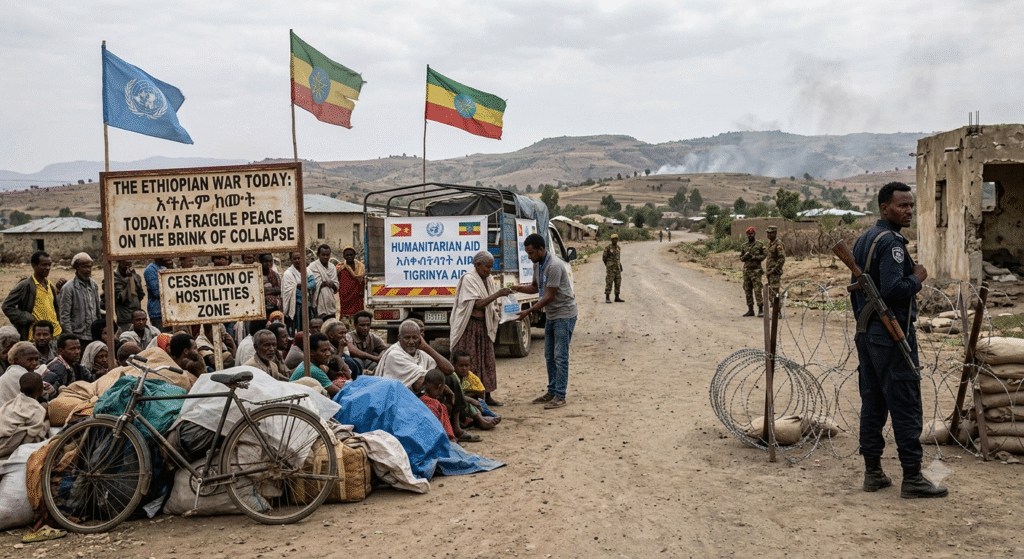
As of August 2026, Ethiopia stands on the precipice of a catastrophic return to full-scale conflict. The Pretoria Peace Agreement, signed in November 2022 to end a two-year civil war that claimed an estimated 600,000 lives, is rapidly unravelling . While the Ethiopian government continues to project authority, the country is fragmented by multiple active insurgencies, a worsening humanitarian crisis, and the spectre of renewed conflict in the Tigray region that threatens to destabilize the entire Horn of Africa .
The Unravelling of the Pretoria Agreement
The most immediate and dangerous flashpoint is the resurgence of fighting in northern Ethiopia. In a serious escalation on August 1, intense clashes erupted between federal forces and the Tigray People’s Liberation Front (TPLF) in the Shererina area of western Tigray, near the Sudanese border . The fighting, which involved heavy artillery and drones, forced hundreds of civilians to flee into Sudan . The TPLF accused the federal government of launching a “large-scale ground offensive” to “subjugate and divide” the people of Tigray, while a government minister blamed the “TPLF clique” for initiating the fighting .
By August 2, the clashes had reportedly ended following a de-escalation, but the damage to the peace process is lasting and profound . The European Union has now explicitly accused the TPLF of violating the cessation of hostilities agreement, citing the establishment of a “parallel regional council” and “forced military recruitment” in the region . This follows months of accusations from both sides regarding unfulfilled commitments, particularly around disarmament, governance mechanisms in Tigray, and the unresolved legal status of the TPLF .
Analysts warn that the Pretoria Agreement, while ending large-scale combat, failed to address the root causes of the conflict . The TPLF has effectively regained control of Tigray by pushing out the interim administration that was created as part of the peace deal, a clear sign that the political settlement was unsustainable . The situation is further complicated by allegations that Eritrea is backing the TPLF, which has led to accusations of foreign military interference and raised fears that the conflict could become a proxy for the Sudanese civil war .
A Country Engulfed in Multiple Conflicts
The crisis in Tigray is not an isolated conflict. It is a symptom of a broader, deeply entrenched instability that has fractured the nation. Prime Minister Abiy Ahmed’s Prosperity Party won a landslide victory in the June 2026 elections, securing 438 of 501 contested seats . However, this political mandate masks a country where the government is fighting on multiple fronts. On election day, 143 polling stations failed to open in Ethiopia’s two most populous regions, Amhara and Oromia, due to safety concerns .
The government is engaged in a brutal conflict with the Fano militia in Amhara and the Oromo Liberation Army (OLA) in Oromia; both groups have rejected the election and seek greater autonomy . The situation in Oromia has been particularly violent, with more than 60 people killed in late July in ethnic violence in the western Amuru district . Analysts note that these “multiple active conflicts” operate entirely outside regular political processes and will not be resolved by any electoral outcome .
A Humanitarian Crisis Deepens
The devastating impact of these conflicts is compounded by a severe funding shortfall for humanitarian operations. The UN Children’s Fund (UNICEF) has warned that its 2026 Humanitarian Action for Children appeal, which requires $401.5 million, is only 22% funded . This gap is hampering life-saving assistance for a population facing “a complex humanitarian crisis” driven by a lethal combination of conflict, displacement, climate shocks, and economic pressures .
The numbers are staggering. Over 20 million people in Ethiopia are still in need of humanitarian assistance, and the country hosts over 1.1 million refugees . The child malnutrition crisis remains entrenched, with over 104,000 children treated for severe wasting in just two months . The situation is being exacerbated by the lingering effects of the war. UNICEF notes that insecurity is disrupting livelihoods and aid delivery, while a significant 26% increase in diesel prices driven by Middle East tensions is choking supply chains and making humanitarian work more expensive .
Conclusion
Ethiopia is caught in a dangerous spiral. The Pretoria Agreement, hailed as a historic step toward stability, is being openly violated . The government is pursuing a military-centered approach to resolve its multiple insurgencies, while key international partners risk legitimizing this strategy without addressing the root causes of conflict . As the international community grapples with a series of global crises, the fundamental principles of international law and national sovereignty in the Horn of Africa are being challenged . The window to salvage the peace and prevent another catastrophic war is rapidly closing.
