

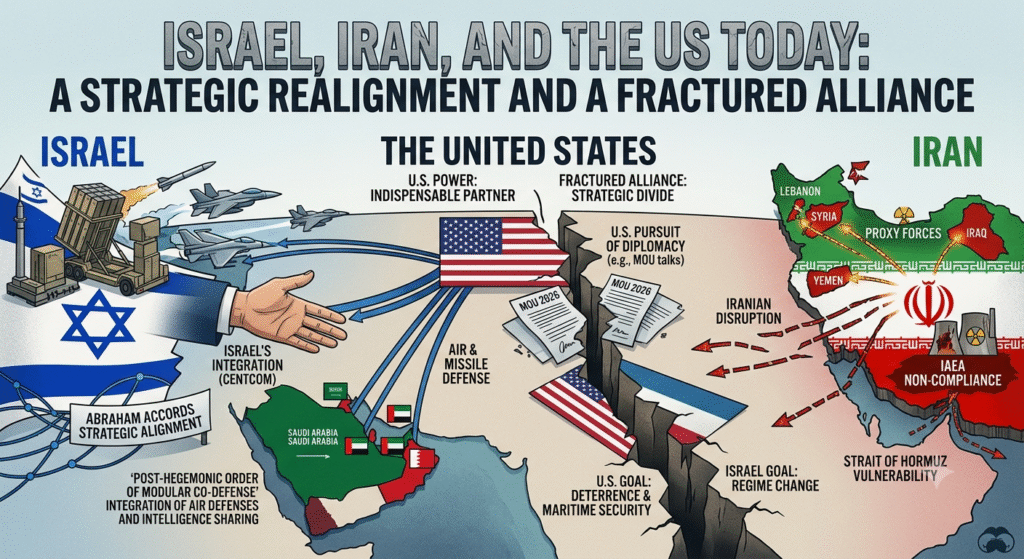
August 2026 marks a pivotal moment in the Middle East, defined by the volatile interplay between the United States, Iran, and Israel. The region is caught between a flurry of diplomatic initiatives aimed at de-escalation and the stark reality of a war that has already reshaped the geopolitical landscape. At the heart of this dynamic is a fundamental rupture in the US-Israel alliance, leaving Israel feeling increasingly marginalized as Washington pursues its own strategic objectives.
A Pivot to Diplomacy: Trump’s Deal-Making Gamble
The most significant development is the clear and growing belief within Israel that President Donald Trump is on a path to securing an agreement with Iran . This perception is driving a wedge between the two allies, as the US administration prioritizes a diplomatic off-ramp to the conflict .
President Trump has publicly stated his belief that the war “can’t go much longer” and that he is directly involved in negotiations to end it, with the goal of reopening the Strait of Hormuz and addressing Iran’s nuclear program . However, Iran has consistently denied holding direct talks with the US, maintaining that all discussions are conducted through Omani mediation regarding the management of the strategic strait . This disparity in narratives contributes to a climate of deep uncertainty.
A Pattern of Escalation and Recantation
This diplomatic push follows a now-familiar pattern for the Trump administration: a dramatic threat of massive military action followed by an abrupt cancellation. On August 1, Trump threatened to launch what he called the “most severe bombing” of Iran . Within hours, he reversed course, announcing that a “framework for peace” was in place and that Israel had joined his commitment to stand down .
However, this sudden about-face exposed a deep strategic rift. Multiple Israeli officials revealed that they were completely blindsided by the decision. Prime Minister Benjamin Netanyahu and Defence Minister Israel Katz learned of the cancellation not through official channels, but via Trump’s post on Truth Social . This left them in a state of “complete information vacuum” for hours, generating a profound sense of being “abandoned by an ally” .
The Fracturing of a Strategic Alliance: From Collaboration to Collision
This episode is not an isolated incident but rather the culmination of a long-building structural shift in US-Israel relations. The core of their partnership, “containing Iran,” is being redefined. While Israel views Iran as an existential threat requiring proactive military action, the US is increasingly seeing the conflict as a disruption to its broader strategic objectives .
Analysts note that Israel’s influence over US decision-making has been diluted as Iran has found ways to directly impact US interests, particularly through the blockade of the Strait of Hormuz . Israel is now openly considered a “card” in the US’ broader negotiations with Iran . The rift is also evident in other regional issues, such as the potential US sale of F-35 fighter jets to Turkey, a move Israel fiercely opposes, viewing it as a direct threat to its qualitative military edge .
Israel’s Response: A Threat of Unilateral Action
In response to what it perceives as a weakening American posture, Israel is signaling a willingness to act alone. Prime Minister Netanyahu has reiterated his determination to prevent Iran from obtaining nuclear weapons, implicitly threatening unilateral military action without US involvement . As Col. (Res.) Uzi Dayan noted, the Israeli assessment is that the US is focused on reaching an agreement, not on subduing Iran, leaving Israel with no choice but to continue its pressure on Tehran .
Conclusion
The present moment finds the US-Israel relationship at a critical juncture. A potential US-Iran agreement seems increasingly likely, leaving Israel to confront a nuclear-capable Iran without its primary ally. Simultaneously, Iran is formalizing its maritime control through legislation and agreements with Oman, while the Houthis continue their naval campaign against Saudi Arabia . The “collision course” that Israeli ministers warned about is rapidly becoming a reality , with the region’s stability and global energy security hanging in the balance.
