

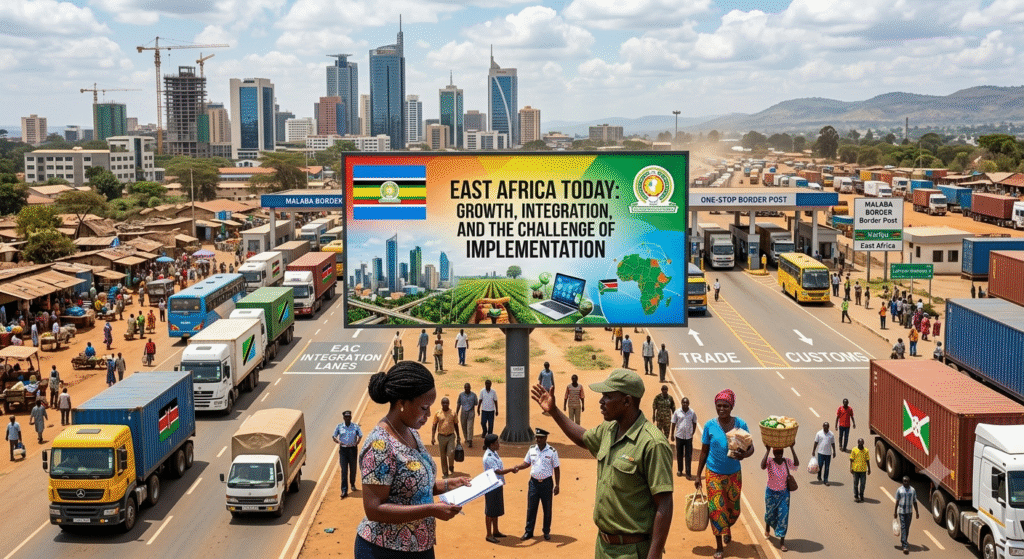
East Africa enters August 2026 with a powerful economic tailwind and an ambitious political agenda. The region remains the continent’s fastest-growing, yet this momentum is severely tested by persistent trade barriers, a stalled monetary union, and the challenge of translating regional ambition into tangible benefits for over 300 million citizens.
Economic Momentum and the Financing Gap
The African Development Bank’s 2026 East Africa Economic Outlook reports that regional growth accelerated from 4.3 percent in 2024 to an estimated 6.6 percent in 2025, driven by resilient private consumption, increased investment, and a growing services sector. While growth is expected to moderate to 5.9 percent in 2026 due to higher energy prices and geopolitical tensions, the region still outperforms Sub-Saharan Africa’s average.
However, this economic success masks a profound challenge. The region faces an annual development financing gap of $119 billion . The AfDB warns that closing this gap requires stronger domestic resource mobilisation, deeper capital markets, and greater private sector participation. As Eva Ruganzu, the Bank’s East Africa Regional Implementation Support Manager, stressed: “Resilience cannot be achieved through isolation. It requires countries to strengthen their domestic capabilities, while also deepening regional cooperation, pooling opportunities, and mobilising capital at greater scale.”
Betty Maina, East Africa Director for Genesis Analytics, highlighted a critical barrier: “Despite having regional ambitions to develop regional value chains, we compromise them through competition, and instead of collaborating, we compete, causing limitations and keeping markets small and fragmented.”
Bilateral Energy Cooperation: A Strategic Milestone
Against this economic backdrop, Tanzania and Uganda have taken a significant step forward. On August 6, the two countries signed a Memorandum of Understanding to develop the port city of Tanga into a regional energy hub.
The agreement, witnessed by Presidents Samia Suluhu Hassan and Yoweri Museveni, leverages Tanga’s strategic position and existing energy infrastructure. This project is directly tied to the East African Crude Oil Pipeline (EACOP), which stretches 1,443 kilometers from Hoima in Uganda to Tanga and is nearing completion. The hub will support fuel storage, blending, marine services, and energy trading. Ugandan Energy Minister Monica Masanza described the agreement as a “significant milestone” that will create jobs for youth, boost trade, and deepen economic ties.
Regional Integration: Ambition Meets Reality
The EAC at a Crossroads
The East African Community now comprises eight member states and over 300 million people, stretching from the Indian Ocean to the Atlantic. This expansion promises a larger market and stronger regional voice, but raises a critical question: can deeper integration keep pace with growing political, economic, and security differences among member states?
The Common Currency Stalled
The vision of a single East African currency by 2031 is under severe threat. Political gridlock, staff shortages, and failure to meet macroeconomic convergence criteria have delayed implementation of this core pillar of integration.
The convergence criteria—requiring inflation below 8 percent, a fiscal deficit under 3 percent of GDP, public debt under 50 percent of GDP, and foreign exchange reserves of at least 4.5 months of import cover—are being widely missed. Only half of member states meet the inflation ceiling; just three comply with the fiscal deficit target, and only two meet the reserve-cover requirement. Partner states are moving further apart rather than converging.
The budget allocation for the monetary roadmap is just $4.12 million (3.71 percent of the EAC’s total budget), and the East African Monetary Institute remains unestablished, with political disputes over which country should host it paralyzing progress.
Trade Barriers and the Common Market
While economic integration is the stated goal, trade barriers persist. President Museveni, in a meeting with Kenya’s new High Commissioner-designate Ababu Namwamba, emphasized that imposing taxes and restrictions on goods moving between Uganda and Kenya weakens the East African Common Market. He argued that East Africa’s prosperity depends on creating a larger integrated market, drawing lessons from the evolution of the United States. Museveni cited Uganda’s decision to continue allowing Tanzanian rice into its market despite pressure from local farmers, saying restricting trade would undermine the Common Market and discourage local producers from improving productivity.
The East African Business Council and EAC Secretariat have pledged to strengthen cooperation to address persistent non-tariff barriers. A $24.6 million UNEP commitment is financing studies to reduce greenhouse gas emissions from heavy-duty trucks on the Northern Corridor, a critical trade route handling 75,000 tonnes of cargo daily from the Port of Mombasa.
Conclusion
East Africa’s trajectory in 2026 is one of profound contrast. The region’s economic growth is impressive, infrastructure projects like EACOP are advancing, and diplomatic efforts to deepen ties continue. Yet the vision of a truly integrated East African Community remains elusive, held back by mutual suspicion, economic divergence, and a persistent gap between ambition and implementation. The coming years will test whether East Africa can transform its economic strength and strategic partnerships into meaningful integration that benefits all its citizens.
