

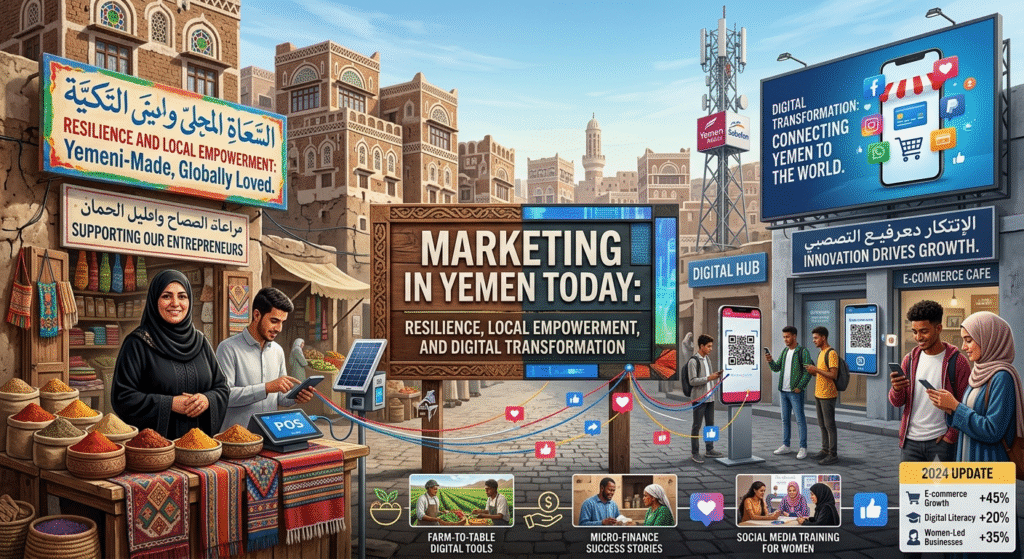
In the war-torn nation of Yemen, marketing has evolved far beyond conventional advertising into a critical tool for economic survival and recovery. As of August 2026, the country’s marketing landscape is characterized by a profound paradox. While the advertising industry is constrained by political instability, limited infrastructure, and a fragmented market , there is a notable surge in marketing activities focused on empowering local communities, developing agricultural value chains, and pioneering digital and smart advertising solutions . This dual reality reflects a country where marketing is being redefined not just as a promotional tool, but as a pillar of economic resilience.
The Local Empowerment Model: Marketing as a Development Tool
Perhaps the most significant development in Yemen’s marketing landscape is the strategic use of marketing to strengthen local production and food security. The concept of “marketing” is being directly integrated into large-scale development projects designed to create sustainable livelihoods for the country’s most vulnerable populations.
A prime example is the launch of the cattle breeding, milk production, and marketing project in Dhamar Governorate by the Zakat Authority in July 2026. This ambitious $293 million project is distributing dairy cows to 250 poor families . However, its success hinges on a comprehensive marketing and value chain strategy. The project is not just about production; it connects beneficiaries to milk collection centers and guarantees the purchase of their surplus milk by the Yemen Dairy Factory at a fixed price of 350 Yemeni riyals per liter. This guarantees a stable market for the producers, ensuring each family a daily income of 2,000 to 3,000 riyals and moving them “from the cycle of need to the cycle of production” . This approach shows how marketing, particularly of perishable goods, is being used to directly reduce Yemen’s heavy dependence on imported powdered milk—a bill estimated at $340 million annually—and strengthen the national economy .
Similarly, the Al-Rujm Cooperative Society in Mahweet governorate launched the marketing of locally produced “composite local flour” in May 2026 . This initiative, supported by the local authority and the Ministry of Economy, is designed to break monopolies and prevent price gouging by connecting farmers directly with consumers. The cooperative is using fixed points of sale and clear price displays to create a transparent marketing channel, with plans to later extend this model to local honey and other farmers’ products .
Digital Transformation and Smart Advertising
While grassroots marketing is flourishing in the agricultural sector, Yemen’s broader advertising market is on the cusp of a digital transformation. The growth of digital platforms is gradually reshaping how businesses engage with their customers . Reports highlight increasing internet penetration and digital adoption as key drivers for the Yemen advertising market, with a growing demand for targeted advertising solutions . This shift is pushing the market toward “smart advertising,” which is increasingly data-driven and algorithmic.
According to market forecasts, the Yemen smart advertising market is being segmented by advanced mediums, including digital display ads, social media ads, video & OTT ads, and even in-game advertising . The methodologies driving this growth are sophisticated, involving behavioral analytics, real-time bidding, and AI integration through machine learning and automated bidding platforms . This indicates that although the country faces severe economic challenges and fluctuating currency values , businesses are looking to leverage technology for more efficient and measurable marketing campaigns.
This digital shift is also mirrored in the banking sector. As a recent analysis from the Yemen Banks Association noted, Yemen has entered an era of “Digital-first Banking Marketing,” where customer relationships and trust are built “across screens before branches, and through smartphones more than customer service offices” . Banks are pivoting from traditional campaigns to content-driven and customer-centric communications on social media platforms, which have an increasing influence on customer behavior and financial decisions .
The Credibility and Effectiveness of Media
The effectiveness of marketing communication in Yemen is becoming a subject of academic study, highlighting its growing importance. A recent master’s thesis from Sana’a University’s College of Media analyzed the persuasive methods used by Yemeni and international companies in their advertisements on YouTube . The research found that Yemeni companies primarily rely on the “justification” style of persuasion, whereas international (Jordanian/British) companies employ multiple styles simultaneously . This underscores a tangible difference in marketing sophistication and points to a clear opportunity for Yemeni marketers to develop more dynamic and multifaceted advertising strategies.
Conclusion
Marketing in Yemen today is a powerful narrative of resilience. In a nation where a decade of conflict has decimated the economy, marketing is being used as a tool for economic empowerment at the community level, connecting local producers to markets and reducing reliance on expensive imports. At the same time, a digital revolution is brewing, with businesses and institutions like Yemeni banks adopting smart advertising and data-driven strategies to build customer loyalty in an increasingly connected world . The future of marketing in Yemen lies in bridging these two worlds—leveraging the trust and community focus of local initiatives with the efficiency and reach of digital technology to build a stable and promising economic environment .