

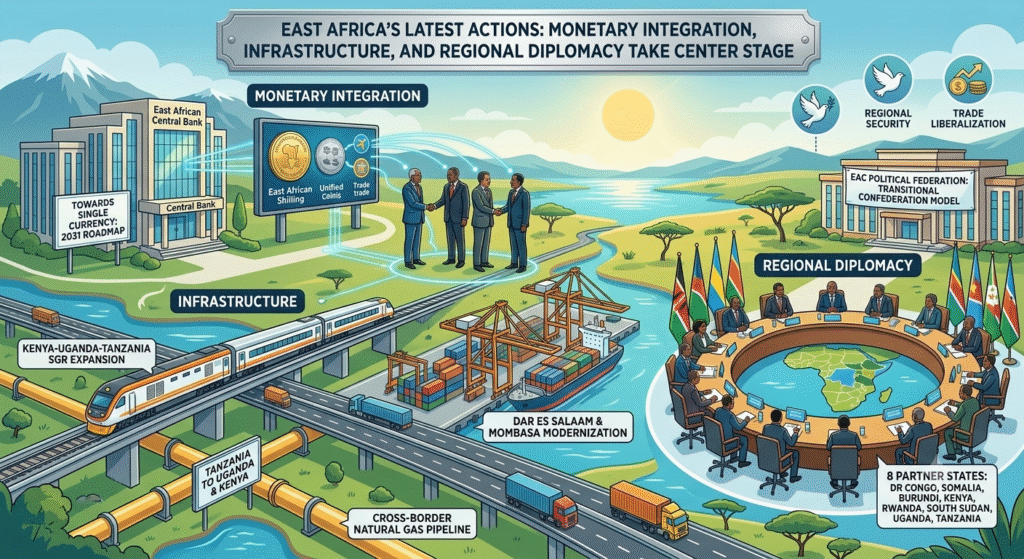
The final week of July 2026 has been one of intense activity across East Africa. From high-level monetary talks and landmark infrastructure proposals to renewed defense cooperation and regional diplomatic summits, a series of significant actions are reshaping the regional landscape. This flurry of activity underscores the bloc’s ambition to deepen integration, but it also throws into sharp relief the persistent challenges that threaten to undermine these very goals.
Monetary Integration: The Single Currency Pledge and Persistent Hurdles
A key action was the 29th Ordinary Meeting of the East African Community (EAC) Monetary Affairs Committee, held in Kampala, Uganda, from July 20 to 24 . Central bank governors and senior officials from all partner states reaffirmed their commitment to establishing a single East African currency by 2031, which is a core pillar of the East African Monetary Union (EAMU) roadmap .
The meeting projected the region’s economic growth at a robust 5.2% in 2026, outperforming the Sub-Saharan African average of 4.3% . The Committee also noted encouraging progress in modernizing monetary policies and expanding the use of the East African Payment System . Somalia, the bloc’s newest member, reaffirmed its commitment to regional monetary integration and harmonizing its financial supervision and payment systems with EAC standards . A senior official from the Bank of South Sudan also signed the joint communique, underscoring that country’s dedication to the 2031 target .
However, this commitment masks a far more complicated reality. The vision of a single currency is under severe threat from several intertwined problems .
The Challenge of Convergence: A critical action item from the meeting was the urgent call for partner states to meet the agreed macroeconomic convergence criteria. These criteria are strict, requiring member states to maintain:
- An inflation ceiling of 8%
- A fiscal deficit below 3% of GDP
- Gross public debt under 50% of GDP
- Foreign exchange reserves of at least 4.5 months of import cover .
Currently, progress is “uneven,” and some states are moving further apart rather than converging . For instance, only half of the eight member states meet the inflation target, and even fewer comply with the fiscal deficit and public debt ceilings .
The Political Stalemate: Beyond economics, the project is paralyzed by political gridlock over which country should host the East African Monetary Institute (EAMI)—the precursor to a regional central bank. An independent verification commission ranked Tanzania as the most technically suitable host, but this outcome was rejected by Kenya, Uganda, and South Sudan, who favored a political solution . The EAMI is the “operational engine room” for the monetary union, and without its establishment, technical progress on the single currency has “effectively halted” . The EAC has allocated only $4.12 million (3.71% of the total budget) for the entire monetary roadmap, reflecting its low priority .
Infrastructure and Trade: A Major Refinery and Breaking Down Barriers
In a parallel action, the Kenyan government is accelerating plans for a Sh2.2 trillion East Africa oil refinery . The project, proposed by Nigerian billionaire Aliko Dangote, is a regional undertaking that would involve multiple East African countries and foreign investors . Deputy President Kithure Kindiki stated that Lamu has emerged as the leading potential site and that Kenya is working closely with EAC partners to build consensus . The refinery is expected to create jobs, establish a petrochemical hub, and cushion the region’s economy from shocks caused by sharp rises in oil prices .
Meanwhile, the Parliamentary Committee on East African Affairs has adopted a new work plan that prioritizes the elimination of non-tariff barriers (NTBs) that continue to frustrate cross-border trade . The committee also identified the construction of the Standard Gauge Railway (SGR) from Mombasa through Malaba to Kampala as a strategic priority . This focus on hard and soft infrastructure is critical, as the removal of NTBs and improved transport links are essential for lowering the cost of doing business and boosting intra-regional trade . However, the committee also expressed concern over persistent delays by several EAC states in remitting their annual contributions, which is crippling the operations of key Community institutions .
Diplomacy, Security, and Media: A Region in Motion
Beyond the EAC, other significant actions are unfolding.
Diplomacy: In a powerful symbol of solidarity, Prime Minister Abiy Ahmed of Ethiopia hosted the leaders of Djibouti and Somalia in Jigjiga for a summit focused on strengthening trade, security, and diplomatic relations across the Horn of Africa .
Security: In a move with direct implications for regional security, the UK will resume military training in Kenya, after a brief suspension . The training, which involves over 1,000 Kenyan soldiers annually preparing for deployment to Somalia to combat al-Shabab, is a critical component of counter-terrorism efforts in the region . The resumption came after a delay linked to Kenyan legislators’ concerns about protecting nearby communities and allegations of past human rights violations involving British soldiers .
Media: In a development for regional media freedom, Ugandan President Yoweri Museveni authorized the resumption of Nation Media Group’s (NMG) operations, ending a month-long shutdown of one of East Africa’s largest independent media companies . This decision was hailed as an important milestone for regional investment, media development, and East African integration .
Conclusion
The latest actions in East Africa present a stark picture of a region striving for integration. The commitments to a single currency, major infrastructure projects, and the resumption of key partnerships are significant steps forward. However, the ongoing political deadlocks over the EAMI, the failure to meet macroeconomic targets, and the persistent trade barriers reveal deep fault lines. The region’s future success will depend not on the grand pronouncements of its leaders, but on their ability to translate these latest actions into tangible results that overcome the deep-seated challenges of economic convergence, political will, and institutional capacity.
