

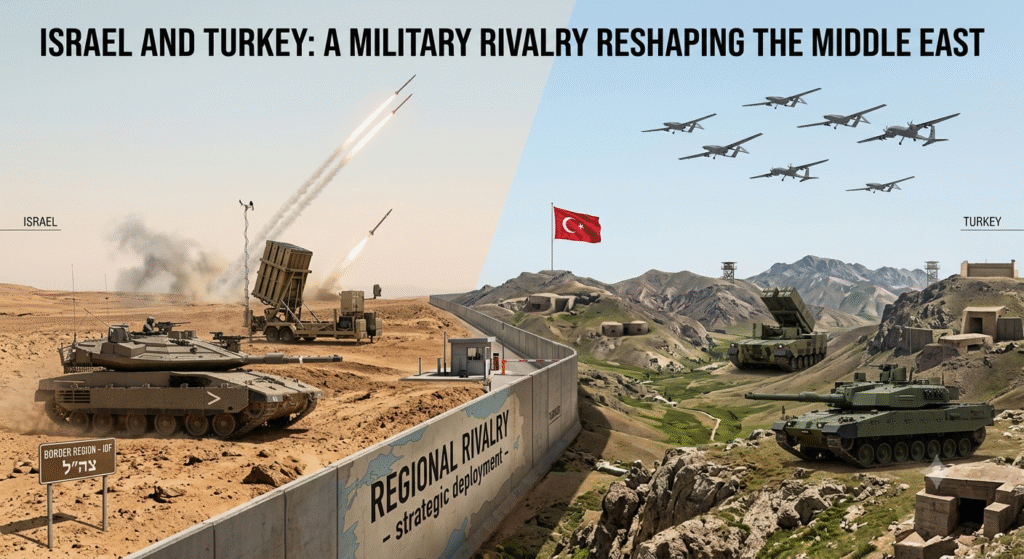
For decades, Iran was considered Israel’s primary strategic threat. However, as we enter the second half of 2026, a fundamental shift is occurring in the Middle East’s geopolitical landscape. Military analysts and intelligence officials now argue that Turkey has emerged as Israel’s most significant long-term strategic challenge, presenting a unique and formidable rival that differs profoundly from the threats Israel has faced in the past.
The military capabilities of Israel and Turkey, once considered allies with extensive cooperation, are now being compared and contrasted as a reflection of a growing rivalry that is reshaping the security architecture of the entire region.
The End of an Era and the Rise of a New Rival
The foundation of this rivalry is the perception, widely shared in Jerusalem, that Iran’s regional hegemony is waning. The military and political structures of Tehran, following recent conflicts, are seen as significantly weakened. This decline is creating a power vacuum, and Israeli officials, including Prime Minister Benjamin Netanyahu, believe Turkey is positioning itself to fill it.
Giora Eiland, a former Israeli national security adviser, encapsulated this fear by noting that while Iran sought to surround Israel with a Shi’ite “ring of fire,” Turkey is now attempting to build a Sunni one. This is not merely a diplomatic rivalry; it is a military one fought on multiple fronts. Turkish and Israeli interests and forces now operate in close proximity in Syria, and tensions are escalating in the strategic waterways of the Eastern Mediterranean.
A Tale of Two Militaries
According to the 2026 Global Firepower Index, a widely cited ranking of military strength, Turkey is the number one military power in the Middle East, with a Power Index of 0.1975. In contrast, Israel is a close second, with a score of 0.2707. While the gap is not enormous, it reflects two very different military doctrines and compositions.
Turkey’s Advantage: Size and Industry
Turkey’s military strength lies in its massive conventional capacity. It boasts the second-largest standing army in NATO, with 481,000 active personnel and 380,000 in reserve. This is supported by a sizable navy that operates more than 10 active diesel-electric submarines, numerous frigates, and drone carriers capable of projecting power across the Mediterranean.
Crucially, Turkey has invested heavily in a domestic defense industry. Companies like Baykar have produced combat-proven weapons like the Bayraktar TB2 drone. Turkey is also developing its own fifth-generation fighter jet, the KAAN, and the Altay main battle tank, reducing its dependence on foreign suppliers. This industrial base and its ability to sustain prolonged operations give it a strategic depth that Israel lacks.
Israel’s Advantage: Technology and Quality
Israel’s military strength is defined by superior technology, intelligence, and rapid-response capabilities. Its qualitative military edge (QME) has historically been the cornerstone of its security doctrine. This is most evident in its air force, which is the only one in the region currently operating the F-35 “Adir,” a fifth-generation stealth fighter. This aircraft gives Israel an unparalleled ability to penetrate advanced air defense systems and conduct long-range strikes, a capability its leadership is desperate to maintain.
However, this QME is threatened by the very nature of the rivalry with Turkey.
The Flashpoint: The F-35 Controversy
The most visible symbol of this military rivalry is the fierce battle over the potential sale of American F-35 fighter jets to Turkey. In July 2026, during a NATO summit, U.S. President Donald Trump announced his willingness to lift sanctions and reconsider Turkey’s return to the F-35 program. Turkey was removed from the program in 2019 after purchasing the Russian S-400 air defense system.
This decision has triggered an aggressive campaign from Israel. Prime Minister Benjamin Netanyahu has used American television interviews to argue that selling the F-35 to Turkey would “destroy the balance of power in the Middle East”. He has characterized Turkey as a state with “aggressive ambitions” and argued that providing the advanced jet to a government led by Recep Tayyip Erdogan poses an existential risk.
For Israel, the issue is not merely the number of planes Turkey might receive but the loss of exclusive access to a technology that underpins its entire security doctrine.
A Naval Showdown and a Shifting Security Paradigm
The rivalry is not confined to the skies. The Israeli Navy is now actively preparing for a potential “Turkish front” at sea. Turkey already enjoys a significant numerical advantage, possessing far more frigates, amphibious landing ships, and submarines than Israel. Defense officials have warned that a confrontation at sea is “not an impossible scenario”. In response, the Israel Defense Forces (IDF) is considering purchasing advanced anti-submarine warfare aircraft, like the Boeing P-8 Poseidon, to counter the Turkish submarine threat. These moves highlight the high-stakes naval dimension of the rivalry.
Conclusion
The military comparison between Israel and Turkey reveals a fundamental shift in regional power. As Iran recedes, Turkey has risen as a formidable competitor with a blend of NATO-aligned conventional power and a growing domestic defense industry. For Israel, the challenge is unprecedented. For decades, its primary adversaries were non-state actors or state sponsors of terrorism with inferior technology. Turkey, however, is a peer competitor with the capacity to challenge Israel’s most cherished military asset: its qualitative military edge. The battle over the F-35 is likely just the opening chapter in what many predict will be the defining strategic competition of the next decade.
