

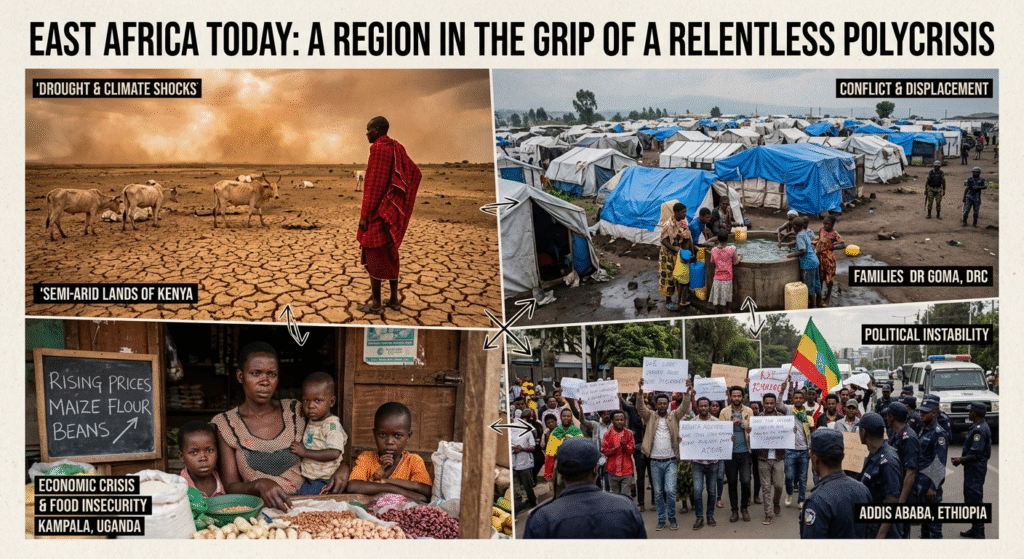
As of mid-2026, East Africa finds itself trapped in the throes of a devastating “polycrisis”—a complex, overlapping web of climate shocks, violent conflict, economic instability, and public health emergencies that are compounding one another with catastrophic effect . From the drought-stricken highlands of Ethiopia to the conflict-ravaged plains of Sudan, and from the displacement camps of Somalia to the tense corridors of regional politics, the challenges confronting the region are unprecedented in their scale and severity. With a humanitarian system gutted by funding cuts and a fragile regional integration agenda under strain, the future of this strategically vital part of Africa hangs in the balance.
A Humanitarian Catastrophe Unfolds
The most immediate and visible crisis is the humanitarian catastrophe gripping the region. According to the United Nations Office for the Coordination of Humanitarian Affairs (OCHA), an estimated 48.5 million people in Eastern Africa are in desperate need of assistance in 2026 . This staggering number is driven by a lethal combination of factors that are pushing millions to the brink of famine.
Food insecurity has escalated dramatically, with 40.5 million people facing severe hunger, an increase of 1.6 million from the beginning of 2025 . The largest spikes have been reported in South Sudan, Kenya, Sudan, and Tanzania . The situation in Somalia is particularly dire; a famine risk was confirmed in May 2026 for the first time since 2022, with an estimated 6 million people, one-third of the population, at critical levels of food insecurity . The crop production in some areas of Somalia is estimated to be a staggering 83% below the long-term average .
This crisis is being fueled by both human-made and natural factors. In Sudan and South Sudan, conflict and displacement are undermining agricultural production despite favorable climatic conditions in some areas . Meanwhile, a severe drought in southern Ethiopia and Somalia, exacerbated by emerging El Niño conditions, has caused widespread crop failure, rapid rangeland degradation, and catastrophic livestock losses . The damage is compounded by the spillover effects of the conflict in the Middle East, which has driven up fuel, transport, and food costs, further straining already fragile economies . A resulting fertilizer shortage is projected to reduce harvests later in the year, prolonging high food prices long after the active conflict ends .
The human toll is immense. Across the region, the refugee population has swelled to over 6.3 million, one of the largest refugee populations in the world . The public health situation is equally grim, with cholera cases more than doubling to 12,400 in the second quarter of 2026 and mpox cases reported in displacement-affected areas . In Somalia, more than 500 health and nutrition facilities have closed due to funding shortages, leaving vulnerable populations without essential care .
The Anatomy of a Polycrisis: Conflict and Climate
The crises facing East Africa are not isolated events; they are deeply interconnected, creating a “polycrisis” that is exponentially more damaging than the sum of its parts . Analysts warn that climate shocks and epidemic outbreaks are exacerbating conflicts and encouraging crackdowns on population movements, which in turn worsens access for humanitarian aid .
Conflict remains a common denominator of the contemporary famine risk. Almost every country in the region, with the exception of Kenya, is experiencing protracted violent conflicts . The brutal civil war in Sudan, where starvation is allegedly being used as a weapon of war, has created a massive humanitarian disaster . South Sudan’s fragile stability is threatened by political turmoil and a struggling economy . The eastern Democratic Republic of the Congo (DRC) remains a volatile geopolitical chessboard, exporting instability faster than it exports its vast mineral wealth . Somalia continues to grapple with insecurity from the al-Shabaab insurgency and clan conflicts , while political tensions simmer in Uganda following disputed elections .
Climate change is the other primary engine of the crisis. The region is enduring the full force of the “triple planetary crisis”—climate change, biodiversity loss, and pollution—manifesting in erratic rainfall, prolonged droughts, and ecosystem degradation . The economic cost is staggering, with East African countries projected to lose between 2 and 4 percent of GDP annually due to climate extremes by 2040 . Climate shocks have become a primary driver of displacement and have severely undermined the livelihoods of the region’s largely agrarian population . The EAC is advancing a 10-year Climate Change Strategy to address these risks , but the immediate crisis is overwhelming current capacities.
Political and Regional Strains
The cascading crises are also putting immense pressure on the region’s political fabric and its integration agenda. The East African Community (EAC), once a symbol of regional hope, is facing a “Great Sifting” as member states struggle with their own internal crises .
The DRC, now a member, is a “liability that exports instability faster than it exports minerals” . South Sudan and Burundi are grappling with skyrocketing inflation—179 percent and 34 percent respectively—and are trapped in survival mode rather than governance . Tanzania’s democratic promise was shattered in the aftermath of its bloody 2025 elections, leading to a loss of investor confidence . The EAC itself is financially crippled, with member contribution arrears straining its operations and grounding its legislative assembly . The absence of a clear political direction, symbolized by the lack of a scheduled Heads of State Summit, puts the region’s integration agenda in a deep freeze .
The Collapse of the Humanitarian Lifeline
Compounding these catastrophic conditions is the systematic dismantling of the international humanitarian response system that the region has historically relied upon. The closure of USAID and severe funding cuts by most Western nations have “gutted” the global capacity to respond to major shocks . The UNHCR has reported a devastating funding gap, with its 2026 operations funded at just 23 percent of its overall needs, threatening to shut down lifesaving health, education, and protection services by the end of July .
Humanitarian programs have been shut down, staff laid off, and infrastructure sold . The onus has now fallen more heavily on local communities, governments, and mutual aid groups, which are stepping up heroically but lack the resources to match the scale of the need . While efforts to support local initiatives and ease restrictions on diaspora remittances are underway , the international community’s withdrawal is leaving millions to face a brutal wake-up call alone.
In this era of brutal reckoning, East Africa stands at a precipice. The convergence of conflict, climate, economic collapse, and political dysfunction presents a monumental challenge that no single nation or community can solve alone. The world is watching, but more importantly, the world is needed. As 2026 unfolds, the future of millions hangs in the balance, dependent on whether the international community will once again commit to supporting a region that has been pushed to the brink.
