

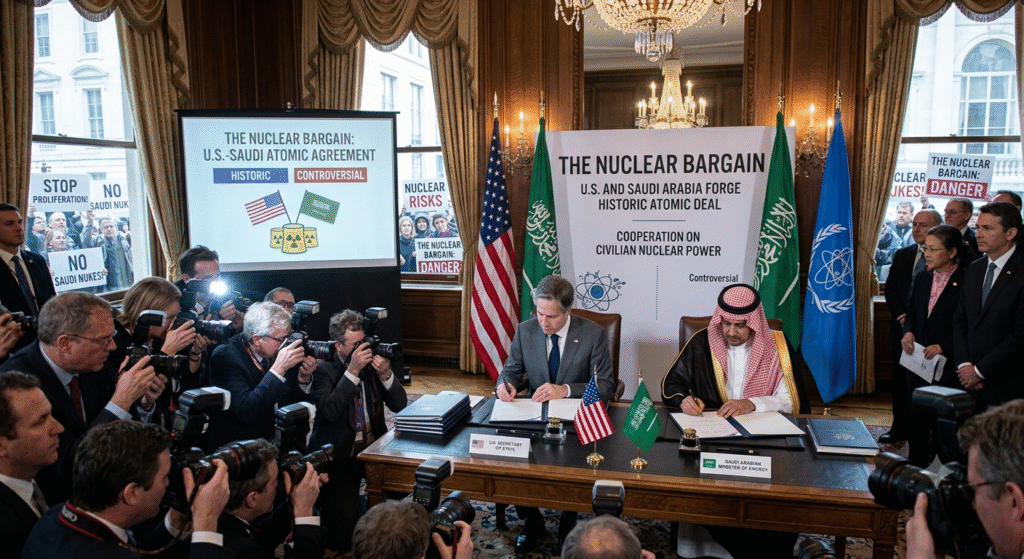
In a landmark development with profound implications for the Middle East and global non-proliferation efforts, the United States and Saudi Arabia have formalized a civilian nuclear cooperation agreement. The pact, signed on July 23, 2026, represents a pivotal moment in the strategic partnership between the two nations, but it has also ignited a firestorm of controversy due to the specific terms it contains regarding uranium enrichment .
The agreement follows months of high-level negotiations, building on a November 2025 meeting between President Donald Trump and Saudi Crown Prince Mohammed bin Salman . While hailed by the Trump administration as a landmark deal that will strengthen the U.S. nuclear industry and provide billions of dollars in contracts, it has alarmed arms control experts and many lawmakers who fear it could trigger a nuclear arms race in one of the world’s most volatile regions .
The Core of the Agreement: Enrichment and the “Gold Standard”
At the heart of the controversy is the agreement’s stance on uranium enrichment and spent fuel reprocessing—technologies that can produce fuel for nuclear power plants or, alternatively, material for nuclear weapons. Historically, U.S. policy has promoted a “gold standard” for civilian nuclear cooperation with partners in the Middle East, requiring them to forgo these sensitive capabilities. The United Arab Emirates famously accepted this standard in its 2009 nuclear deal with Washington .
The new U.S.-Saudi agreement, however, does not contain such a prohibition . According to multiple reports, the pact allows for a legal pathway for cooperation on the nuclear fuel cycle, meaning Saudi Arabia could eventually enrich uranium and reprocess spent nuclear fuel . The Trump administration argues that the deal adheres to the non-proliferation standards set forth in the U.S. Atomic Energy Act, which it describes as among the “world’s strongest” . Officials have also noted that the agreement does not immediately obligate the United States to transfer enrichment technology, but rather establishes a framework for potential future cooperation .
Furthermore, unlike previous U.S. deals, this agreement does not require Saudi Arabia to sign the International Atomic Energy Agency’s (IAEA) Additional Protocol . This protocol grants the IAEA broader inspection powers, including the authority to conduct short-notice “snap” inspections at undeclared facilities—a crucial tool for preventing clandestine nuclear weapons programs . The Biden administration’s plan had included this provision, but the Trump administration dropped it, a decision that has drawn sharp criticism .
Saudi Motives and Regional Dynamics
For Saudi Arabia, the agreement is a cornerstone of its Vision 2030 plan to diversify its economy away from oil. The kingdom, which currently uses fossil fuels to generate almost all of its domestic energy, sees nuclear power as a key component of its future energy mix . However, the strategic and security motivations are equally significant.
Crown Prince Mohammed bin Salman has long been explicit about Saudi Arabia’s nuclear ambitions, framing them in direct response to its regional rival, Iran. In a 2018 interview, he stated that “without a doubt, if Iran developed a nuclear bomb, we will follow suit as soon as possible” . This declaration has been a central driver of the kingdom’s insistence on maintaining its right to enrich uranium .
The deal comes at a time of extreme tension with Iran. The United States and Iran are engaged in fragile, ongoing negotiations following the signing of a peace memorandum in June 2026, which aims to resolve the long-standing conflict over Iran’s nuclear program . The new nuclear pact with Saudi Arabia risks undermining those talks by demonstrating that the U.S. is willing to accept a pathway to a nuclear-weapons capability for the kingdom, potentially giving Tehran less incentive to limit its own program . The geopolitical chessboard is further complicated by renewed fighting between Saudi Arabia and Iran-backed Houthi rebels in Yemen, which directly preceded the deal’s announcement .
American Concerns and the Path Forward
In the United States, the reaction to the agreement has been sharply divided. The Trump administration and its allies in the nuclear industry have championed the deal as a major economic victory that solidifies U.S. influence in the region and prevents Saudi Arabia from turning to competitors like China or Russia for nuclear technology . Senator Jim Risch, a Republican, has voiced support for the Crown Prince’s view that the deal benefits both countries .
Conversely, a coalition of Democratic lawmakers and non-proliferation advocates have decried the agreement as a dangerous gamble that could start a nuclear arms race in the Middle East . Senator Edward Markey, a leading critic, stated, “They are allowing Saudi Arabia, a belligerent and authoritarian nation, to develop nuclear weapons technologies while starting a war with Iran… This deal would make us all less safe” . Kelsey Davenport, director for non-proliferation policy at the Arms Control Association, has urged Congress to reject the deal, warning it opens the door for wider nuclear proliferation .
The deal, known as a Section 123 Agreement, is now before Congress for a 90-day review period . Lawmakers can pass a joint resolution of disapproval to block the agreement, but it would require a two-thirds majority in both chambers to overcome a certain presidential veto . Given the political dynamics, it remains uncertain if opponents can muster enough votes to derail it . The Senate Bill S 4243, known as the “No Nuclear Weapons for Saudi Arabia Act of 2026,” introduced earlier this year, represents a legislative effort to impose stricter oversight on such a pact . As the world watches, the coming months will be critical in determining whether this historic deal ushers in a new era of energy cooperation or accelerates the proliferation of the most dangerous technologies on Earth.