

MANILA — July 22, 2026
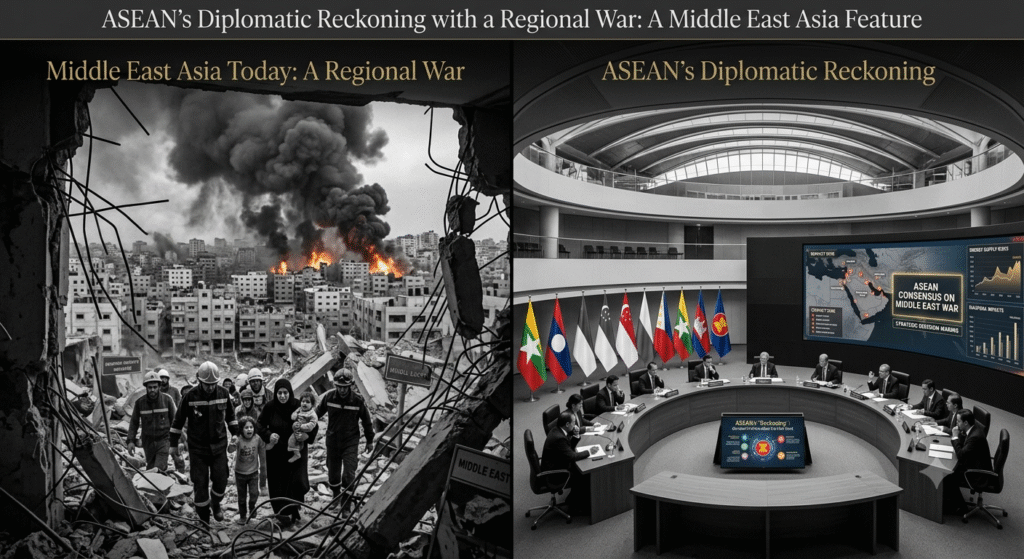
The war between the United States and Iran has reached Southeast Asia’s doorstep—not through direct military escalation, but through the stark economic and diplomatic logic that binds the world’s most volatile region to one of its most dynamic. As foreign ministers from the 11-member Association of Southeast Asian Nations gather in Manila this week, they have issued an urgent joint statement expressing “serious concern” over renewed hostilities that threaten energy supplies, global trade, and regional stability .
The timing could not be more precarious. On July 20, Yemen’s Iran-aligned Houthis announced a naval blockade on Saudi Arabia, opening a potential new front in the conflict and raising the threat to global energy supplies beyond the Gulf . For Southeast Asia, a major oil importer with a combined GDP of $3.8 trillion, this is an economic body blow .
‘Serious Concern’ Over the Escalating Crisis
“We are deeply concerned that these developments severely undermine the ongoing efforts of key mediators and diminish the prospects for a peaceful resolution through dialogue and diplomacy,” the ASEAN ministers declared in a joint statement after a closed-door meeting on July 21 .
The top diplomats called on the United States and Iran to “exercise utmost self-restraint” and avoid any actions that could further aggravate the situation . They emphasized the need for “a complete and immediate cessation of hostilities across all fronts in the Middle East” .
Philippine Foreign Affairs Secretary Ma. Theresa Lazaro, whose country holds ASEAN’s rotating chair, explained the urgency: “This is the only document in our discussions that addresses geopolitical issues. Due to the urgency of the situation, we had to issue this joint statement as soon as possible” .
The Strait of Hormuz: A Chokehold on Asia’s Economy
At the heart of ASEAN’s concern is the Strait of Hormuz, the narrow waterway through which approximately one-fifth of the world’s oil once passed. The renewed US-Iran conflict has turned the strait into a shooting gallery, with devastating consequences for energy-importing nations across Asia .
The ministers stressed the importance of “maintaining maritime safety and security” in the strait and called for the restoration of “safe, unimpeded and continuous navigation of vessels” in accordance with international law . They expressed “deep concern over any discriminatory or unilateral measures that may impede or obstruct vessels” transiting the passage .
The stakes are existential. Southeast Asia has sought to fast-track an ASEAN oil-sharing mechanism to mitigate the impact of the supply crunch . The conflict has already sent fuel prices soaring across the region, driving inflation and threatening economic growth.
The Houthi Factor: A New Front in the Red Sea
The crisis took a dangerous new turn on July 20, when Iran-aligned Houthi forces announced a naval blockade on Saudi Arabia at the Red Sea’s Bab al-Mandeb Strait . The announcement threatens to cut off Saudi oil exports through the Red Sea—a route that has become critical since the Strait of Hormuz was effectively closed .
According to shipping data, Saudi Arabia exports more than 3.6 million barrels of oil and related fuels daily through the Bab al-Mandeb, most destined for Asia . A full blockade could reduce global oil supply by approximately 7 percent . The Houthis have warned that any Saudi retaliation will face “full and severe escalation” .
The blockade also has a regional dimension. The Houthis argued that Saudi Arabia has “blockaded Yemeni ports and airports for years” and that their action is a legitimate response . International Crisis Group analyst Ahmed Nagi noted that while the Houthis’ rhetoric is designed to rally domestic support, their actions are closely tied to Iran’s broader regional strategy .
U.S.-China Rivalry Adds to ASEAN’s Headaches
As if the Middle East crisis were not enough, ASEAN leaders are also navigating deep tensions closer to home. U.S. Secretary of State Marco Rubio and Chinese Foreign Minister Wang Yi are both attending the Manila meetings, with the prospect of a bilateral meeting on the sidelines .
Rubio, writing in Philippine newspapers, reaffirmed the U.S. commitment to freedom of navigation in the South China Sea, warning that if the waters “fall under the control of a power willing to use commerce as a geopolitical weapon,” both the U.S. and ASEAN states would face “dire new threats to their sovereignty, security and economic futures” .
Tensions between Manila and Beijing have intensified in recent days after the Philippine military accused Chinese Coast Guard personnel of striking one of its navy personnel with a baton near Second Thomas Shoal . President Ferdinand Marcos Jr summoned China’s ambassador in Manila, while Manila’s envoy was summoned in Beijing .
Wang Yi, for his part, has urged ASEAN not to be a forum for bilateral maritime disputes. The Chinese foreign ministry stated: “The Philippines should earnestly fulfil its duties as ASEAN’s rotating chair, promote dialogue and cooperation, rather than placing its own political interests above regional peace and stability” .
What Comes Next: A Region Bracing for Impact
The Manila meetings, running through July 24, will include the ASEAN Post-Ministerial Conference with the United States, the ASEAN Plus Three, the East Asia Summit, and the ASEAN Regional Forum . Rubio is expected to hold bilateral meetings with Wang Yi and possibly Russian Foreign Minister Sergei Lavrov .
Japan has already signaled its alignment with U.S. strategy. Foreign Minister Toshimitsu Motegi met with Rubio on July 21 and agreed to maintain “close communication” on the Iran situation, emphasizing the importance of ensuring freedom of navigation through the Strait of Hormuz .
The United Kingdom has also intensified its military coordination, with new Prime Minister Andy Burnham approving the continued use of British bases to support U.S. defensive military operations, including Diego Garcia in the Indian Ocean and RAF Fairford in England . Bulgaria is considering allowing U.S. aerial refueling aircraft to operate from its territory, despite Iranian warnings against such a move .
Conclusion: A Region Caught Between Two Crises
ASEAN’s urgent diplomatic intervention reflects a stark reality: the Middle East war is no longer a distant conflict. The Houthi blockade in the Red Sea, the closure of the Strait of Hormuz, and the wider US-Iran confrontation are threatening Southeast Asia’s energy security, economic stability, and geopolitical equilibrium.
As Philippine Foreign Secretary Lazaro put it: “In a fractured global landscape, no single nation can weather these storms alone. Our strength and resilience lie in our community” . Whether that community can navigate between the pressures of a Middle East war, the Sino-U.S. rivalry, and its own internal challenges will define ASEAN’s future—and the stability of an entire region .