

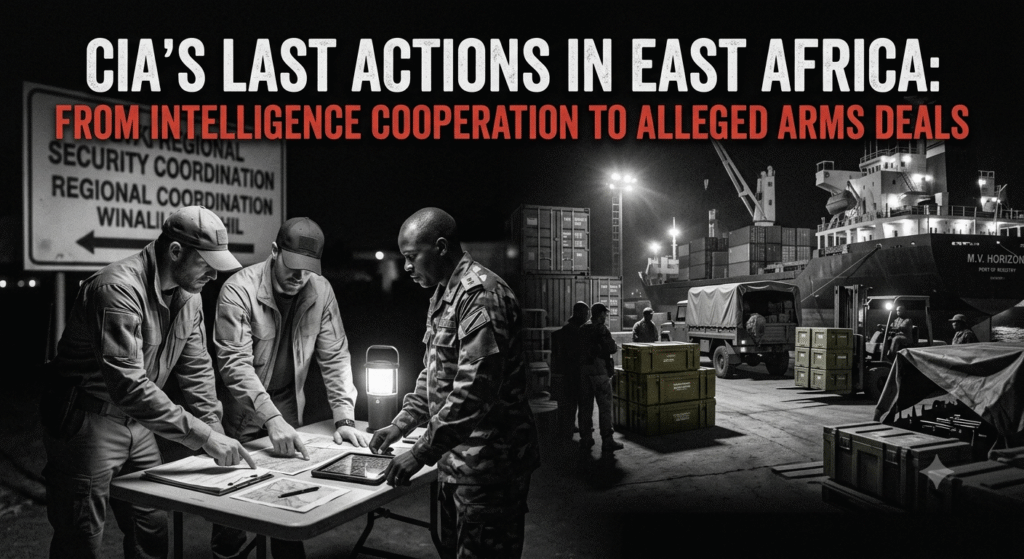
The Central Intelligence Agency (CIA) remains one of the most influential foreign intelligence actors in East Africa, operating across a spectrum that spans counter-terrorism intelligence sharing, covert operations, and—most recently—controversial allegations of involvement in regional arms smuggling investigations. The past week has seen new developments that underscore both the agency’s deep footprint and its vulnerability to regional scrutiny.
Intelligence Cooperation Against Al-Shabaab
At its core, CIA activity in East Africa remains focused on countering jihadist terrorism, particularly Al-Shabaab, described as “the wealthiest and most active Al-Qaeda affiliate in the world” . Operating from its large military presence at Camp Lemonnier in Djibouti, the U.S. maintains extensive intelligence cooperation with partner states including Somalia, Kenya, Ethiopia, and Djibouti .
This cooperation includes information sharing, professional training, the establishment of joint coordination mechanisms, and at times, the integration of local forces into intelligence-led operational activity . The CIA has also maintained a field station in Somalia, supporting the federal government’s efforts against Al-Shabaab alongside U.S. Africa Command (AFRICOM) drone operations .
In a rare public acknowledgment of CIA engagement in the region, then-CIA Director William Burns made an unannounced visit to Kenya and Somalia in January 2024—a highly unusual move that reflected the agency’s prioritization of East African security . Burns met with Kenyan President William Ruto and Somali President Hassan Sheikh Mohamud to discuss regional instability, the conflict in Sudan, and the continuing threat from Al-Shabaab .
The Godka Jilacow Controversy
The most visible recent CIA-related controversy centers on the Godka Jilacow prison in Mogadishu, operated by Somalia’s National Intelligence and Security Agency (NISA). In March 2026, Al-Shabaab released a propaganda video celebrating a previous October 2025 attack on the prison, explicitly claiming that the facility was “also used by the United States’ Central Intelligence Agency (CIA) to imprison and torture local Somalis” .
While the claim comes from an Al-Shabaab propaganda source and serves the group’s narrative, it highlights the persistent perception of CIA involvement in Somalia’s internal security apparatus. Al-Shabaab framed the prison in the same context as other American military and CIA prisons during the global war on terror, alleging abuse and torture of innocent Muslims .
Malawi Arms Trafficking Allegations
The most significant development of the past week involves an investigation into senior Malawi Defence Force officers. On July 3, 2026, the Platform for Investigative Journalism reported that the CIA had flagged an arms-smuggling network involving Malawian officers allegedly helping Sudanese rebel groups obtain heavy weapons .
According to the report, the intelligence was shared with Malawi’s National Intelligence Service and formed the basis of a complaint lodged with the Anti-Corruption Bureau. The U.S. Embassy in Lilongwe has declined to comment, and the CIA report itself has not been made public . The Malawi Defence Force confirmed it had been approached by the ACB but could not comment while investigations are ongoing .
The case illustrates the CIA’s role in tracking illicit arms flows across the region—a dimension of the agency’s work that often remains hidden from public view. It also underscores the geopolitical significance of East Africa as an arena where U.S. security interests intersect with local governance challenges and Sudan’s ongoing conflict .
The Enduring Debate
The CIA’s operations in East Africa have long been the subject of debate. Critics have questioned whether intelligence-led interventions in Somalia have created more instability than they have resolved. Some intelligence experts have argued that “in the case of countering Al Qaeda, the record seems to suggest that less is more,” with smaller investments achieving better results .
For its part, the agency’s work is embedded within a broader U.S. strategy of great-power competition, seeking to preserve American advantage amid the deepening presence of China and Russia in the region . Whether measured by intelligence cooperation against Al-Shabaab or the tracking of arms flows to Sudan, the CIA remains a central—if often invisible—actor in East Africa’s security landscape.
