

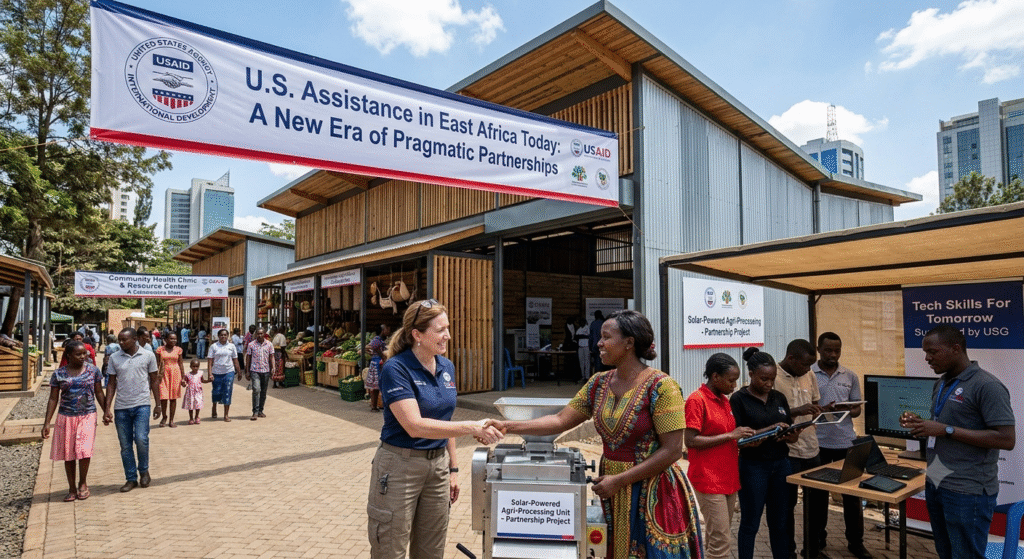
The United States is executing a major strategic shift in its approach to East Africa. Recent actions indicate a move away from traditional foreign aid towards what officials describe as a partnership model focused on “self-reliance” and economic benefit for U.S. producers. From massive food aid packages to military training exercises and direct foreign investment, U.S. assistance is being mobilized on multiple fronts to address the region’s crises while advancing American strategic interests.
Part 1: Emergency Food Assistance – A $235 Million Lifeline
The most significant announcement came on July 14, 2026, when the U.S. Department of Agriculture (USDA) signed an agreement in principle with Catholic Relief Services to deliver up to $235 million in emergency food and nutrition assistance to millions of people facing extreme hunger in Sudan and Ethiopia. The initiative will mobilize more than 110,000 metric tons of U.S.-grown agricultural commodities under USDA’s “Farmers First” strategy, mandating that all food aid be sourced 100% from American producers.
Michelle Bekkering, USDA’s Deputy Under Secretary for Trade and Foreign Agricultural Affairs, emphasized the dual purpose of the program: “American farmers feed, fuel, and clothe the world, and under President Trump’s leadership, we’re utilizing that bounty to serve those in need while ensuring that the benefits of U.S. food aid flow back to America’s hardworking farmers, ranchers, and producers that make this assistance possible”.
The agreement represents a broader policy shift following the transfer of the Food for Peace Title II program to USDA, moving to return the program to its core mission of delivering “lifesaving food assistance that directs economic benefits back to American producers”.
Part 2: Health Assistance – Conditions and Resistance
The State Department’s new global health strategy requires recipient governments to share responsibility by increasing their own health spending, aiming to build “durable systems that can eventually be self-reliant”. Under this new model, the U.S. is contributing $1.6 billion to a health deal with Kenya, with the East African nation pledging $850 million over five years.
However, this shift has not been without controversy. Some African nations are reportedly resisting the new aid deals due to their attached conditions. The approach marks a departure from previous USAID-driven programs, requiring direct co-financing from recipient governments.
Part 3: Military Cooperation – Justified Accord 2026
U.S. military assistance in the region was highlighted by Exercise Justified Accord 2026 (JA26), U.S. Africa Command’s largest annual, multinational exercise in East Africa, held across Djibouti, Kenya, and Tanzania. The exercise integrated approximately 1,500 personnel from the United States and several partner nations to “build readiness, deepen partnerships and strengthen regional security”.
The exercise featured a comprehensive training program tailored to shared regional security needs. In Kenya, activities focused on enhancing joint command and control, including a multinational live-fire exercise and defensive cyber operations. In Tanzania, the focus was on readiness for crisis response, with a bilateral field training exercise on jungle warfare and counter-improvised explosive devices.
The Massachusetts National Guard continued its decade-long partnership with Kenya, while the Nebraska National Guard built upon its newly developed partnership with Tanzania. U.S. Lt. Col. Jason Fernandez, the JA26 branch chief, stressed: “The true strength of Justified Accord lies in our partners taking the lead… creating a powerful, partner-led security network capable of shouldering the responsibility for a stable and prosperous East Africa”.
Part 4: Farmer-to-Farmer – Modernizing Agriculture
The U.S. is also addressing the root causes of food insecurity through agricultural development. A new Farmer-to-Farmer program, organized through U.S. Mission Uganda and USAID in partnership with Catholic Relief Services, will place 125 American volunteer farmers in Uganda to train local counterparts on modern farming techniques.
The initiative aims to improve yields and address weather changes at a time when yields across East Africa have been depressed by poor farming techniques. The program will focus on maize and oil seed crops such as groundnuts, sunflower, and sesame—”vital to the masses within East Africa”.
This five-year program will include nearly 500 volunteer assignments across Ethiopia, Tanzania, Kenya, and Uganda, aiming to improve the livelihoods of 10,000 low-income households.
Part 5: U.S. Development Finance – A Strategic Anchor
On January 28, 2026, the U.S. International Development Finance Corporation (DFC) announced Selam Demissie as the new Regional Managing Director based in Kenya. The DFC has over $10 billion in exposure in Sub-Saharan Africa, underscoring the continent’s central role in advancing U.S. foreign policy objectives. DFC CEO Ben Black described Kenya as “a strategic partner and a regional anchor for advancing U.S. interests in East Africa”.
Conclusion
U.S. assistance in East Africa today is characterized by a more transactional approach focused on co-financing and domestic economic returns. The $235 million food aid package, military training through JA26, and the new Farmer-to-Farmer program demonstrate an integrated strategy. However, the new health aid conditionality has faced resistance from some African nations. Whether this approach will prove more sustainable than its predecessors remains to be seen, but its impact on the region’s most vulnerable populations is immediate and significant.
