

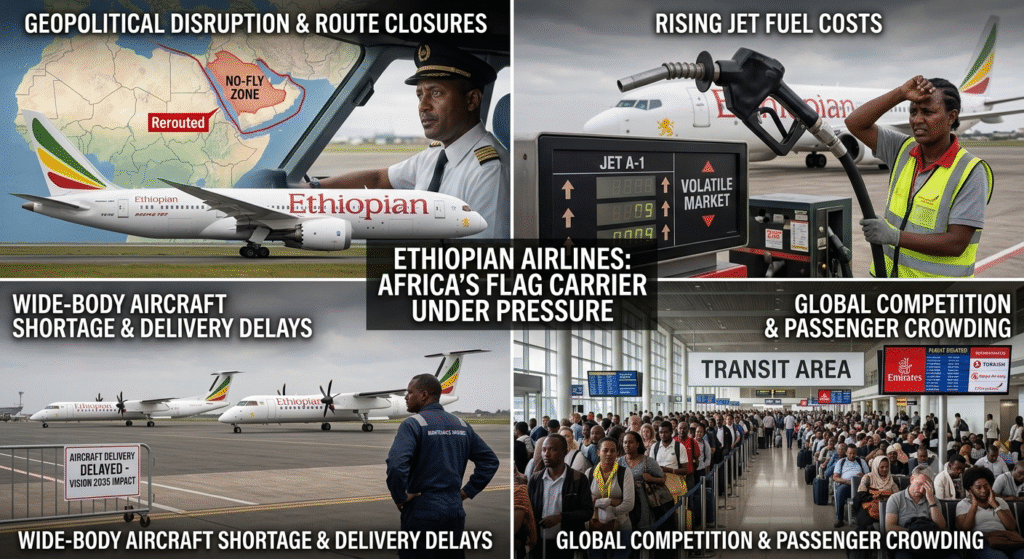
Ethiopian Airlines, celebrated as Africa’s largest and most profitable carrier, is currently navigating one of its most challenging operational periods. The airline faces a confluence of crises that are grounding aircraft, squeezing profit margins, and raising ticket prices, presenting a significant test of its long-standing reputation for resilience.
The Parts Shortage: A Persistent Supply Chain Crisis
A prolonged shortage of aircraft spare parts has emerged as the most immediate operational headache for the airline. This supply-chain bottleneck, now persisting for a fifth year since the pandemic, has forced the carrier to ground a striking number of its fleet .
On any given day, roughly a quarter of the airline’s 21 domestic aircraft are grounded due to a lack of engine components . This grounding is predominantly affecting the Bombardier Q400 turboprops, where delays in the supply of spare parts from manufacturer Pratt & Whitney have rendered several aircraft unable to fly . The shortage extends to its wide-body international fleet as well, with two Boeing 787 Dreamliners grounded due to a lack of Rolls-Royce engines . Slow global production from suppliers and delays in engine repairs—which have stretched from three months to over six—are the root causes .
The consequences are stark: the constrained seat capacity has led to a $28 million loss on domestic routes . In a tight financial environment, customers are bearing the brunt, facing sharp and sudden fare increases .
The Fuel Cost Crisis: Margins Under Siege
Compounding the spare parts shortage is the escalating cost of jet fuel. The conflict in the Middle East has caused a dramatic spike in energy prices, with jet fuel costs in Addis Ababa nearly doubling . As a result, fuel now accounts for 54% of the airline’s operating costs—a significant leap from approximately 40% prior to the crisis .
This surge has had a tangible impact on routes, particularly to the Gulf region. For instance, the airline has been forced to reduce its daily service to Dubai from three flights to two due to weakened demand . While fuel supply disruptions have largely been resolved, the financial impact of the price hike is ongoing. Ethiopian Airlines expects profit margins to be cut roughly in half, though the airline has stated it will still remain profitable . To combat this, the airline is reportedly exploring a short-term fuel contract with Saudi Arabia to provide price certainty and is pushing for policies to support domestic fuel production .
Commercial and Financial Pressure
Beyond supply chains and fuel, Ethiopian Airlines is managing significant commercial and financial pressure.
The Birr Depreciation: A weakening Ethiopian Birr has severely eroded revenue margins on domestic tickets priced in local currency, adding to the financial strain .
Currency Repatriation Issues: The airline’s decision to begin selling tickets in Port Sudan, Sudan, exclusively in US dollars rather than the local Sudanese pound has drawn criticism. However, this move reflects the airline’s challenge in repatriating revenues accumulated in local currencies that are rapidly depreciating .
Airspace Disruption: The same Middle East conflict that is driving up fuel costs has also led to airspace restrictions, forcing the airline to suspend services to 10 destinations in the region. This resulted in the cancellation of more than 100 weekly flights, with an estimated weekly financial impact of $137 million .
Despite record revenues, these escalating costs have led to increased debt servicing, rising receivables, and a tightening liquidity across the group .
The Broader Regional Role and “Public Service” Mandate
Ethiopian Airlines’ importance extends beyond its own balance sheet. As a beacon for African aviation, its problems have a ripple effect.
Role as a Stabilizer: The airline’s operational scale has allowed it to “absorb much of the shock” from regional disruptions, maintaining its hub at Addis Ababa while other carriers struggle . Its influence is also seen in its ability to support other flag carriers; for example, Uganda Airlines has turned to Ethiopian Airlines for wet-leased aircraft and management expertise as it faces its own fleet disruption .
The “Public Service” Mandate: While a commercially viable entity, Ethiopian Airlines also has a public service mandate in Ethiopia. Despite its financial woes, it continues operating loss-making routes for the sake of national connectivity, a balancing act that complicates its commercial goals .
A Long-Term Vision Under Strain
Despite these immediate pressures, Ethiopian Airlines has not abandoned its long-term growth ambitions. The carrier continues to evaluate an order for up to 25 smaller commercial aircraft as part of a fleet renewal and expansion program and is moving forward with its Vision 2035 strategy to more than 100 new aircraft . As the airline continues to grapple with these problems, it presents a powerful case study in how global volatility and structural challenges can test even the most formidable of Africa’s corporate champions.
