

NAIROBI — July 19, 2026
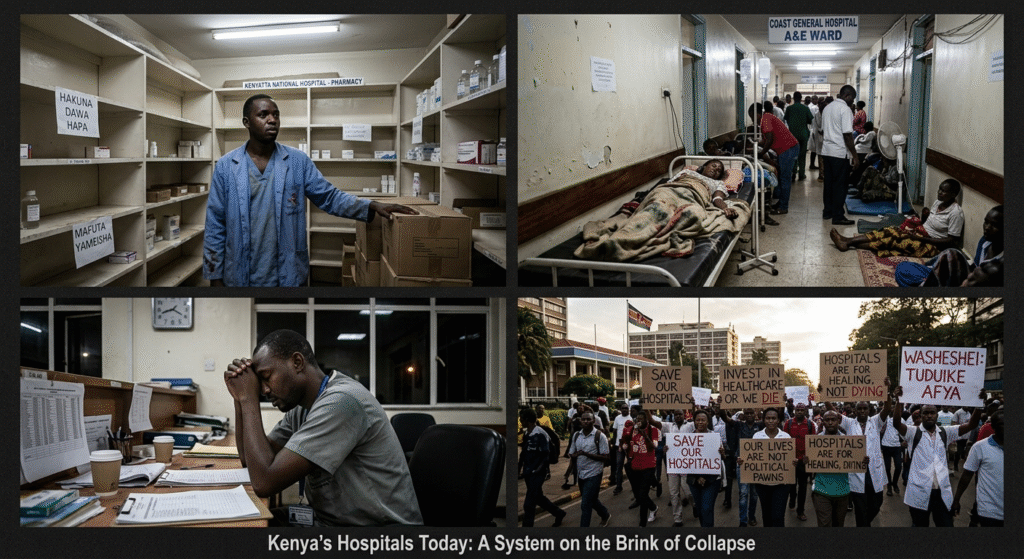
Just before midnight on Monday, July 20, Kenya’s public healthcare system is expected to grind to a halt. Following months of simmering tension, the Kenya Health Caucus, comprising six medical unions, has officially declared that healthcare workers across all 47 counties will down their tools. This collective action threatens to shut down public medical facilities nationwide as workers demand immediate structural reforms, job security, and the honouring of long-delayed legal agreements .
The Impending Nationwide Shutdown
The Kenya Health Caucus, representing clinical officers, environmental health practitioners, medical laboratory officers, nutritionists, pharmaceutical technologists, and biomedical engineers, has given the Council of Governors a stark ultimatum. Union leaders point to a persistent failure by the Ministry of Health, the Council of Governors, and county administrations to absorb Universal Health Coverage and Global Fund health workers into permanent and pensionable employment, thereby perpetuating job insecurity and unfair labour practices .
Despite the National Assembly and Senate allocating funds to transition 7,450 UHC staff to permanent positions, the Council of Governors has refused to issue appointment letters. Health workers cannot access medical insurance, lack formal engagement with the counties they serve, and face uncertain salaries as the payroll cycle closes .
The unions have also condemned the Council of Governors for failing to sign and execute a duly negotiated Collective Bargaining Agreement and for not fully implementing the obligations contained in the Return-to-Work Formula dated January 28, 2026. County governments had committed to signing the CBA by February 16, which would have provided clinical officers with monthly risk allowances of up to Sh7,000 starting July 2026 .
Union chairperson Peterson Wachira summed up the frustration: “Workers have no other bargaining tool but their services.” Millions of Kenyans who rely on the public healthcare system now face the terrifying prospect of locked hospital doors and unattended wards .
A History of Paralysis: Disruption Already Underway
The nationwide strike threat comes after weeks of already crippling disruption. In Kitui county, health services have been paralysed after nurses protested against salary delays and the non-implementation of a Collective Bargaining Agreement negotiated in November 2017 .
In Kisumu, clinical officers downed tools, citing persistent neglect by the county government. Issues included delayed salary payments, lack of promotions, inadequate staffing, shortages of medical equipment, and the county’s refusal to sign a national CBA that other counties had adopted . Some workers have gone months without pay. Outpatient departments, ENT and pulmonary clinics were closed, and inpatient services severely affected .
The Kenya National Union of Nurses has dismissed calls for mediation, with Secretary-General Seth Panyako stating: “We shall only engage in negotiations if the agenda is grading structures and harmonising salaries” .
The Financial Crisis: Hospitals Crippled by Debt
The labour crisis is compounded by a severe financial crisis affecting both public and private hospitals. The Rural and Urban Private Hospitals Association has raised the alarm over massive payment delays by the Social Health Authority. Since SHA’s launch in October 2024, hospitals have submitted claims worth Sh93 billion, yet only Sh50 billion has been reimbursed. A Sh43 billion shortfall, coupled with Sh33 billion in unpaid NHIF arrears, has left facilities crippled by debts exceeding Sh76 billion .
Some hospitals have not been paid since June . Rev. Joseph Kariuki, Vice Chairman of RUPHA, warned that many facilities are on the brink of closure, unable to pay salaries, rent, loans, or equipment costs while continuing to treat patients under SHA directives .
Private hospitals risk collapse, especially in rural counties like Wajir, Mandera, Marsabit, and Samburu where they are often the only lifeline . The SHA collects about Sh5 billion monthly but pays out Sh9 billion, leaving a Sh4 billion deficit .
Beyond the Crisis: Deep-Seated Systemic Failures
Beyond the immediate funding and labour disputes, Kenya’s hospital system suffers from deeper structural problems that the 2025/2026 budget allocation of Sh138.1 billion has failed to address. The Kenya National Commission on Human Rights documented persistent complaints including delayed treatment, limited outreach services, patient detention over unpaid bills, and inadequate protections in digital health programmes .
A recent study published in Social Science & Medicine found that Kenyan hospitals lack the systems necessary to deploy resources effectively when patients need them. Health Facility Assessments may show sufficient resources are available in facilities, but an absence of systems to make them available at the point of care results in what researchers describe as a state of “arrested development” — a scenario where short-term global health projects actually resist positive change .
The January 2026 case of Davis Lichuma, who was tortured and denied emergency care at Kenyatta National Hospital because he could not pay consultation fees, exemplifies this systemic failure. Despite the constitutional guarantee that no person shall be denied emergency medical treatment, reports of patients being denied emergency care persist across the country .
Conclusion
Kenya’s hospitals are facing a crisis of compounded failures: labour disputes that threaten nationwide shutdowns, a financial system that is strangling both public and private facilities, and deep-seated structural issues that prevent even adequate resources from reaching patients in need. As the July 20 strike deadline approaches, millions of Kenyans face the prospect of locked doors and unattended wards — a grim reality for a country that has promised universal health coverage to all its citizens.